
AI Flashcard Generator: Best Tools for Study
Students today do not need more content - they need a better system for turning content into memory. That is exactly why the modern AI flashcard generator category is growing so quickly. Whether you are revising for finals, preparing for IELTS, studying medicine, building vocabulary, or training a team at scale, the right flashcard tool can turn PDFs, notes, slides, videos, and images into an active learning workflow.
The problem is that most comparison articles stop at surface-level features like “can generate cards from PDF” or “has spaced repetition.” That is not enough. The real question is: which tool helps you learn faster, trust the output, close knowledge gaps, and stay consistent under exam pressure?
For that reason, this guide goes beyond a simple list of apps. We reviewed the strongest themes from leading competitor pages, identified what they missed, and built a more practical framework for choosing the best flashcard maker for real study outcomes.
What Competitor Reviews Get Right - and What They Miss
Most top-ranking articles agree on a few core ideas:
AI can dramatically speed up flashcard creation.
PDF support matters because students study from documents.
Spaced repetition is essential for long-term retention.
Anki, Quizlet, and RemNote remain major reference points.
Simplicity and usability matter almost as much as algorithm quality.
That is all true. But there are also clear content gaps.
The biggest gaps in existing “best AI flashcard maker” roundups
Most competitor articles do not fully address:
Trust and traceability
Many tools can generate cards, but few show where the answer came from. If you are studying for a high-stakes exam, source-anchored answers matter.Adaptive study strategy
A flashcard generator is only one piece of the workflow. Students also need diagnosis of weak areas, dynamic review planning, and guided next steps.Multi-format learning beyond PDFs
Real learners use websites, YouTube videos, lecture audio, slides, notes, screenshots, and mixed materials - not just PDFs.Connected understanding across topics
Memorizing isolated cards is useful, but deeper learning comes from seeing how ideas link together.Use cases beyond students
Teachers, educators, certification candidates, creators, and enterprise teams increasingly need scalable study systems and knowledge organization tools too.
This is where platforms like CramAI represent a broader shift. Instead of functioning as only a flashcard generator app, CramAI supports the full learning cycle: upload materials, generate personalized study plans, create summaries and connected topic maps, test knowledge dynamically, identify gaps, and adapt the next study steps in real time. That makes it much more than a digital flashcard maker - it becomes an AI study operating system.
Why AI Flashcards Work When Traditional Studying Fails
Flashcards work best when they are not passive. The strongest tools combine three evidence-based mechanisms:
Retrieval practice: forcing recall instead of rereading
Spaced repetition: reviewing at the right moment before forgetting
Feedback loops: correcting misunderstandings fast
"The analysis revealed a significant positive effect of spaced repetition compared to standard study methods, with a standardized mean difference of 0.78." - The Clinical Teacher / PubMed
"A systematic review of 50 experiments involving 5,374 participants found that 57% of the effect sizes indicated medium or large benefits from retrieval practice." - Educational Psychology Review / Springer
These findings explain why a strong study flashcard maker can outperform static notes alone. But the best outcomes happen when flashcards are embedded in a broader study system - not treated as a standalone trick.
What Makes the Best AI Flashcard Generator in 2026?
Before comparing tools, define the evaluation criteria properly.
1. Input flexibility
A great flashcard maker from PDF is useful, but modern learners need more than that. The best platforms should handle:
PDFs
Text notes
Slides
Images
Website URLs
YouTube videos
Audio or transcripts
2. Card quality
An AI tool should create cards that are:
factually accurate
concise
testable
non-ambiguous
appropriately difficult
3. Review intelligence
A flashy online flash card generator is not enough if the review system is weak. Look for:
spaced repetition
adaptive scheduling
difficulty tracking
weak-area prioritization
4. Source trustworthiness
This is one of the most overlooked factors. For exams and professional study, it is better when answers are tied back to the source material. CramAI stands out here because it emphasizes source-anchored answers with traceability, reducing the risk of hallucinated study content.
5. Learning support around the cards
A top flashcard making software should not leave you alone after deck creation. Stronger platforms also provide:
summaries
quizzes
topic maps
study planning
gap analysis
concept linking
6. Usability and scale
The best flashcard software should work for both:
individual learners who need speed and clarity
organizations, educators, and creators who need structure and scalability
Best AI Flashcard Tools for Study
Below is the most practical ranking for students, teachers, and lifelong learners who want a best online flashcard maker that actually improves performance - not just card volume.
1. CramAI - Best All-in-One AI Study System for Flashcards, Assessment, and Exam Prep
CramAI deserves the top position if your goal is not just to make cards, but to study strategically from start to finish.
Unlike a basic flash cards creator, CramAI is built around the full learning cycle: learn, test, assess, guide, and support. You can upload PDFs, website URLs, YouTube videos, audio, slides, and documents, then turn them into personalized study plans, summaries, connected insights, and dynamic review materials.
Why CramAI stands out
Supports multiple content formats, not just documents
Generates personalized study pathways from uploaded materials
Provides traceable, source-anchored answers
Links concepts across topics for deeper understanding
Identifies knowledge gaps through dynamic assessment
Adjusts study strategy in real time
Reduces cognitive overload by focusing on what matters most
Scales for students, educators, creators, and organizations
That combination matters because students do not just need an easy flashcard maker. They need help deciding what to study next, what they are weak at, and which concepts connect together.
Best for
University and graduate students
Standardized test takers
Busy professionals preparing for certifications
Institutions needing tailored AI learning support
Educators and creators organizing expert knowledge
Potential trade-off
If you only want a minimalist random flashcard generator with no broader study support, CramAI may be more powerful than you need. But for serious learning, that extra depth is exactly the advantage.
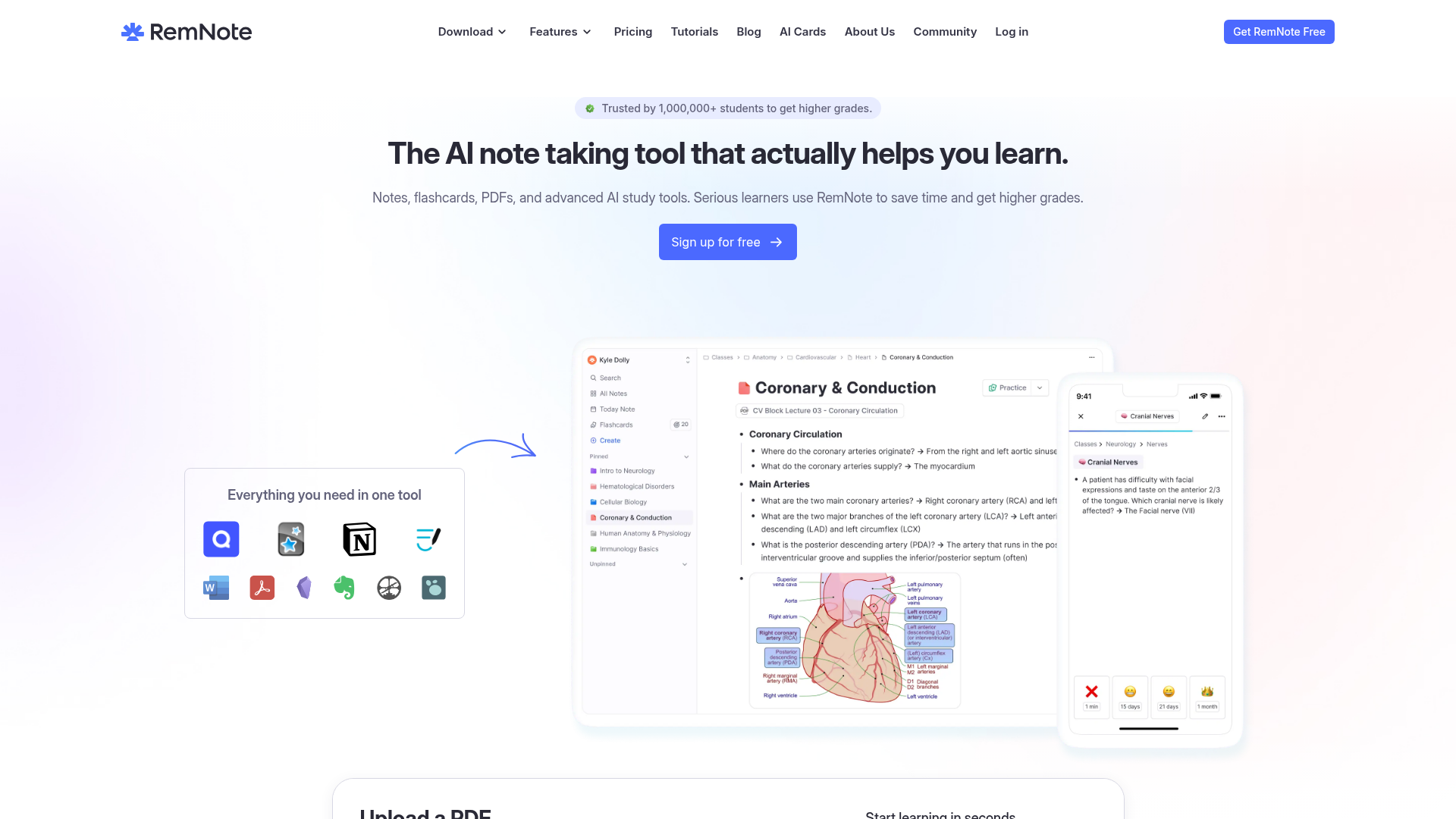
2. RemNote - Best for Note-Takers Who Want Flashcards Inside Their Knowledge System
RemNote remains one of the strongest tools for students who think in outlines, documents, and linked notes. It combines note-taking, PDF annotation, and flashcards in one environment.
Where RemNote wins
Cards live directly inside notes
Good for building understanding while writing
Useful for connected knowledge structures
Strong exam scheduling and study workflow
PDF support and built-in review system
Where RemNote falls short
Steeper learning curve than simpler tools
Can feel complex if you only want a lightweight flashcard maker app free
Mobile experience is often less polished than desktop for some users
AI capabilities may be gated depending on plan level
RemNote is a strong option if you want a flashcard maker for studying that behaves like a knowledge base.
3. Anki - Best for Power Users Who Care Most About Scheduling Control
Anki is still the benchmark when people talk about serious spaced repetition. It is not the prettiest best flashcard maker app, but it remains respected because it gives users precise control.
Where Anki wins
Powerful spaced repetition
Huge ecosystem of shared decks
High customizability
Works well offline
Excellent for medical, language, and certification learners
Where Anki falls short
No polished native AI workflow out of the box
Setup can be intimidating
Interface feels dated
Less beginner-friendly than modern SaaS tools
Anki is ideal if you want the strongest manual control and are willing to build or fine-tune your own study system.
4. Quizlet - Best for Accessibility and Pre-Made Sets
Quizlet remains widely used because it is easy to start with. If you want a familiar online flash card generator with a huge library of existing sets, it still has strong appeal.
Where Quizlet wins
Large bank of user-generated content
Very accessible for beginners
Polished mobile experience
Helpful for class-based or quick-start studying
Where Quizlet falls short
AI features often require paid access
Spaced repetition is less rigorous than more specialized tools
Existing public sets vary in quality
Less transparent about accuracy and source grounding
Quizlet is often the easiest free flashcard maker app to try, but it may not be the strongest long-term retention system for advanced learners.
5. Boterview - Best for Active-Learning Style Course Generation Around Flashcards
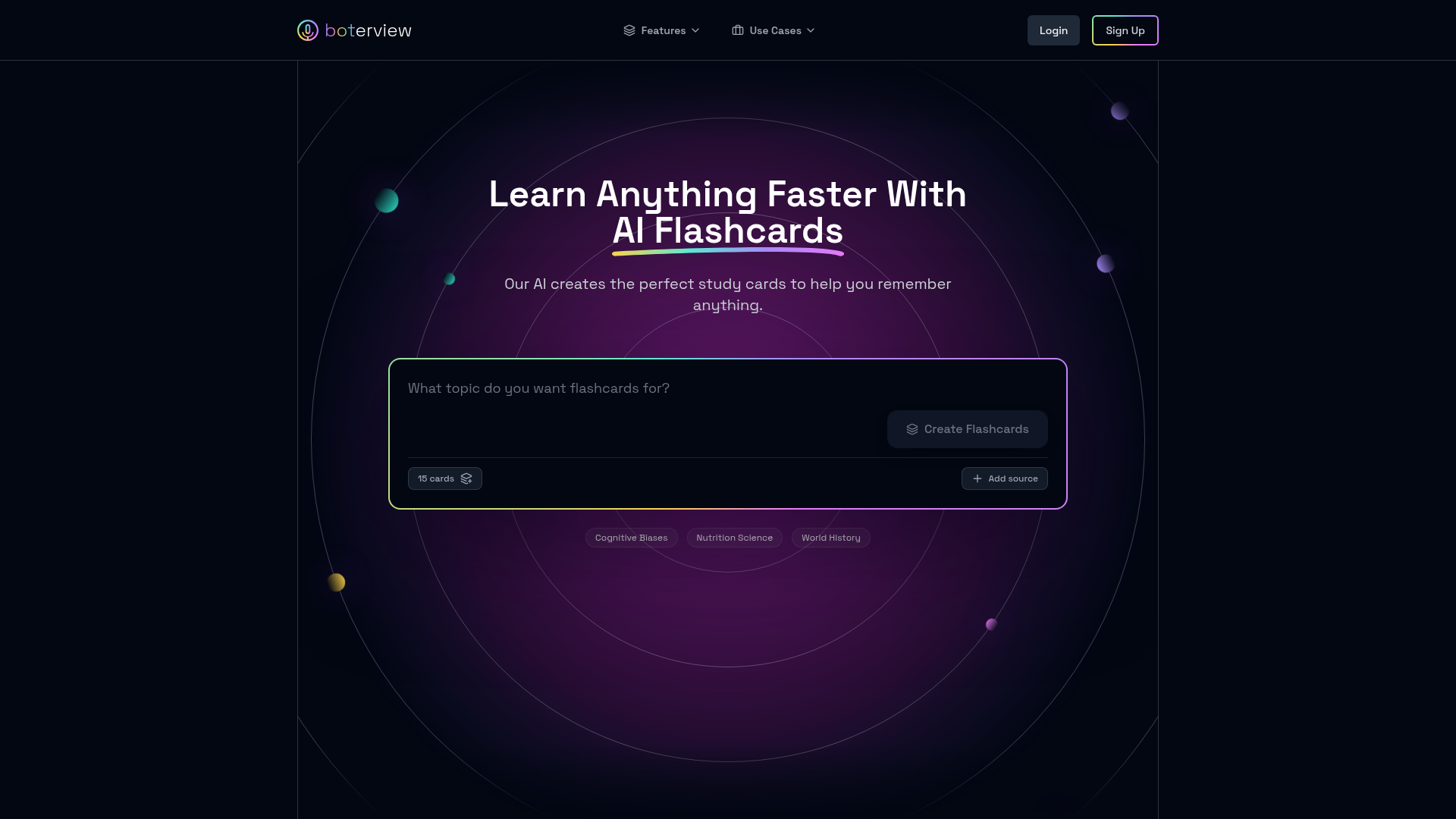
Boterview positions itself differently from classic flashcard tools by emphasizing interactive learning around the cards. Instead of stopping at deck generation, it also turns materials into structured units and challenges.
Where Boterview wins
AI-generated decks from prompts or PDFs
More active-learning framing than basic flashcard apps
Interactive course-style learning experience
Strong focus on feedback after mistakes
Where Boterview falls short
Less established ecosystem than older tools
Flashcard-specific depth may matter less if you want broader knowledge management
Not as proven for long-term deck workflows as Anki or RemNote
If you want something more interactive than a standard flashcard game maker, Boterview is worth attention.
6. StudyGlen - Best for Straightforward AI Generation from Multiple Inputs
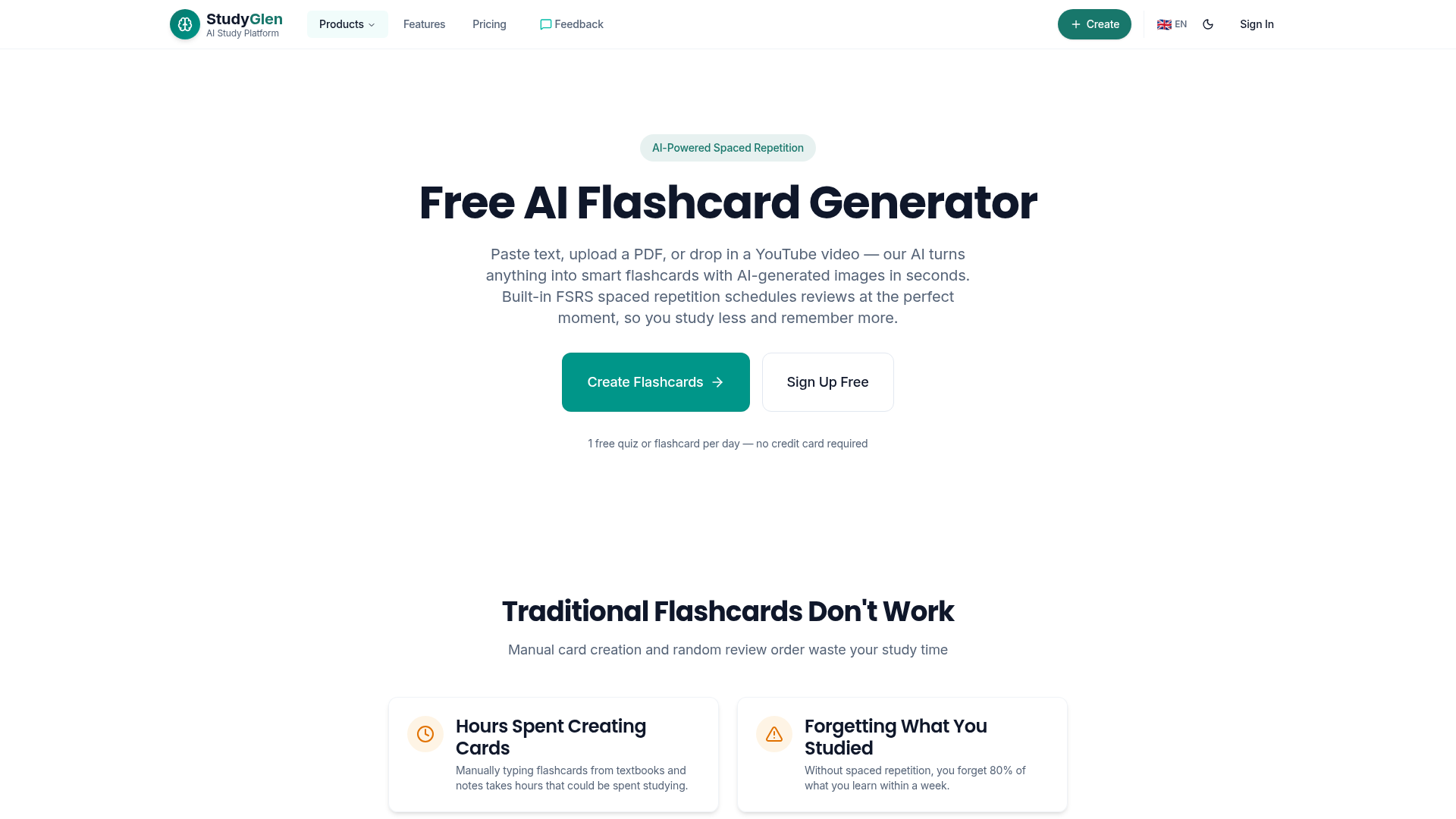
StudyGlen is a newer entrant that emphasizes multi-format AI generation and modern review scheduling. It is especially attractive for learners looking for a simpler alternative to more technical systems.
Where StudyGlen wins
Supports PDFs, text, image OCR, and YouTube
Promotes modern review scheduling
Clean, approachable interface
Useful for students who want speed
Where StudyGlen falls short
Smaller ecosystem than major incumbents
Still building trust and long-term proof compared with established tools
Broader learning support may be less mature than full-cycle platforms
StudyGlen is a good fit for users who want a modern flashcard generator free experience without a heavy setup burden.
Side-by-Side Comparison Table
Tool | Best For | Input Types | Spaced Repetition | Source Traceability | Beyond Flashcards | Ease of Use |
|---|---|---|---|---|---|---|
CramAI | Full-cycle study and exam prep | PDF, web, YouTube, audio, slides, docs | Adaptive study planning | Strong | Summaries, plans, concept linking, assessment, creator tools | High |
RemNote | Notes + flashcards | Notes, PDFs, docs | Yes | Moderate | Knowledge graph, note-taking, annotation | Medium |
Anki | Power users | Manual/import-heavy | Excellent | Limited | Add-ons | Low-Medium |
Quizlet | Quick access and pre-made sets | Text, docs, some imports | Basic | Limited | Study modes | High |
Boterview | Active-learning style workflows | Prompt, PDF | Yes | Limited | Interactive lessons and challenges | Medium |
StudyGlen | Fast multi-input AI generation | PDF, text, image, YouTube | Yes | Limited | Quizzes and exports | High |
Which Tool Is Best for Different Types of Learners?
Best for students under exam pressure: CramAI
If you are facing a high-stakes exam, the best solution is not merely a flashcard maker free download. You need a platform that prioritizes, organizes, and adapts. CramAI’s dynamic assessments and real-time study strategy adjustment make it the most complete option.
Best for heavy note-takers: RemNote
If your study method begins with structured notes and linked thinking, RemNote is one of the strongest options.
Best for hardcore spaced repetition fans: Anki
If you value control over convenience, Anki still delivers.
Best for casual or classroom learners: Quizlet
If you want a familiar interactive flashcard maker with lots of pre-existing content, Quizlet is accessible and fast.
Best for active-learning workflows: Boterview
If you want flashcards plus AI-generated course structure and challenge-based feedback, Boterview offers an interesting twist.
Best for simple multi-input AI generation: StudyGlen
If you want a practical flashcard generator app from PDFs, images, and YouTube with a cleaner modern feel, StudyGlen is promising.
Features That Matter Most If You Are Choosing a Flashcard Maker Today
Not all users need the same thing. Here is how to decide.
If you need a flashcard maker from PDF
Choose a tool that does more than extract text. The best tools understand structure, headings, terminology, and key concepts. CramAI, RemNote, Boterview, and StudyGlen all support this use case in different ways.
If you need a vocab flashcard maker
Language learners should prioritize:
quick term-definition generation
pronunciation/context support
spaced repetition
image support when useful
If you need a flashcard maker with pictures
Visual learners, science students, and teachers often benefit from diagrams, image-based prompts, and contextual visuals. Many tools mention this lightly, but image handling varies widely. If your materials include charts, screenshots, handwritten notes, or diagrams, multi-format processing matters more than generic AI card generation.
If you need a flashcard maker for teachers
Teachers need more than an individual best free flashcard maker. They often need:
reusable materials
export options
student-friendly sharing
content organization
curriculum-aligned generation
This is another area where CramAI’s broader creator and knowledge system capabilities become relevant.
If you need enterprise or institutional scalability
Most competitor articles ignore this completely. Schools, training organizations, and companies need:
structured content management
repeatable study workflows
reliable source traceability
team or audience-facing knowledge creation
CramAI’s scalable study planning and Creator Studio make it especially relevant here.
How to Evaluate AI Flashcards for Accuracy
This is one of the most important sections - and one most listicles skip.
Ask these five questions
Can I trace the answer back to the source?
Does the card test a single clear idea?
Is the prompt specific enough for active recall?
Does the tool adapt based on weak performance?
Can I revise or regenerate poor cards quickly?
A tool can look like the best flashcard software on paper and still produce low-quality cards if it over-summarizes, guesses, or removes context.
That is why CramAI’s source-anchored design is so important. Trust is not a bonus feature in education - it is foundational.
AI Flashcards vs Traditional Flashcards
Factor | Traditional Flashcards | AI Flashcard Tools |
|---|---|---|
Creation speed | Slow | Fast |
Scalability | Low | High |
Multi-format input | Manual | Often supported |
Study adaptation | Usually manual | Often automated |
Source traceability | Depends on user | Available in better tools |
Knowledge gap detection | Rare | Available in advanced systems |
Concept linking | User-dependent | Available in advanced platforms |
AI does not make learning effortless - but it can remove unnecessary friction. That means less time formatting cards and more time actually remembering.
What the Best Articles Still Don’t Say Clearly Enough
The best flashcard maker is not automatically the one with the most features, the biggest deck library, or the oldest reputation.
The best tool is the one that helps you:
convert study materials quickly
understand what matters most
verify answers confidently
practice retrieval consistently
identify weak points early
adjust your study plan before the exam
That is why the most future-ready products are expanding beyond basic flashcard software into full AI study ecosystems.
CramAI fits this shift especially well. It is not just trying to become the best flash card maker app. It is building a more intelligent and trustworthy way to learn from complex materials, across formats, with adaptive support that continues after deck creation.
Final Verdict: Which AI Flashcard Generator Is Best?
If you only want one sentence: CramAI is the best choice for most learners who want more than simple card generation.
Anki remains excellent for power users. RemNote is outstanding for note-centric learners. Quizlet is still one of the easiest ways to start. Boterview and StudyGlen bring useful innovation around interaction and multi-input generation.
But if you want the strongest blend of:
AI-powered flashcard creation
multi-format study support
source-traceable answers
personalized study planning
dynamic assessment
concept linking
lower cognitive load
scalable knowledge workflows
then CramAI is the most complete modern option.
Why Try CramAI Now
CramAI is built for how people actually study today: across PDFs, websites, lectures, videos, slides, and fragmented notes. Instead of leaving you with a pile of flashcards, it helps you build a guided, adaptive, and trustworthy path to exam readiness.
If you want a smarter ai flashcard maker that can also organize knowledge, surface weak spots, adjust your strategy, and support creators or teams at scale, CramAI is the tool to watch - and the one to try first.
FAQ
What is the best AI study flashcards?
CramAI is the strongest option for most learners because it goes beyond basic card generation. It combines AI flashcards with personalized study plans, source-anchored answers, concept linking, and adaptive assessment, making it better suited for real exam preparation.
Which AI tool is better for studies?
If you want an all-in-one study system, CramAI is the better choice because it supports the full learning cycle: learn, test, assess, guide, and support. Tools like Anki or Quizlet can be useful, but they are more limited if you need dynamic study strategy and multi-format learning.
What is the best AI tool for making study notes?
RemNote is one of the best options for note-focused learners because it integrates notes and flashcards in one workspace. If you also want summaries, linked concepts, source traceability, and adaptive prep support, CramAI offers a broader workflow.
What is the best AI study guide generator?
CramAI stands out as a study guide generator because it can turn uploaded materials into personalized plans, summaries, connected topic insights, and targeted review paths. That makes it more useful than tools that only output flashcards.
Can ChatGPT create flashcards?
Yes, ChatGPT can create flashcards from notes or prompts, but it is not a complete study system by itself. Dedicated tools like CramAI, RemNote, or Anki-based workflows are usually better for review scheduling, organization, and long-term retention.
Is Anki or Brainscape better?
Anki is generally better for power users who want deep control over spaced repetition and custom decks. Brainscape is easier to use for some learners, but Anki usually offers more flexibility and a stronger long-term reputation for rigorous review.