
AI for Learning: 9 Smart Ways to Study Better
If your current study routine feels slow, fragmented, or exhausting, you are not alone. Students, certification candidates, educators, and busy professionals all face the same challenge: too much material, too little time, and too much uncertainty about what to focus on next. That is exactly where AI for learning becomes valuable - not as a shortcut, but as a smarter system for understanding, revising, testing, and improving.
Instead of juggling PDFs, lecture slides, YouTube videos, notes, flashcards, and practice questions across disconnected apps, modern AI study platforms can bring everything into one flow. The best systems help you upload source material, turn it into structured study plans, identify weak spots, generate targeted revision, and adapt in real time as your understanding changes.
This article breaks down 9 smart ways to study better with AI, what most competing articles leave out, and how a platform like CramAI can support the full learning cycle - from first exposure to final exam readiness.
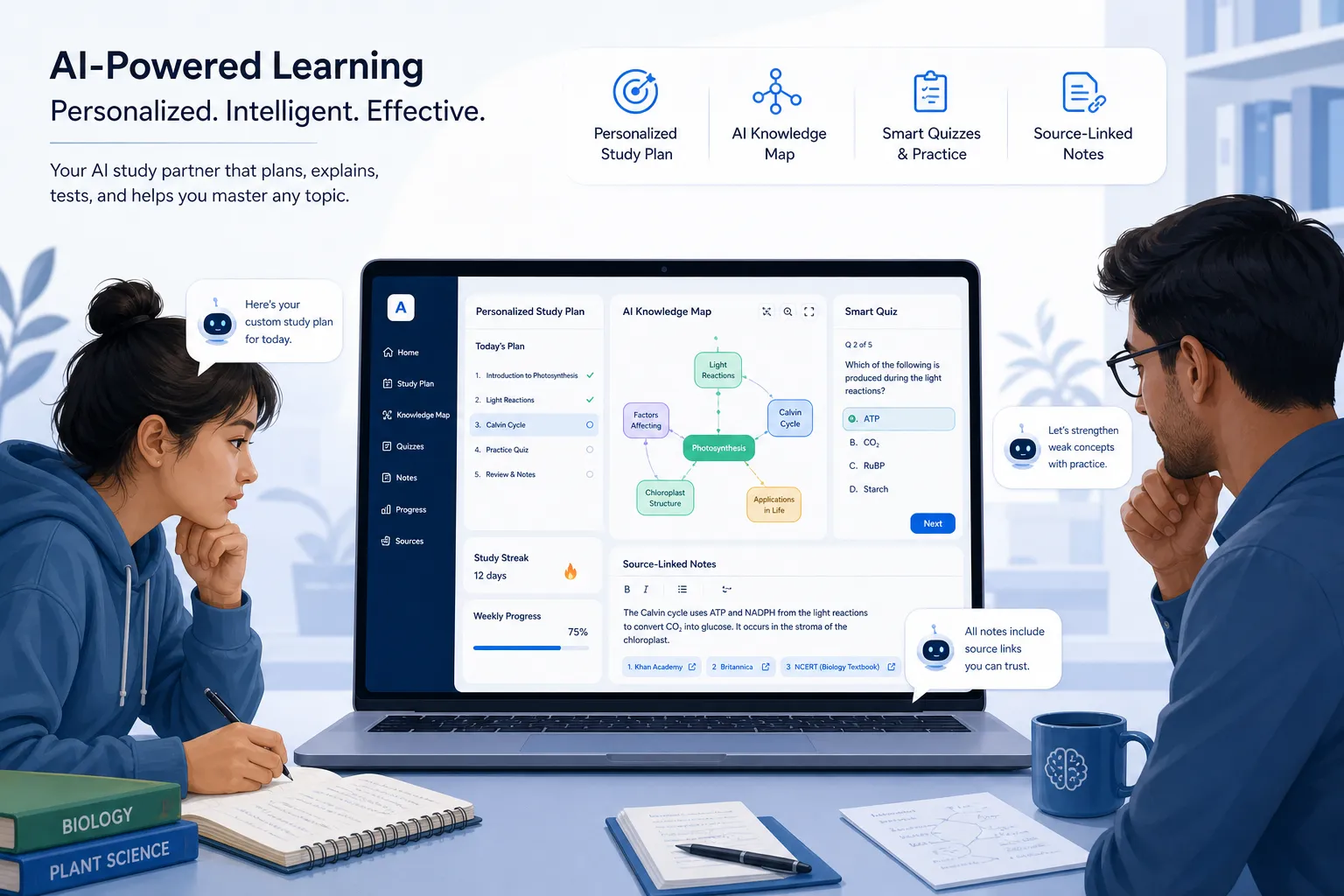
Why AI for Learning Is Changing How We Study
Traditional studying often breaks down for one simple reason: it asks learners to do everything manually. You have to decide what matters, summarize it, organize it, build a revision plan, create practice questions, and somehow detect your own blind spots. That is a heavy cognitive load before real learning even begins.
AI reduces that friction by helping with:
structuring messy materials
extracting key concepts
building personalized study sequences
generating practice and feedback loops
tracing answers back to the original source
adapting revision based on performance
That last point matters. Many tools generate content, but fewer help learners make better decisions about what to study next and why. CramAI is built around that higher-value layer: not just producing notes, but guiding users through learn, test, assess, guide, and support in one connected workflow.
"Active recall, also known as retrieval practice, significantly enhances learning and memory retention." - Carnegie Mellon University
"A 2024 meta-analysis of 45 studies on AI-enabled adaptive learning systems found a significant positive effect on learner outcomes, with an overall effect size of 0.55." - SAGE Journals
What Most Articles About AI Study Tools Miss
Many blog posts on AI in education repeat the same surface-level points: AI can summarize, make flashcards, and answer questions. Useful, yes - but incomplete.
Here are the content gaps most articles gloss over:
Common Advice | What It Misses | Why It Matters |
|---|---|---|
“Use AI to summarize notes” | No discussion of source traceability | Learners need to verify accuracy, especially for exams |
“Generate quizzes with AI” | No gap analysis | Practice is more powerful when targeted to weak areas |
“Ask AI to explain concepts” | No cross-topic linking | Real understanding depends on connections, not isolated facts |
“Save time with automation” | No guidance on cognitive load reduction | Efficiency only helps if it sharpens focus |
“AI personalizes learning” | No real-time plan adaptation | Static plans fail when learner performance changes |
“AI works for students” | Ignores professionals, creators, and teams | Modern learning happens far beyond classrooms |
CramAI closes these gaps by combining multimodal input, source-anchored outputs, dynamic assessments, and adaptive study planning into a single system.
9 Smart Ways to Study Better With AI
1. Turn scattered materials into one structured study system
The first win with AI is not speed. It is structure.
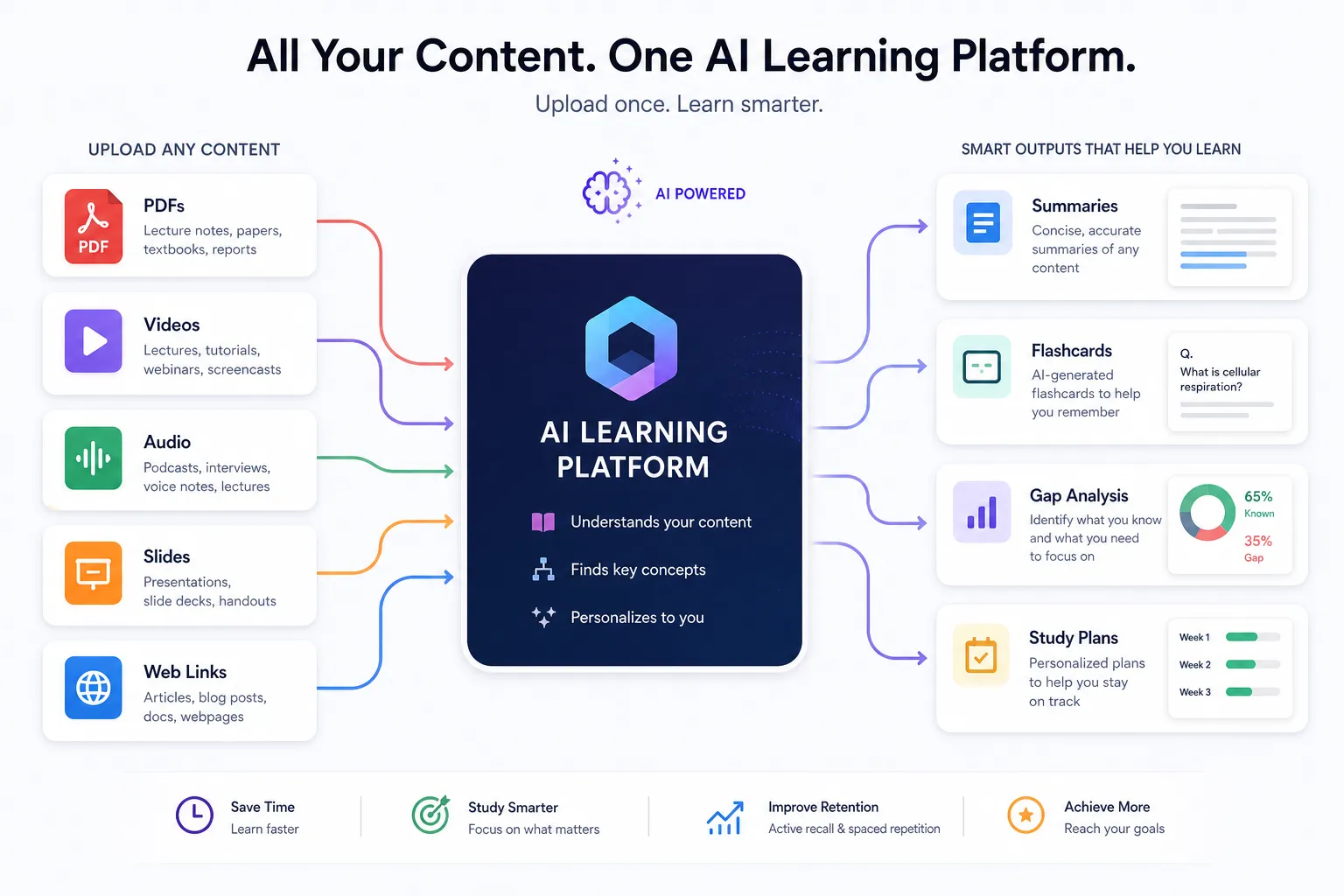
Most learners work across multiple formats: PDFs, lecture slides, website articles, recordings, YouTube lessons, handwritten notes, and documents. When those inputs remain disconnected, revision becomes chaotic. AI for learning can centralize them and create a coherent foundation for study.
With CramAI, users can upload:
PDFs
website URLs
YouTube videos
audio files
documents
slides
From there, the platform can transform those materials into a personalized study framework instead of leaving users to organize everything manually.
Why this matters
A well-structured learning environment lowers friction. Instead of asking, “Where was that concept again?” you can move straight into active learning.
2. Build personalized study plans from your actual material
Generic study schedules rarely work because they are not built around the learner’s real goals, timeline, or source content.
AI can now create personalized study plans using the exact materials you need to master. That means a law student preparing from case summaries, an IELTS candidate working from speaking prompts and reading passages, or a project manager reviewing certification slides can all get a custom path based on the same principle: study what matters most, in the order that makes sense.
What a smarter study plan should include
topic prioritization
estimated workload
difficulty-based sequencing
revision timing
targeted practice checkpoints
flexible updates when progress changes
CramAI is designed for this kind of dynamic planning. Rather than producing a static checklist, it can support adaptive preparation that changes based on what you know, what you miss, and how close you are to the assessment.
3. Use source-anchored answers you can actually trust
One of the biggest frustrations with AI study tools is uncertainty. Did the system answer from your materials, or did it improvise? For high-stakes learning, that question matters.
A trustworthy AI learning platform should do more than provide fast answers. It should show where the answer came from.
Why traceability is a competitive advantage
For exam prep, compliance learning, professional certifications, and educational content creation, source anchoring helps users:
verify claims quickly
reduce hallucination risk
study with more confidence
revisit original context
strengthen evidence-based understanding
This is one of CramAI’s strongest differentiators. Its interactive learning experience emphasizes traceability back to the original source, helping learners build confidence without losing rigor.
4. Link concepts across topics for deeper understanding
Memorizing isolated facts is rarely enough. Exams and real-world problem-solving reward learners who understand how concepts connect.
AI can help reveal relationships between topics that are easy to miss during normal revision. For example:
economics concepts linked across supply, incentives, and policy
biology systems connected through process chains
IELTS writing themes connected across vocabulary, structure, and argumentation
business frameworks connected across strategy, operations, and finance
From fragments to knowledge maps
Instead of learning in disconnected chunks, AI can help generate:
concept maps
topic clusters
dependency chains
theme summaries
prerequisite relationships
CramAI supports this deeper mode of learning through visualized knowledge maps and connected topic insights, which is especially valuable for learners dealing with complex, cumulative material.
5. Generate practice that exposes knowledge gaps
Practice is only useful when it shows you something real. Too many learners spend hours reviewing material they already know while weak areas stay hidden until exam day.
AI improves this by generating dynamic assessments that detect what you understand, what you only recognize passively, and where misunderstanding persists.
Better than generic practice questions
A strong AI assessment workflow should:
test recall, not just recognition
vary question difficulty
revisit weak areas
distinguish between confident errors and uncertain guesses
update future study priorities
That is where CramAI’s dynamic assessment engine adds value. It does not just help users test themselves; it helps them see which gaps matter most and what to do next.
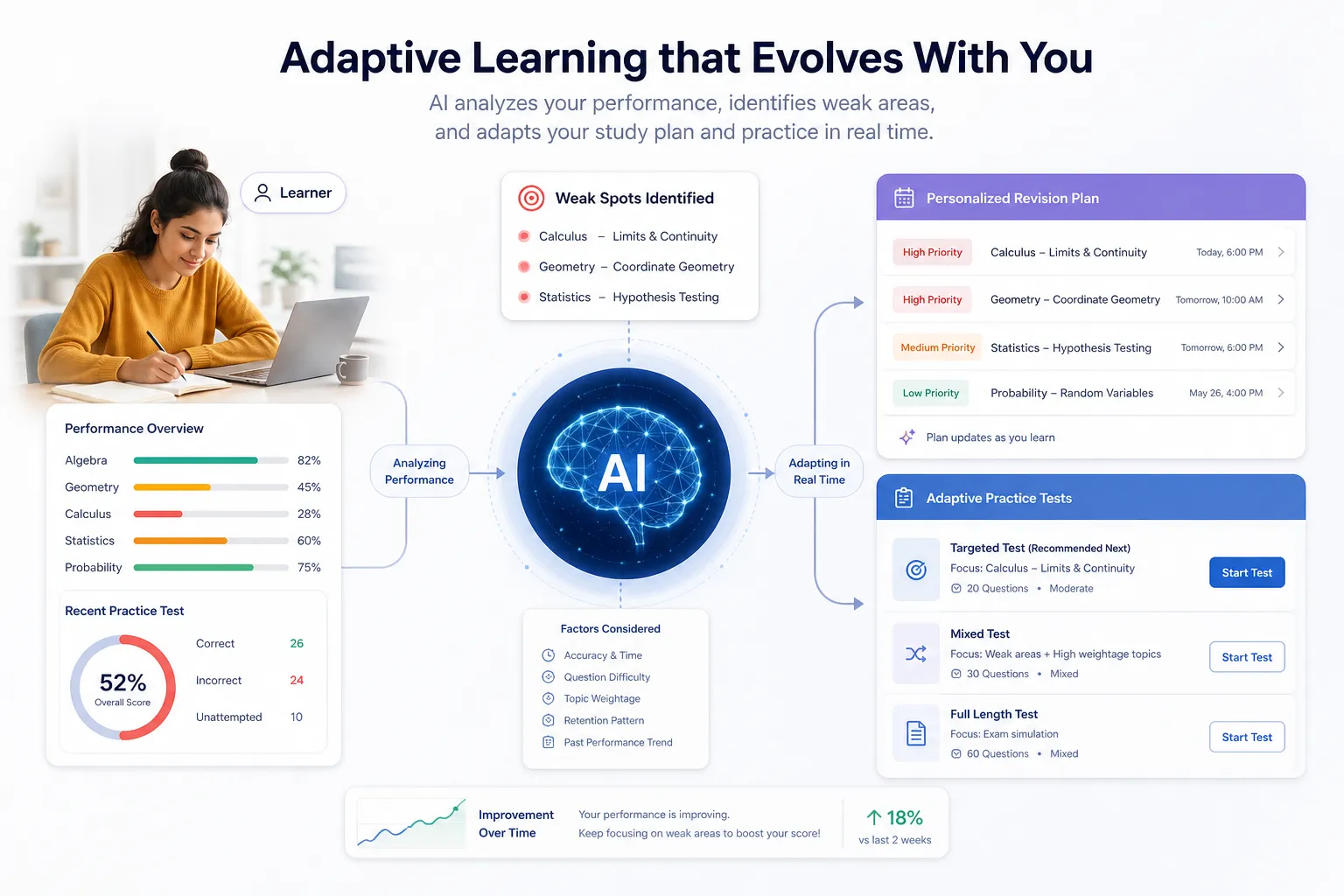
6. Adjust your study strategy in real time
This is where AI begins to outperform traditional planning in a serious way.
Most people build a revision plan once and then follow it even when the evidence says they should change it. Maybe a topic turned out easier than expected. Maybe one section keeps producing errors. Maybe time is running short.
An effective AI learning system should respond to those changes automatically.
Real-time adaptation can mean:
spending less time on mastered content
increasing review frequency for weak topics
switching formats from reading to retrieval practice
compressing plans before deadlines
balancing breadth versus depth depending on exam format
CramAI is designed to automatically adjust study strategies in real time, helping learners focus on what will move the score, not what simply fills the schedule.
7. Reduce cognitive load by focusing attention on what matters
Many learners do not struggle because they are lazy. They struggle because they are overloaded.
The issue is rarely access to information. It is deciding what to do with it.
AI for learning becomes powerful when it helps reduce cognitive load by:
filtering low-value material
clarifying priority topics
simplifying review paths
surfacing the next best action
shortening the distance between confusion and clarity
A practical shift in studying
Instead of this:
gather material
sort material
summarize material
plan revision
make flashcards
create questions
start learning
AI can compress that into:
upload material
get a study plan
review summaries and concept maps
test weak areas
adapt and repeat
That reduction in effort is not just a productivity gain. It preserves mental energy for higher-order thinking and performance.
8. Support different learners, not just traditional students
One weakness in many competitor articles is their narrow audience. AI study support is not only for college students cramming for finals.
It also fits:
professionals preparing for certifications
language learners preparing for IELTS or similar exams
graduate students managing dense reading loads
educators organizing teaching materials
creators building knowledge products
institutions training cohorts at scale
How use cases differ
Learner Type | Main Challenge | How AI Helps |
|---|---|---|
Undergraduate student | Information overload | Summaries, planning, targeted practice |
Certification candidate | Limited time | Priority-based revision and gap analysis |
IELTS learner | Skill-specific prep | Practice, feedback, and topic linking |
Educator or coach | Content organization | Structured materials and learning workflows |
Team or institution | Scalable support | Standardized yet personalized study systems |
Knowledge creator | Turning expertise into assets | Organized source libraries and content generation |
CramAI is especially well-positioned here because it serves not just learners, but also organizations and creators through scalable plans and a Creator Studio for knowledge organization and content generation.
9. Use AI as a full learning partner, not a one-off tool
The highest-value use of AI is not “ask a question, get an answer.” It is having a system that supports the entire study cycle.
That means one platform helping you:
understand new material
summarize and organize it
connect concepts
generate practice
assess gaps
update the plan
support final revision
What all-in-one support looks like
CramAI positions itself as an end-to-end learning and exam prep partner through five connected functions:
Phase | What Learners Need | How CramAI Helps |
|---|---|---|
Learn | Clarify and organize new content | Source-based summaries, maps, connected insights |
Test | Check understanding | Practice generation and targeted questioning |
Assess | Detect weak points | Dynamic knowledge gap analysis |
Guide | Know what to study next | Personalized, adaptive study planning |
Support | Stay consistent and efficient | Lower cognitive load and multimodal assistance |
That all-in-one approach is what separates a useful AI feature from a genuinely transformative study platform.
How CramAI Compares to Traditional AI Study Approaches
Here is a practical side-by-side view:
Capability | Basic AI Chat Tool | Traditional Study Method | CramAI |
|---|---|---|---|
Handles multiple formats | Limited | Manual | Yes |
Builds plans from uploaded material | Rarely | Manual | Yes |
Source traceability | Often weak | Depends on user | Strong |
Connects topics visually | Limited | Manual | Yes |
Identifies knowledge gaps | Minimal | Slow and inconsistent | Yes |
Adapts in real time | No | No | Yes |
Supports creators and teams | Limited | Fragmented | Yes |
Reduces cognitive overhead | Partial | Low | High |
Best Practices for Using AI for Learning Without Becoming Overdependent
AI should improve learning, not replace thinking. The strongest outcomes come when you use it as a strategic amplifier.
Follow these rules
Use AI to organize before you memorize
Let the platform structure and prioritize material first. Then do the actual retrieval practice yourself.
Verify high-stakes answers
Even with source-anchored systems, always confirm critical exam facts and interpretations.
Prefer active study outputs
Summaries are helpful, but practice questions, explanation prompts, and gap analysis usually produce better retention.
Review connected concepts, not just isolated notes
Knowledge maps and cross-topic links often expose misunderstandings earlier than flashcards alone.
Let the plan change
If performance data shows a weak area, adapt. Do not stay attached to a study plan that no longer fits.
A Smarter Study Workflow You Can Use Today
If you want a practical routine, this is a strong starting framework:
Step 1: Upload all relevant material
Gather your lecture slides, PDFs, articles, recordings, and video links.
Step 2: Generate a personalized learning plan
Use AI to organize the material into a manageable sequence based on your timeline and goals.
Step 3: Review condensed summaries and concept links
Build a high-level mental model before diving into detailed memorization.
Step 4: Test early
Do not wait until the end to self-assess. Use AI-generated assessments to uncover weak points quickly.
Step 5: Focus on gaps
Spend more time on misunderstood concepts, not material you already recognize.
Step 6: Let the strategy adapt
As your performance changes, update the plan and rebalance your revision.
Step 7: Use final review for confidence, not discovery
By exam week, you should already know where your weak spots are and have addressed them.
Final Verdict
AI is no longer just a novelty in education. Used well, it becomes a serious advantage for learners who want more clarity, better retention, and less wasted effort. The biggest gains do not come from asking AI to do the work for you. They come from using AI to structure the work, personalize the process, and sharpen your focus.
That is why CramAI stands out. It goes beyond summaries and chatbot answers to deliver a fuller learning system: multimodal input support, source-anchored responses, personalized study plans, dynamic gap analysis, real-time strategy adjustment, concept linking, and creator-grade knowledge tools.
If you want a smarter, more evidence-based way to prepare for exams, master complex material, or scale learning across individuals and teams, CramAI is built for exactly that.
Ready to study with more precision and less stress?
Try CramAI to transform your materials into a personalized, adaptive, source-traceable learning system - so you can spend less time guessing and more time improving.
FAQ
Which AI is most helpful for studying?
The most helpful AI for studying is one that goes beyond chat responses and offers personalized study plans, source-anchored answers, gap analysis, and adaptive revision. Platforms like CramAI are especially useful because they support the full study cycle from learning to testing to exam prep.
What are the 7 secret methods for studying?
There is no single secret formula, but the most effective methods usually include active recall, spaced repetition, concept linking, targeted practice, gap analysis, focused revision, and adaptive planning. AI can help apply these methods more consistently and efficiently.
Which AI is better than ChatGPT?
That depends on the task. For studying, a specialized platform can be better than a general chatbot if it provides traceable answers, multimodal uploads, dynamic assessments, and real-time study strategy adjustments, which are features CramAI is built around.
Which AI is best for beginners?
The best AI for beginners is one that reduces complexity and clearly shows what to study next. A beginner-friendly tool should offer simple uploads, guided study plans, concise summaries, and structured feedback rather than overwhelming users with too many manual options.
Which AI is better than ChatGPT?
For general conversation, ChatGPT is strong, but for exam preparation and structured learning, a purpose-built system may be better. If you need study materials transformed into plans, assessments, knowledge maps, and source-linked guidance, CramAI offers a more focused learning experience.