
AI for Study: 9 Smart Ways to Learn Better
Studying has changed. The old model - read everything, highlight half the page, hope it sticks - simply cannot keep up with the volume, speed, and complexity of modern learning. Students, exam candidates, professionals preparing for certifications, and lifelong learners all face the same challenge: too much information, too little time, and no reliable system for knowing what to focus on next.
That is exactly why AI for study is becoming essential. Used well, AI does not replace effort or critical thinking. It makes learning more strategic. It helps you convert raw materials into actionable study plans, identify what you do not know yet, practice more effectively, and reduce cognitive overload so you can spend energy on understanding rather than organizing.
At CramAI, we see this shift clearly: the best learners are not necessarily the ones who study the longest. They are the ones who study with better feedback loops, better prioritization, and better tools. An all-in-one AI study partner can now help you learn, test, assess, guide, and improve from the same source set - whether that source is a PDF, lecture slides, a website, a YouTube video, an audio recording, or your own notes.
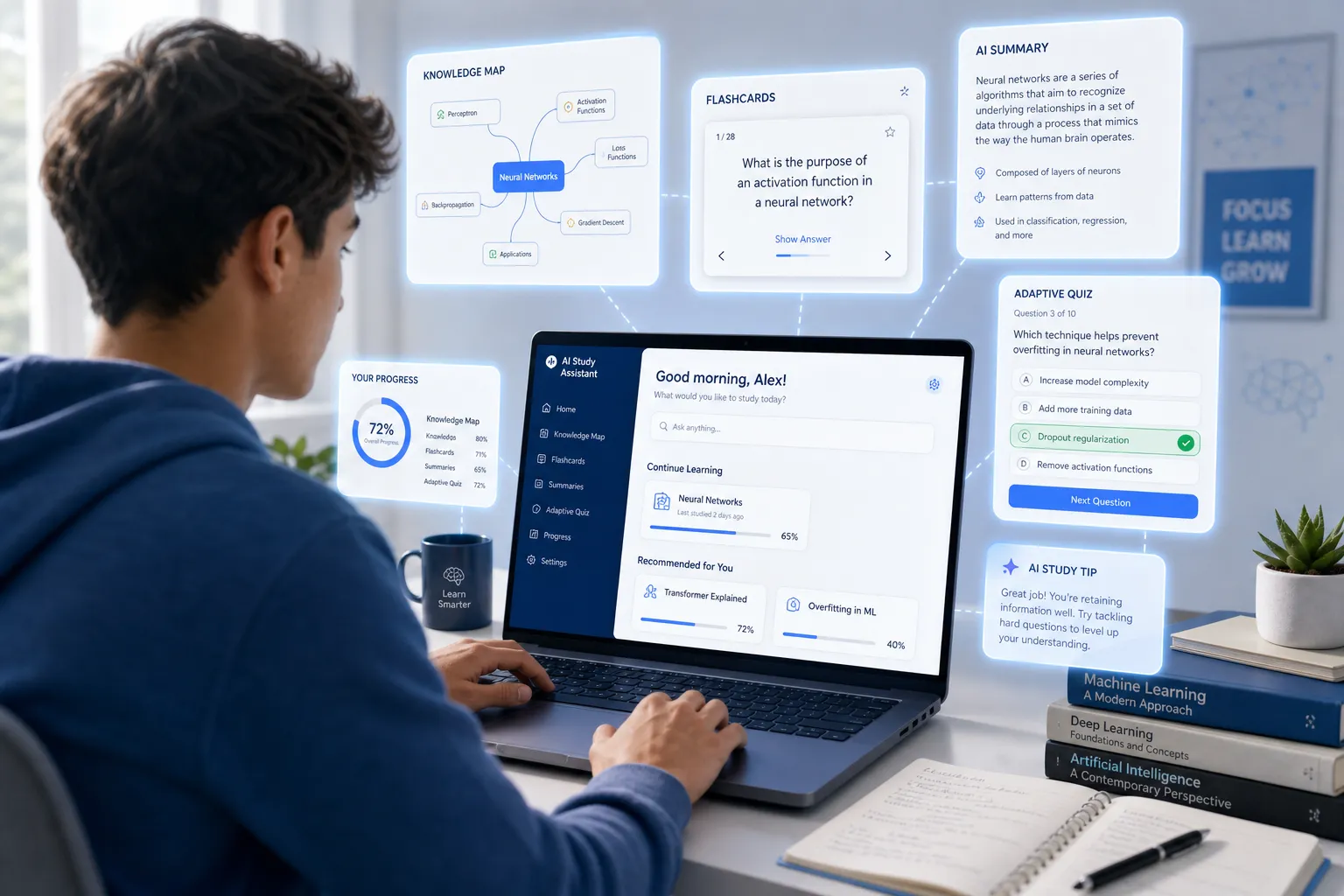
Why AI Is Reshaping How People Study
The strongest case for AI in learning is not novelty. It is effectiveness. Most people do not struggle because they are incapable; they struggle because their study workflow is fragmented. Notes live in one place, lecture recordings in another, practice questions somewhere else, and feedback often arrives too late to matter.
AI improves this by compressing the distance between:
content and comprehension
practice and feedback
weakness detection and next-step planning
effort and measurable progress
"Students who engaged in retrieval practice outperformed approximately 73% of those who used passive study methods." - Adesope et al.
That matters because the best AI study tools are not just text generators. They can operationalize proven learning science such as active recall, spaced review, adaptive questioning, and targeted repetition.
"A study involving 141 students found that 57% utilized AI tools for 26-50% of their study time." - DBITDJR study cited by ACSPublisher
The real opportunity is not to ask AI for answers and move on. It is to use AI to build a more intelligent study system.
What Most Articles Miss About AI for Study
A lot of content on this topic stops at surface-level use cases like “ask AI to summarize notes” or “generate flashcards.” Useful, yes - but incomplete.
What often gets overlooked is that the best results happen when AI can:
work across multiple input formats
keep answers anchored to original sources
connect ideas across topics
diagnose knowledge gaps dynamically
adjust the study plan in real time
help learners decide what not to study yet
That is where modern platforms like CramAI stand apart. Instead of acting like a one-off chatbot, CramAI supports the full learning cycle: upload your materials, transform them into personalized study outputs, trace insights back to their source, assess your retention, and adapt the next step automatically.
The 9 Smartest Ways AI Helps You Learn Better
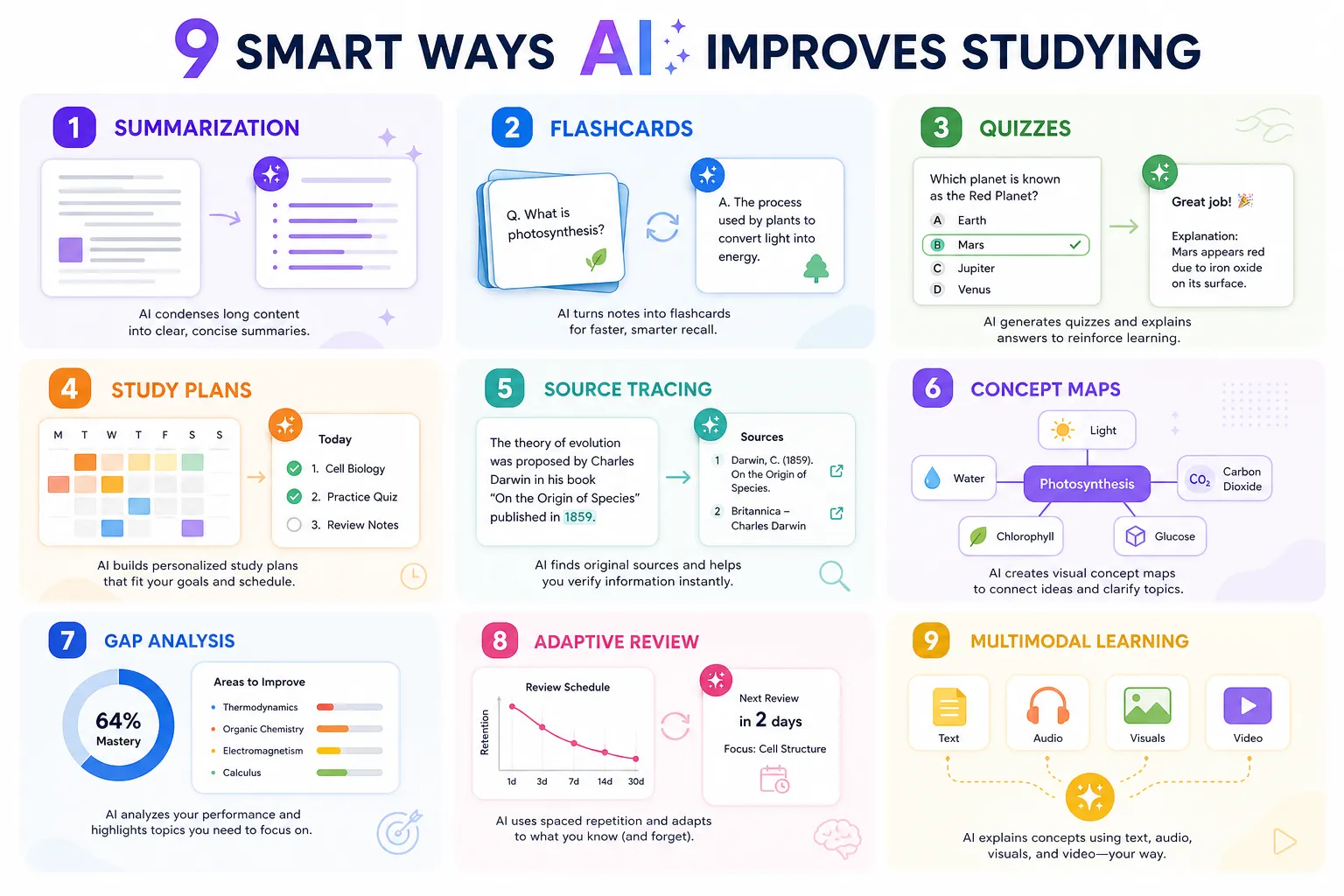
1. AI turns messy materials into a clear study plan
One of the biggest reasons learners stall is not laziness - it is uncertainty. They do not know where to begin, how to sequence topics, or what level of depth is required.
AI can solve that by converting uploaded materials into a structured plan. Instead of treating every chapter equally, it can segment topics, create milestones, and recommend a study order.
With CramAI, this becomes more powerful because the platform can build personalized study plans from PDFs, URLs, YouTube videos, slides, audio files, and documents. That means the plan is grounded in the actual material you need to master, not a generic template.
Why it matters:
reduces overwhelm
creates momentum
helps you start faster
prevents wasted time on low-priority content
2. AI summarizes faster without losing the core meaning
Summarization is one of the most obvious uses of AI, but quality matters. A weak summary strips away nuance. A strong one preserves logic, hierarchy, and definitions while making the material easier to review.
Good AI summaries help learners:
extract the main ideas from long readings
simplify dense language
compare multiple sources quickly
review concepts before class or before an exam
The real advantage appears when summaries are not standalone outputs but part of a larger workflow. In CramAI, summaries can feed into review plans, visual topic maps, and practice assessments - so you are not just shortening information, you are making it more usable.
3. AI generates better practice questions for active recall
Reading feels productive. Retrieval practice is productive. That distinction changes outcomes.
AI can transform your materials into:
multiple-choice questions
short-answer questions
application-based prompts
concept checks
cumulative mixed-topic quizzes
This makes it easier to shift from passive review to active recall, which is one of the highest-leverage study improvements available.
The best systems go further by varying difficulty levels and showing where errors cluster. That is especially valuable for standardized test prep, professional certification study, and university exams where understanding must hold up under pressure.
4. AI identifies knowledge gaps before the exam does
Many learners do not discover their weaknesses until they see the exam paper. At that point, it is too late.
AI-powered assessment changes that by analyzing your responses, detecting recurring misunderstandings, and pinpointing the concepts that are not fully secure yet. This is where adaptive learning becomes practical rather than theoretical.
CramAI emphasizes dynamic assessment and real-time strategy adjustment, which means the platform can identify what you know, what you half-know, and what needs immediate reinforcement. Instead of repeating everything, you target the exact gaps that are lowering your performance.
5. AI adapts your study strategy as you improve
A static study plan becomes less useful the moment your performance changes. If you already mastered a topic, you should not keep reviewing it at the same intensity. If a concept still causes mistakes, it should reappear sooner and in a different form.
This is where AI becomes far more valuable than a simple planner. It can update the path based on evidence.
Traditional study plan vs adaptive AI study flow
Factor | Traditional Approach | AI-Enhanced Approach |
|---|---|---|
Study sequence | Fixed from the start | Adjusts based on progress |
Review frequency | Manual and inconsistent | Optimized by performance |
Weakness detection | Often delayed | Continuous and automated |
Practice difficulty | One-size-fits-all | Personalized and adaptive |
Feedback timing | Late | Immediate |
Focus control | Self-managed only | Guided by data |
When AI adjusts your strategy in real time, you spend less energy guessing and more energy learning.
6. AI links concepts across subjects for deeper understanding
Memorization alone rarely holds up in complex exams. You need to understand how ideas connect.
This is especially true in:
medicine and health sciences
law
engineering
economics
psychology
interdisciplinary graduate study
A strong AI study system can reveal relationships between topics that are usually buried across chapters, instructors, formats, or courses. CramAI’s connected topic insights and knowledge mapping help learners see how one concept influences another, which improves understanding, recall, and transfer.
That is a meaningful advantage over standard chat interfaces, which often answer the immediate question but do not build a reusable structure of knowledge around it.
7. AI reduces cognitive load by focusing attention on what matters most
A major hidden cost in studying is not difficulty - it is decision fatigue. What should I review today? Which source is the right one? Is this paragraph important? Should I memorize this or just understand it?
AI can cut through that noise.
By prioritizing key concepts, surfacing likely exam-relevant material, and narrowing the next best action, AI reduces cognitive load. This frees mental capacity for comprehension and retention rather than constant micro-decisions.
This is one reason learners often report feeling less stuck when using a well-designed AI study platform. They are not just working faster; they are thinking with less friction.
8. AI supports multimodal learning from the materials you already use
Modern study content is not limited to textbooks. Real learning often happens across lecture slides, discussion boards, PDFs, web resources, tutorial videos, audio explainers, and handwritten notes.
Many tools handle only one content type well. That creates friction.
CramAI is designed for multimodal input, allowing users to upload and study from:
PDFs
website URLs
YouTube videos
audio files
slides
documents
That matters because it lets you keep your real-world workflow while gaining AI support across the full material set. It also makes the platform useful not just for students, but for professionals, institutions, and knowledge creators who need scalable learning support.
9. AI gives more trustworthy answers when they are anchored to sources
One of the biggest concerns with AI in education is hallucination. If a tool gives a polished but inaccurate answer, it can damage learning rather than improve it.
That is why source traceability matters.
CramAI differentiates itself with source-anchored answers that point back to the original material. This is a major trust advantage. It means learners can verify claims, revisit context, and build confidence that their understanding comes from the actual source - not just from a plausible-sounding generated response.
For exam prep, this is critical. Trust is not a bonus feature. It is foundational.
What Good AI Study Tools Should Actually Be Able to Do
If you are evaluating tools, do not stop at “it can answer questions.” That is the minimum. A modern system should support a much wider learning loop.
Core capabilities to look for
Capability | Why it matters |
|---|---|
Multi-format uploads | Lets you work from real study materials |
Personalized study planning | Creates a path instead of isolated outputs |
Source traceability | Increases trust and reduces hallucination risk |
Adaptive assessments | Reveals weaknesses early |
Concept mapping | Improves deeper understanding |
Real-time strategy updates | Keeps study efficient as performance changes |
Creator tools | Helps educators and experts organize and publish knowledge |
Scalable deployment | Useful for individuals, schools, and teams |
Where CramAI Fits in the New Study Workflow
CramAI is not just another chatbot for students. It is an AI-powered learning and exam preparation platform built around the full study cycle.
That matters because learners rarely need one isolated feature. They need a system that helps them:
learn from raw materials
test understanding through practice
assess what is weak
guide the next best action
support the process until exam day
What makes CramAI especially relevant
All-in-one study and exam prep support
Personalized study plans from uploaded materials
Support for PDFs, URLs, YouTube videos, audio, slides, and docs
Trustworthy answers anchored to source material
Concept linking across topics for deeper understanding
Dynamic assessments to identify knowledge gaps
Automatic adjustment of study strategy in real time
Reduced cognitive load by emphasizing what matters most
Scalable use for individuals, educators, and organizations
Creator Studio for knowledge organization and content generation
For students, that means less fragmentation. For educators and creators, it means a better way to turn expertise into structured learning experiences. For organizations, it means AI-assisted knowledge readiness at scale.
How AI Study Platforms Compare in Practice
Below is a practical comparison between generic AI use and a purpose-built learning platform.
Use Case | Generic AI Chat Tool | Purpose-Built Platform Like CramAI |
|---|---|---|
Summarize a chapter | Yes | Yes |
Generate quizzes | Sometimes | Yes |
Create a study plan from uploaded materials | Limited | Yes |
Trace answers back to source | Often weak | Strong |
Identify knowledge gaps | Basic | Built for it |
Adjust study strategy in real time | Rare | Yes |
Support multimodal content | Inconsistent | Strong |
Organize creator knowledge | Limited | Yes |
Support exam readiness end-to-end | Partial | Comprehensive |
Real Examples of How Different Learners Can Use AI Better
Undergraduate and graduate students
Use AI to break down readings, generate concept checks, and build adaptive weekly review plans from lectures and PDFs.
IELTS and standardized test candidates
Use AI to target weak areas, simulate question formats, track mistakes, and focus practice on the skills most likely to move the score.
Busy professionals
Use AI to convert certification manuals, policy documents, and video trainings into short, structured study sessions that fit around work.
Educators and knowledge creators
Use AI to organize expertise, generate educational content, build clearer learning sequences, and create more scalable support materials.
Institutions and enterprise teams
Use AI to standardize learning workflows, support onboarding and upskilling, and create tailored knowledge systems for large groups.
A Quick Look at the Current EdTech Landscape
Tools like StudySmart have helped popularize structured studying, flashcards, and spaced repetition. That has been a meaningful step forward for many learners.
But the next generation of study support goes further than structure alone. It combines structure with traceable AI assistance, multimodal content processing, adaptive knowledge-gap detection, and connected concept understanding. That is where platforms like CramAI are positioned to lead.
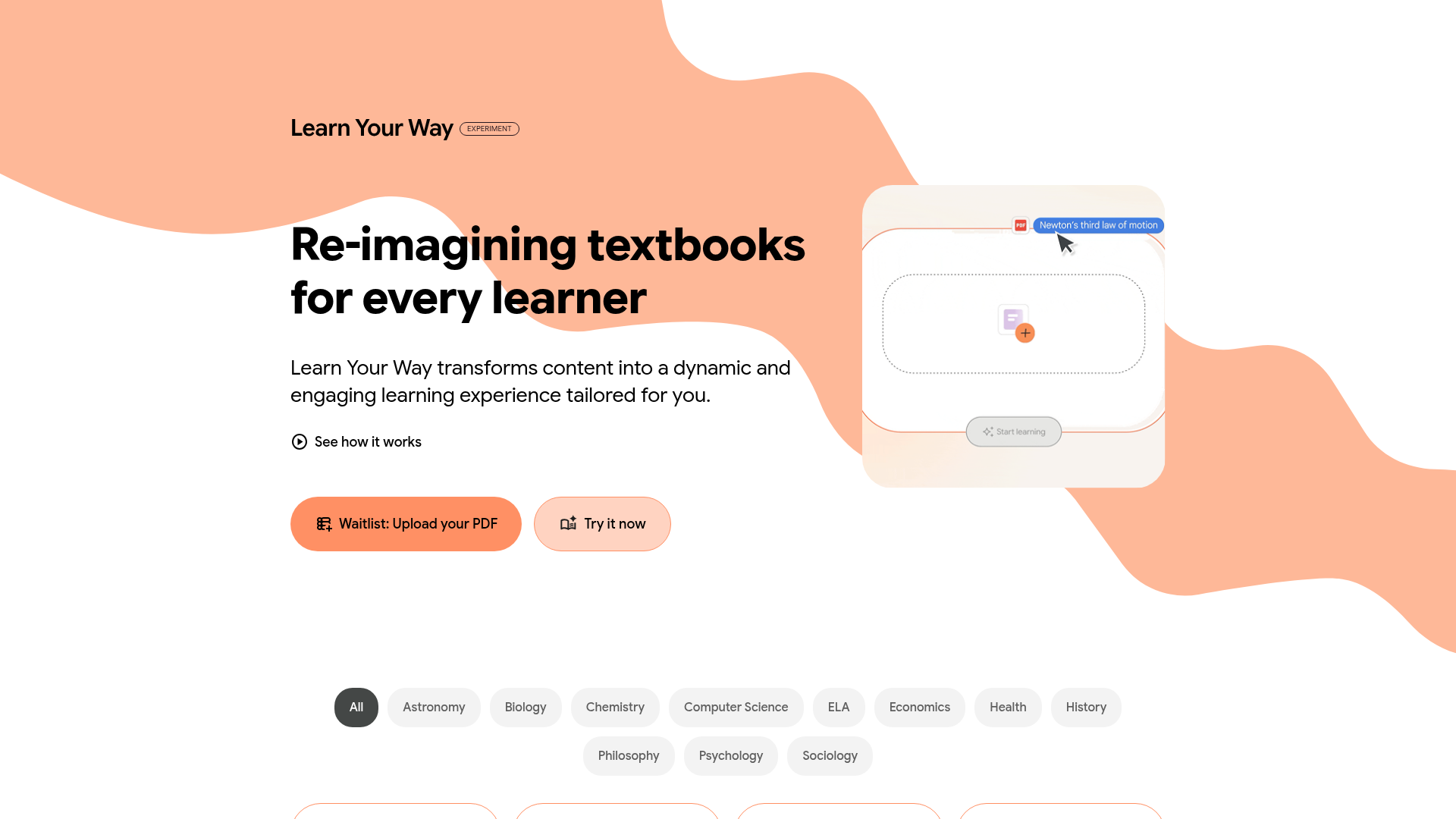
Google’s Learn Your Way also highlights a broader market shift: educational content is increasingly being reimagined as dynamic, personalized, and interaction-rich. That validates the direction of AI-assisted studying - but learners still need a practical platform that supports day-to-day exam preparation, source-grounded answers, and ongoing adaptation. That is the gap CramAI is built to fill.
Best Practices for Using AI Without Becoming Over-Reliant
AI is most effective when it supports thinking rather than replaces it. To get strong results:
Use AI to prepare, not to bypass
Summaries, quizzes, and explanations should make you engage more deeply with the material, not avoid it.
Verify important answers against sources
Source-anchored systems are especially valuable here because they make checking easier.
Practice retrieval before rereading
Ask questions, answer from memory, then review your errors.
Let the plan adapt
If the tool shows a weak area, follow that signal instead of studying only what feels comfortable.
Keep the learning active
Explain concepts out loud, write short answers, compare ideas, and solve problems. AI should increase action, not passivity.
Final Verdict: AI for Study Works Best When It Becomes Your System
AI for study is no longer just a convenience feature. It is becoming the foundation of smarter, more personalized, more evidence-based learning. The biggest gains do not come from using AI once in a while. They come from building it into the full rhythm of how you learn: planning, reviewing, testing, correcting, and progressing.
That is where CramAI offers a compelling advantage. It combines AI-powered study support with source-traceable answers, multimodal material handling, adaptive assessments, concept linking, and real-time study adjustment - all in one workflow.
If you want a study tool that does more than generate text, CramAI is built to help you learn better, find your gaps faster, and prepare with more confidence. Whether you are studying for exams, certifications, or long-term skill growth, the smartest next step is not to study harder alone. It is to study with a system that learns with you.
FAQ
What's the best AI for studying and learning?
The best option is one that goes beyond simple chat and provides study planning, adaptive practice, source-traceable answers, and knowledge-gap detection. For learners who want an all-in-one workflow, CramAI stands out because it supports the full cycle of learning, testing, assessing, and improving.
What is the 10 20 70 rule for AI?
The 10 20 70 rule is often used to describe how AI outcomes depend on more than the model alone: a small part is the tool, a larger part is the workflow, and the biggest part is execution and context. In studying, that means AI helps most when it is embedded into a smart learning system, not used as a one-off shortcut.
How to use AI to improve studying?
Use AI to turn your materials into summaries, quizzes, study plans, and targeted reviews. The most effective approach is to combine AI with active recall, source verification, and adaptive feedback so your study process keeps improving over time.
What is the AI for smart study?
AI for smart study is any system that helps you learn more efficiently by organizing materials, identifying weak areas, and personalizing review. The strongest platforms, like CramAI, also provide source-grounded answers and real-time plan adjustments so studying becomes more accurate and strategic.
Which AI is 100% free?
Some AI tools offer free tiers, but fully featured study platforms often combine free access with paid upgrades for deeper functionality. If accuracy, adaptive assessment, and multi-format study support matter, it is worth comparing whether a free tool meets your actual learning needs.
What AI is better than ChatGPT?
That depends on the task. For general conversation, many tools are comparable, but for learning and exam prep, a specialized platform can be better because it offers study plans, source traceability, multimodal uploads, and adaptive assessments rather than just answers in a chat box.