

AI Homework Solver: Smarter Study Support
Students are no longer asking whether AI belongs in the study process. The real question is how to use an AI homework solver in a way that saves time, improves understanding, and actually strengthens performance.
For undergraduates juggling deadlines, graduate students handling dense reading loads, IELTS and certification candidates balancing study with work, and educators or knowledge creators building learning assets at scale, the pressure is the same: too much information, too little time, and not enough clarity on what matters most.
An effective AI homework help workflow should do more than generate quick answers. It should help learners:
understand the logic behind a solution,
connect assignments to broader concepts,
identify weak spots before exams,
and build a repeatable, evidence-based study system.
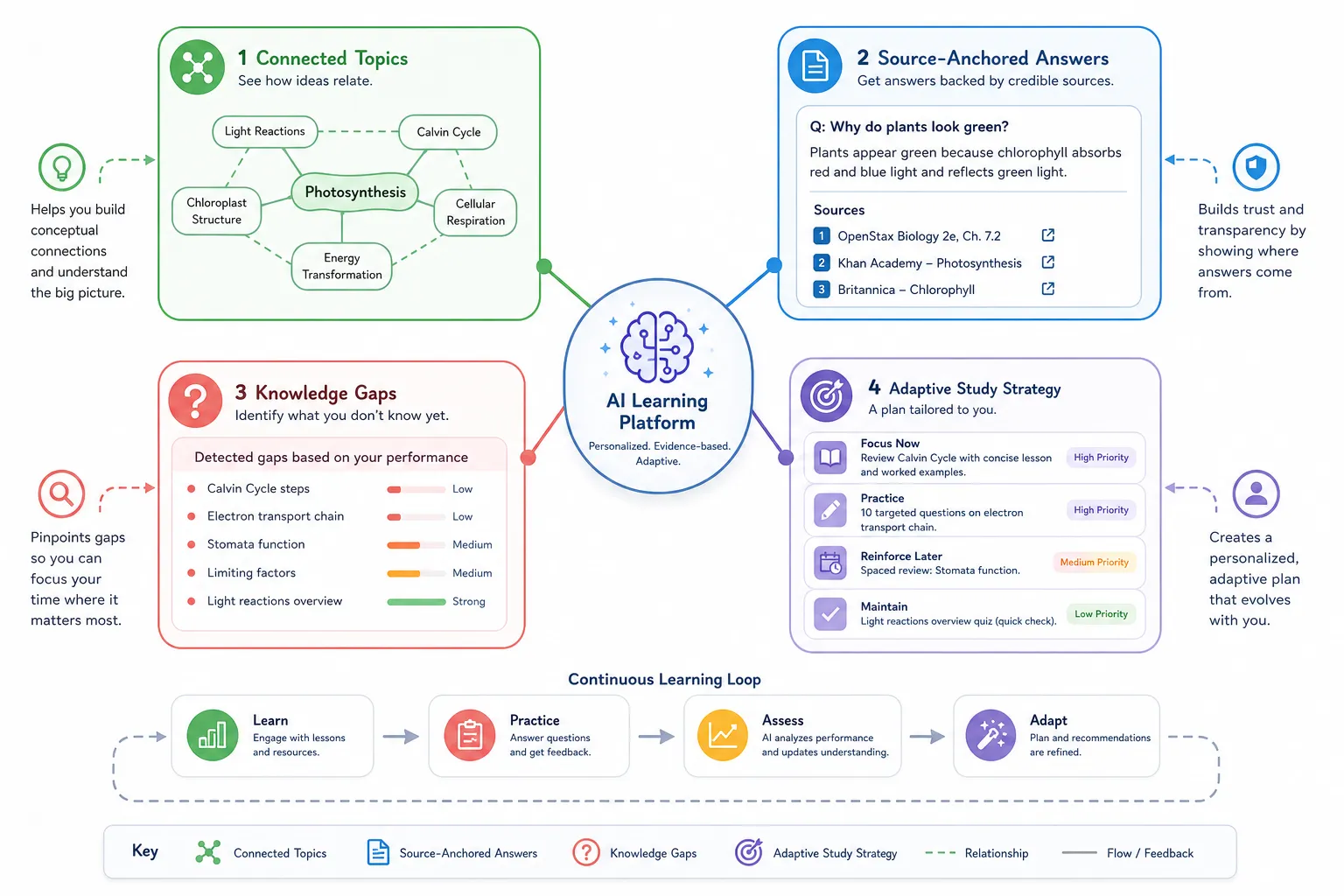
That is where platforms like CramAI stand apart. Instead of acting like a one-off answer box, CramAI supports the full learning cycle: upload source materials, generate personalized study plans, trace answers back to original materials, uncover knowledge gaps, and adapt strategy in real time across formats like PDFs, slides, web pages, YouTube videos, audio, and documents.
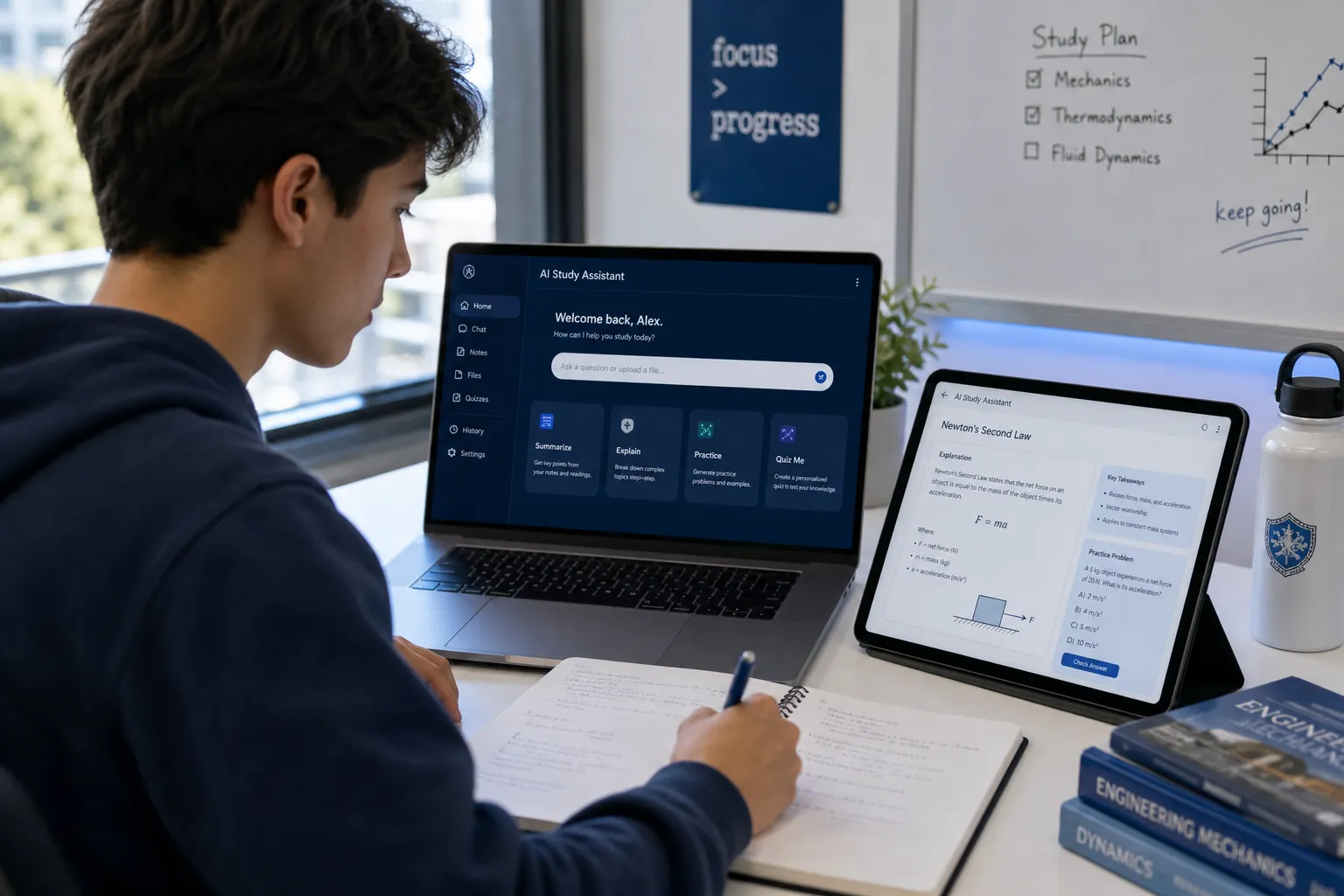
Why AI homework solvers are becoming essential
The strongest competitor pages all make a similar promise: upload a problem, get an answer fast. That promise matters, but it is incomplete.
Students do not just need speed. They need:
reliable explanations,
support across subjects,
flexible input methods,
and a system that helps them retain what they learned later.
That is especially true when assignments feed into midterms, finals, licensing exams, or professional certifications. A generic AI homework tool may solve the task in front of you. A better one helps you learn from the task and carry that understanding forward.
"AI usage for homework among middle school, high school, and college students rose from 48% in May 2025 to 62% by December 2025." - eSchool News
This growth is not surprising. Students want immediate support. But rapid adoption also raises the bar. If more learners are relying on AI homework help, then quality, trust, and study design matter more than ever.
What an AI homework solver actually does
At its core, an AI homework solver analyzes a prompt, image, PDF, or other source material and produces a response. But the best systems go much further than outputting a final answer.
Core functions of a high-value solver
A strong AI homework solution should be able to:
Capability | Why It Matters |
|---|---|
Solve questions step by step | Builds understanding, not just completion |
Accept multiple formats | Matches real student workflows |
Summarize source materials | Cuts down review time |
Link related concepts | Improves retention across classes and topics |
Detect knowledge gaps | Prevents repeated mistakes |
Adapt study recommendations | Makes prep more efficient over time |
Anchor answers to source material | Improves trust and traceability |
This is where CramAI’s model becomes more useful than standard answer generators. It is not just about “solve this.” It is about learn, test, assess, guide, and support from the same environment.
AI homework solver vs general AI homework help
These phrases are often used interchangeably, but there is a meaningful difference.
AI homework help
This is the broad category. It may include:
answer generation,
tutoring chat,
note summaries,
flashcards,
study recommendations,
or concept explanations.
AI homework solver
This is more task-specific. It usually focuses on:
analyzing a concrete question,
processing an uploaded assignment,
and returning a solution or guided explanation.
The practical difference
Feature | General AI Homework Help | AI Homework Solver |
|---|---|---|
Broad tutoring support | Yes | Sometimes |
Direct assignment solving | Sometimes | Yes |
Step-by-step problem breakdown | Sometimes | Usually |
Cross-material study planning | Rare in basic tools | Rare in basic tools |
Source traceability | Often weak | Often weak |
Adaptive study strategy | Uncommon | Uncommon |
Best-in-class integrated workflow | Found in platforms like CramAI | Found in platforms like CramAI |
The real opportunity is combining both. Students need a solver for immediate friction and a broader AI study system for long-term mastery. That combination is exactly where all-in-one platforms have an advantage.
The biggest content gap in most AI homework articles
Most competitor content stays very surface-level. They talk about:
being fast,
supporting math and science,
accepting image uploads,
and giving explanations.
What they often miss is what actually matters to serious learners:
1. Trust and traceability
If an answer appears out of nowhere, students still have to wonder whether it is correct. CramAI reduces this uncertainty by anchoring responses to uploaded source material, making it easier to verify where information came from.
2. Knowledge transfer
Solving one assignment is useful. Connecting that assignment to adjacent ideas, prior mistakes, and future exam topics is much more powerful.
3. Dynamic assessment
Most tools do not identify what the learner still does not know. CramAI can use interaction history and uploaded materials to spotlight weak areas and adjust study plans in real time.
4. Reduced cognitive load
Students are overwhelmed by scattered tabs, notes, videos, and PDFs. A modern AI homework workflow should consolidate this into one organized study system.
5. Multi-role usefulness
Homework support is not just for traditional students. It is relevant for exam candidates, working professionals, educators, tutoring teams, and creators building courses or knowledge products.
How smarter AI homework support improves actual learning
A strong AI homework experience should move the learner through a progression:
Understand the question
See the logic of the solution
Connect it to the larger topic
Test whether the idea stuck
Adjust the study plan if needed
That is a much better model than “copy answer and move on.”
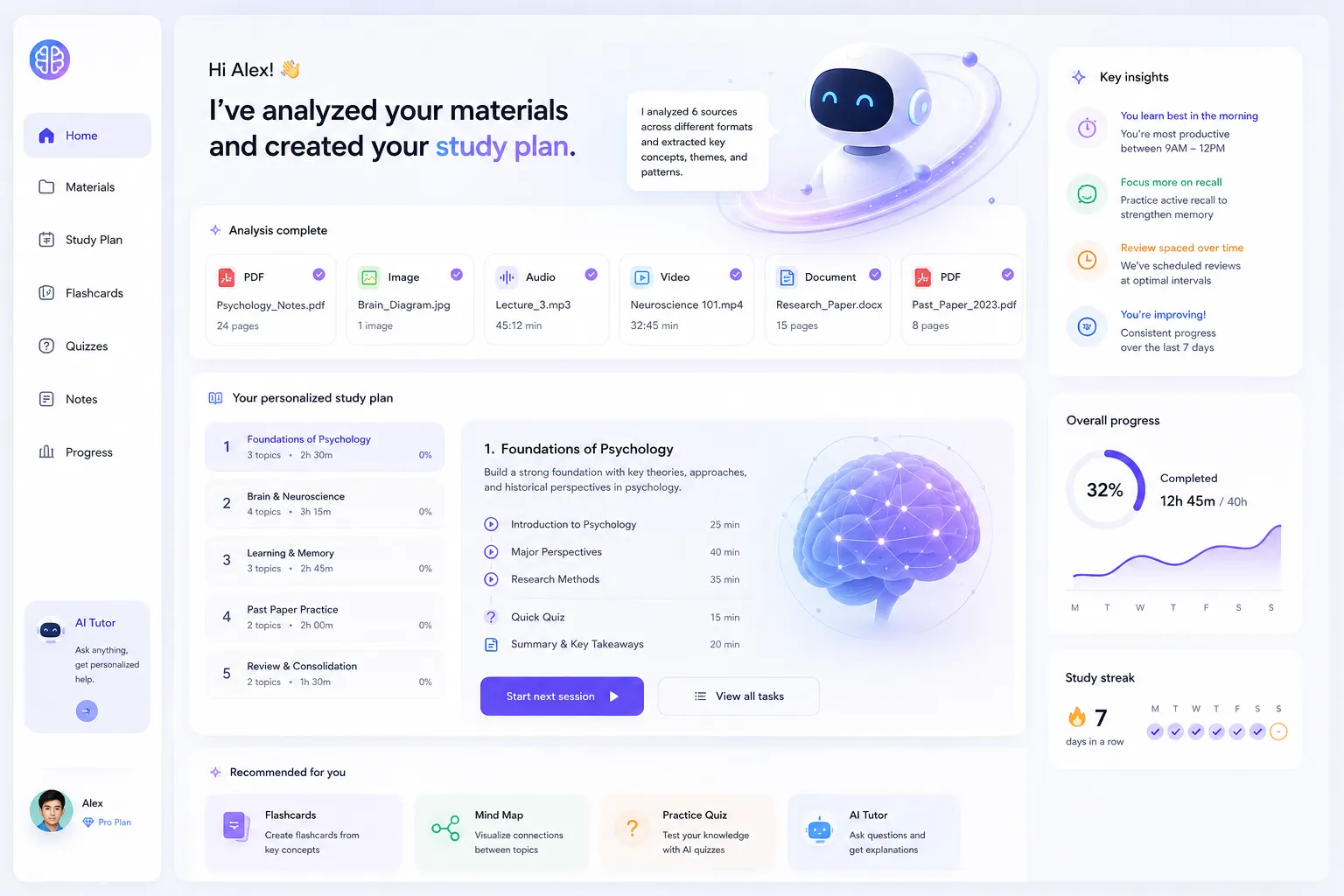
Faster completion without shallow learning
Done right, AI homework help reduces wasted time on:
re-reading confusing prompts,
hunting for relevant chapters,
decoding instructor expectations,
and switching between disconnected tools.
Instead of increasing cognitive clutter, the right platform narrows attention to what matters most right now.
Better understanding through explanation
A final answer has limited value on its own. Step-by-step reasoning, source-based context, and concept linking help students understand:
why the answer is correct,
which rule or principle applies,
where common mistakes happen,
and how to solve similar questions independently.
Stronger exam readiness
Homework is often a preview of assessment logic. If an AI platform can convert class materials into summaries, quizzes, topic maps, and adaptive review plans, then homework stops being isolated busywork and becomes part of a strategic exam-prep system.
What to look for in an AI homework solver
Not every tool deserves a place in a serious study workflow. Here are the features that matter most.
Multi-format input
Students do not study from one neat text box. Real inputs include:
lecture slides,
scanned worksheets,
handwritten notes,
PDFs,
YouTube lessons,
instructor webpages,
audio recordings,
and mixed-source study packets.
CramAI’s multimodal design is especially valuable here because it can transform diverse materials into personalized review paths rather than treating every problem as a standalone query.
Personalized study plans
This is one of the most meaningful differentiators. Instead of just answering “What is the solution?”, a modern platform should answer:
What should I review next?
Which topic am I weak in?
Which source should I revisit?
How should I sequence my revision before the exam?
That kind of personalization turns AI homework into an intelligent study companion.
Source-anchored answers
Trust is a major issue in educational AI. Learners need to know whether an answer came from:
the uploaded textbook chapter,
lecture notes,
a linked website,
or a model’s unsupported guess.
Traceability matters because it helps students verify, cite, and learn with confidence.
Dynamic assessments
A static explanation is helpful. An adaptive system is better. When a platform can identify knowledge gaps and change the next study recommendation automatically, students spend more time on the concepts that will actually improve results.
"A meta-analysis published in 2024 examined 45 studies on artificial intelligence-enabled adaptive learning systems... [and] reported a medium to large positive effect on learner outcomes, with an average effect size of 0.70 compared to non-adaptive methods." - SAGE Journals
This is an important benchmark. Adaptive support is not just a convenience feature. It can materially improve outcomes when implemented well.
Subject use cases: where AI homework solvers help most
The top-ranking pages usually highlight math first, but demand is far broader. The best tools should support both structured and open-ended academic work.
Math and quantitative subjects
AI homework solvers are especially strong in:
algebra,
calculus,
geometry,
statistics,
physics,
engineering,
and finance-related calculations.
These subjects benefit from visible steps, formula breakdowns, and error detection.
Reading-heavy disciplines
In literature, history, law, business, and social science, the need is often different. Students may need help:
extracting key arguments from texts,
summarizing readings,
organizing evidence,
comparing theories,
or turning long-form material into review notes.
Language learning and test prep
For IELTS candidates, multilingual learners, and certification test takers, the value expands again. They may need:
concept summaries,
grammar or vocabulary reinforcement,
speaking or listening materials converted into notes,
and targeted practice based on weak areas.
Professional and lifelong learning
Busy professionals studying for certifications often have the same pain points as students, with even less time. An AI homework workflow becomes more valuable when it can condense inputs, prioritize study actions, and generate creator-friendly outputs like guides, frameworks, or content assets.
What a modern study workflow looks like with CramAI
Most tools stop at the answer. CramAI is more useful when you need an end-to-end system.
A practical workflow
Step | What the learner does | What CramAI adds |
|---|---|---|
Upload materials | Add PDFs, URLs, slides, audio, videos, docs | Unifies scattered inputs |
Get support | Ask questions or solve assignments | Produces guided, source-aware answers |
Build understanding | Review summaries and linked concepts | Shows how topics connect |
Assess readiness | Take dynamic assessments | Identifies gaps and priorities |
Refine strategy | Continue studying | Adjusts plan in real time |
Create outputs | Generate notes or educational assets | Supports creators, tutors, and teams |
This all-in-one approach reduces tool sprawl and keeps studying aligned with actual goals.
Comparing leading homework AI experiences
Below is a high-level comparison of common market positioning based on competitor patterns.
Platform Type | Strengths | Limitations |
|---|---|---|
Mobile-first homework apps | Convenient scanning and fast answers | Often narrow workflows, limited traceability |
Single-page web solvers | Quick and easy to start | Usually shallow on planning and retention |
Generic chatbots | Flexible conversation | Can hallucinate and lack source grounding |
Adaptive all-in-one platforms like CramAI | Personalized plans, multimodal input, source-anchored answers, concept linking, dynamic assessments | More sophisticated workflow, best used as a full study system |
Edubrain
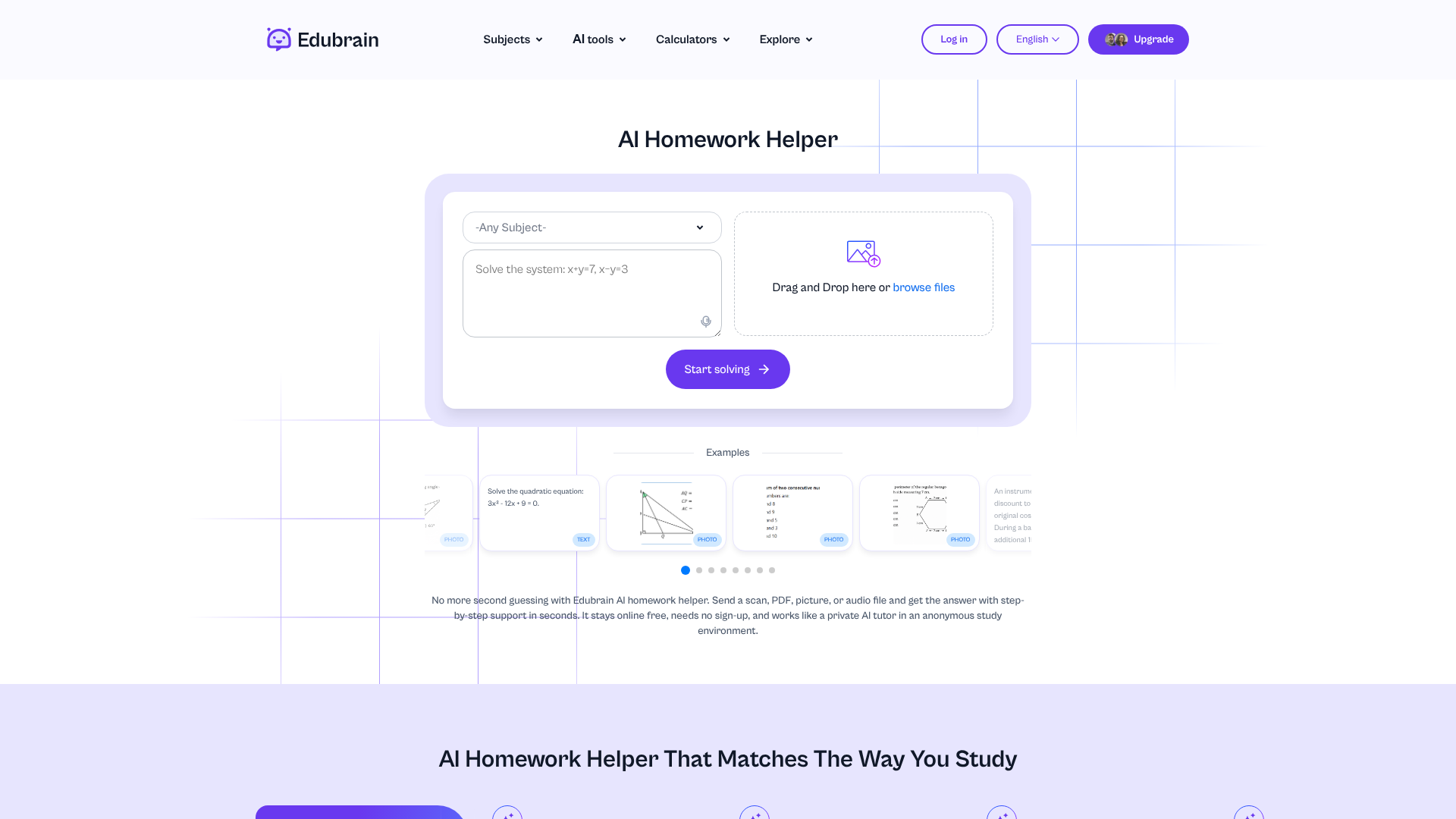
Edubrain emphasizes broad subject coverage, fast answer generation, and multiple input formats including text, images, PDFs, and audio. Its positioning is strong for immediate homework support, especially for students who want quick, tutor-like explanations.
Where a platform like CramAI extends further is in turning those answers into a larger study architecture: connected topics, adaptive study planning, trustworthy source traceability, and support that evolves beyond a single assignment.
NoteGPT
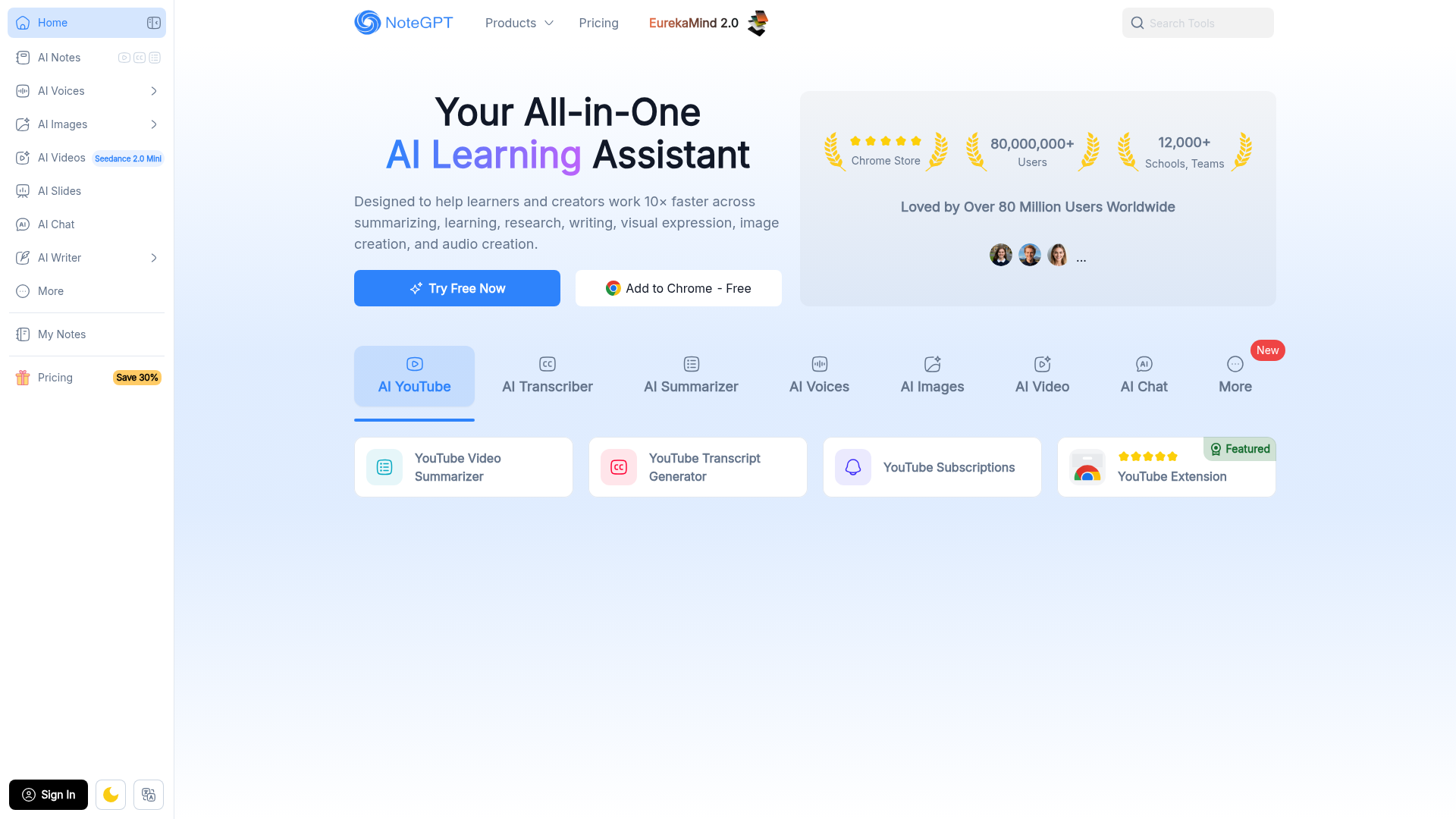
NoteGPT positions its AI homework helper as a free online utility with image and PDF support plus simple explanations. It fits users looking for low-friction access and instant response generation.
The gap, again, is what happens after the answer. For learners who need exam-readiness, knowledge-gap detection, strategy shifts, and organization across many sources, a more integrated system offers greater long-term value.
Best practices for using AI homework help responsibly
Using AI well is not about outsourcing thought. It is about improving study efficiency while keeping learning intact.
Use it to reveal process, not replace process
A good rule: if the AI gives you a solution, make sure you can explain the reasoning in your own words afterward.
Verify against course materials
Source-anchored responses are especially helpful because they reduce the risk of drifting away from what your course actually teaches.
Turn answers into review assets
Do not stop at “solved.” Convert the output into:
a summary,
a concept list,
flashcards,
a mistake log,
or a targeted review plan.
Focus on weak spots
Dynamic assessments are useful because they keep attention on the concepts most likely to block progress.
Why source traceability matters more than speed
Many AI tools can produce an answer quickly. Fewer can show where that answer came from.
That distinction matters because students increasingly need:
defensible understanding,
confidence in factual accuracy,
alignment with class materials,
and less risk of hidden errors.
A source-aware system does more than reduce hallucination risk. It teaches students how to connect claims, evidence, and interpretation. That is valuable for coursework, exam prep, writing, and professional knowledge work alike.
From homework completion to strategic learning
The most important shift in this space is philosophical. AI homework should not be seen as a shortcut around learning. It should be seen as infrastructure for better learning.
That means moving from:
answer generation to understanding,
isolated assignments to connected knowledge,
static explanations to adaptive study loops,
and fragmented tools to one coordinated platform.
CramAI aligns with that future because it supports not just assignment resolution, but the broader ecosystem of learning:
multimodal uploads,
personalized study plans,
dynamic assessment,
real-time adjustment,
knowledge mapping,
creator tools,
and scalable workflows for individuals, educators, and organizations.
Final verdict: what makes an AI homework solver truly smart
A smart AI homework solver does not just help you finish faster. It helps you study better, verify more confidently, and improve over time.
If all you need is a quick answer, many tools can provide that. But if you want an AI system that reduces cognitive load, organizes scattered materials, links concepts across topics, adapts to your weak areas, and grounds answers in source material, the difference becomes clear.
CramAI is built for learners who want more than surface-level AI homework help. It is designed for students, exam candidates, professionals, educators, creators, and teams that need a trustworthy, all-in-one study engine rather than a one-off solver.
If your goal is not just to complete homework but to turn every assignment into measurable progress, try CramAI and build a smarter study workflow from the first upload.