
AI How Does It Work: A Beginner’s Guide
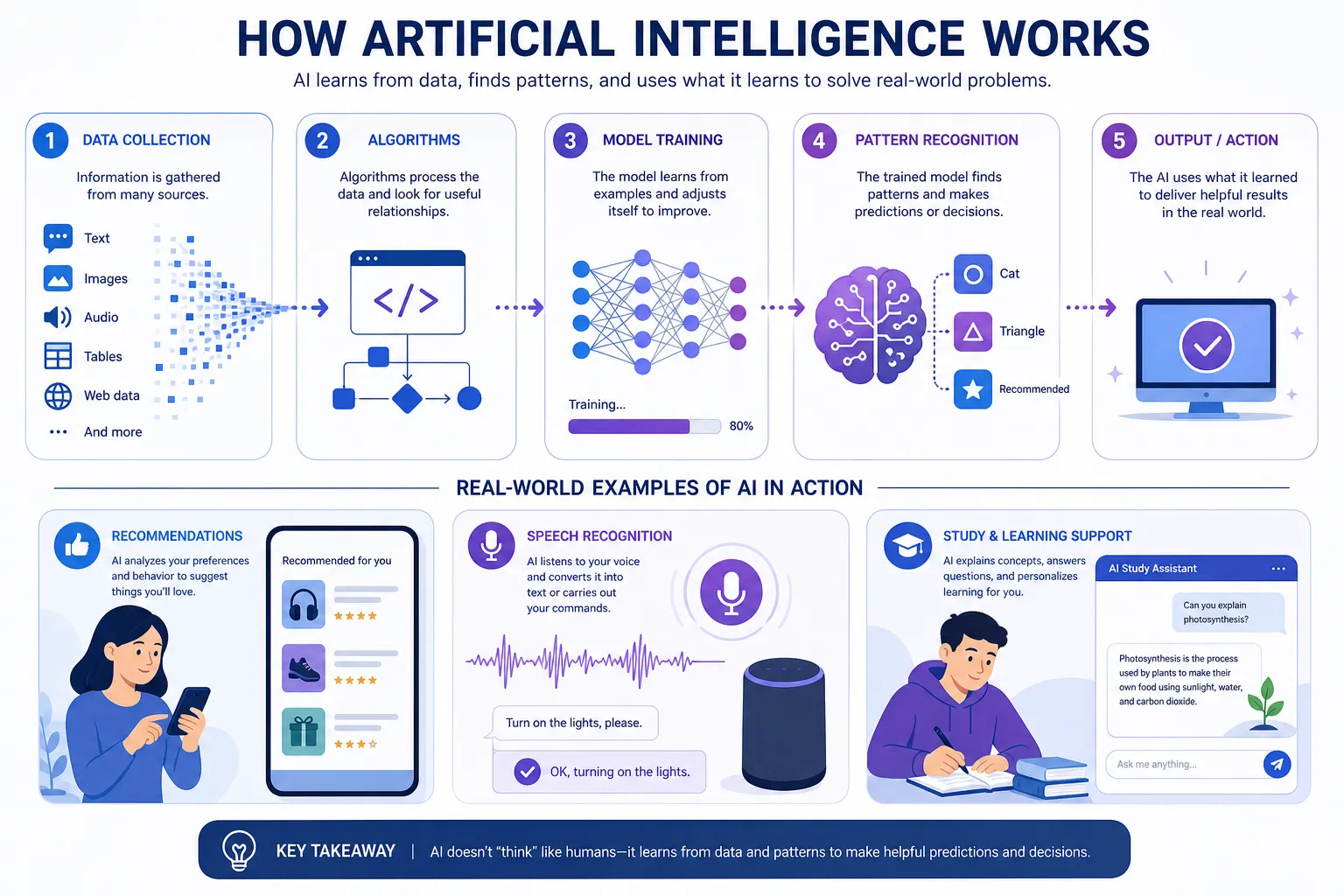
Artificial intelligence can feel mysterious until you strip away the buzzwords. If you’ve been asking ai how does it work, the short answer is this: AI learns patterns from data, uses algorithms to make predictions or decisions, and improves through training and feedback.
That sounds simple, but for students, exam candidates, professionals, educators, and lifelong learners, the real challenge is understanding what that actually means in practice. Why does an AI chatbot answer in seconds? How does Netflix recommend something you actually want to watch? Why can one model recognize speech while another helps summarize lecture notes or build a study plan?
This guide explains AI in plain English. No heavy jargon. No assumption that you have a technical background. Just a practical, beginner-friendly walkthrough of how AI works, why it matters, where it succeeds, and where it can go wrong.
For learners especially, understanding AI is no longer optional. It is becoming part of how people research, study, revise, write, and prepare for exams. That is exactly why platforms like CramAI matter: they turn AI from a vague concept into something useful and trustworthy for real learning. Instead of generic outputs, CramAI helps users upload source materials, generate personalized study plans, identify knowledge gaps, and get source-anchored answers with traceability.
"As of May 2026, 19.5% of U.S. businesses reported using artificial intelligence (AI) in their operations." - U.S. Census Bureau
"According to a 2025 survey by edX, 54% of workers believe AI-related skills are very or extremely important for remaining competitive in their careers, yet only 4% are currently pursuing AI-related education or training." - edX
What Artificial Intelligence Actually Is
Artificial intelligence is a way of building computer systems that can perform tasks that normally require human intelligence.
These tasks include:
recognizing images
understanding language
spotting patterns in data
making recommendations
answering questions
predicting likely outcomes
AI does not mean a machine is conscious or “thinking” like a human. In most real-world cases, AI is better understood as a highly specialized system trained to do a specific kind of task very well.
For example:
a spam filter learns which emails look suspicious
a voice assistant learns to convert speech into text
a recommendation engine learns what content you may like next
a study platform can learn what topics a student struggles with and adapt accordingly
That last example is especially relevant in education. AI becomes most valuable when it does more than generate answers. It should help learners organize complexity, reduce cognitive overload, and direct attention to what matters most. That is where a platform like CramAI stands apart: it supports the full learning cycle from content upload to plan creation, assessment, guidance, and revision.
The Simple Formula Behind How AI Works
At a beginner level, most AI systems follow the same broad formula:
Step | What happens | Plain-English meaning |
|---|---|---|
Data | The system is given examples | AI needs material to learn from |
Algorithm | A method processes the data | The model looks for patterns |
Training | The system adjusts based on results | It gets better through practice |
Prediction | It applies what it learned | It makes a guess or decision |
Feedback | Results are evaluated and refined | It improves over time |
So if you want the clearest possible answer to ai how does it work, here it is:
AI works by learning patterns from data, using those patterns to make predictions, and improving its performance through repeated training and feedback.
The Five Building Blocks of AI
1. Data: The raw material
Data is the starting point for almost every AI system.
Data can be:
text
images
audio
video
numbers
documents
click behavior
user interactions
If you were training an AI to recognize cats, you would feed it many images labeled “cat” and “not cat.” If you were building an AI study assistant, you might feed it course notes, textbook chapters, lecture slides, PDFs, videos, and practice questions.
The quality of data matters as much as the quantity. If the data is poor, incomplete, outdated, or biased, the AI’s output will reflect those problems.
That is one reason source traceability matters so much in educational AI. When learners can see where an answer came from, they are not forced to trust a black box. CramAI’s source-anchored responses help users verify information against original materials, which is essential for serious study and exam prep.
2. Algorithms: The rule system for learning
An algorithm is the method an AI system uses to process data and find relationships in it.
Think of it like a recipe or procedure. The algorithm tells the system how to learn from examples. Some algorithms classify things into categories. Others predict numbers. Others generate text.
You do not need to memorize technical algorithm names to understand the concept. What matters is this:
the AI receives examples
the algorithm looks for useful patterns
the system uses those patterns to make future predictions
3. Models: The trained brain of the system
A model is what you get after training an algorithm on data.
Before training, the system knows very little. After training, the model contains learned relationships that it can use on new inputs.
For example:
a trained image model can identify objects in photos
a trained language model can generate text
a trained recommendation model can suggest products or videos
a trained learning assistant can spot weak areas in a student’s understanding
When people talk about “AI models,” they usually mean these trained systems.
4. Training: The learning phase
Training is the process where the model learns from data.
During training, the system makes a prediction, compares it to the correct answer, measures how wrong it was, and then adjusts itself.
This cycle happens again and again, often millions of times.
A simple example:
the model sees a photo
it predicts “dog”
the correct label is “cat”
the system adjusts its internal settings
next time, it has a better chance of getting it right
This trial-and-improve process is one of the foundations of modern AI.
5. Inference: The moment AI becomes useful
Inference is when the trained model is used in the real world.
This is the moment when:
your voice assistant answers
your map app reroutes traffic
a chatbot responds
an AI tutor explains a concept
a learning platform generates your next study recommendation
Training is how the model learns. Inference is how you experience the result.
How AI Learns Patterns
The heart of AI is pattern recognition.
Humans do this too. If you see enough examples, you begin to notice regularities. AI does something similar, but mathematically and at scale.
Examples of pattern recognition in AI:
In language: predicting which word should come next
In images: recognizing shapes, textures, or edges
In finance: detecting suspicious transaction behavior
In education: identifying which topics a learner repeatedly misses
In healthcare: spotting anomalies in scans
This is why AI can be so powerful in learning environments. Students rarely struggle uniformly. One learner may understand concepts but fail application questions. Another may memorize facts but miss cross-topic connections. A strong AI learning platform should recognize those patterns and adapt.
CramAI is built around that idea. It does not just process content. It helps connect concepts across topics, detect knowledge gaps through dynamic assessment, and automatically adjust study strategies in real time.
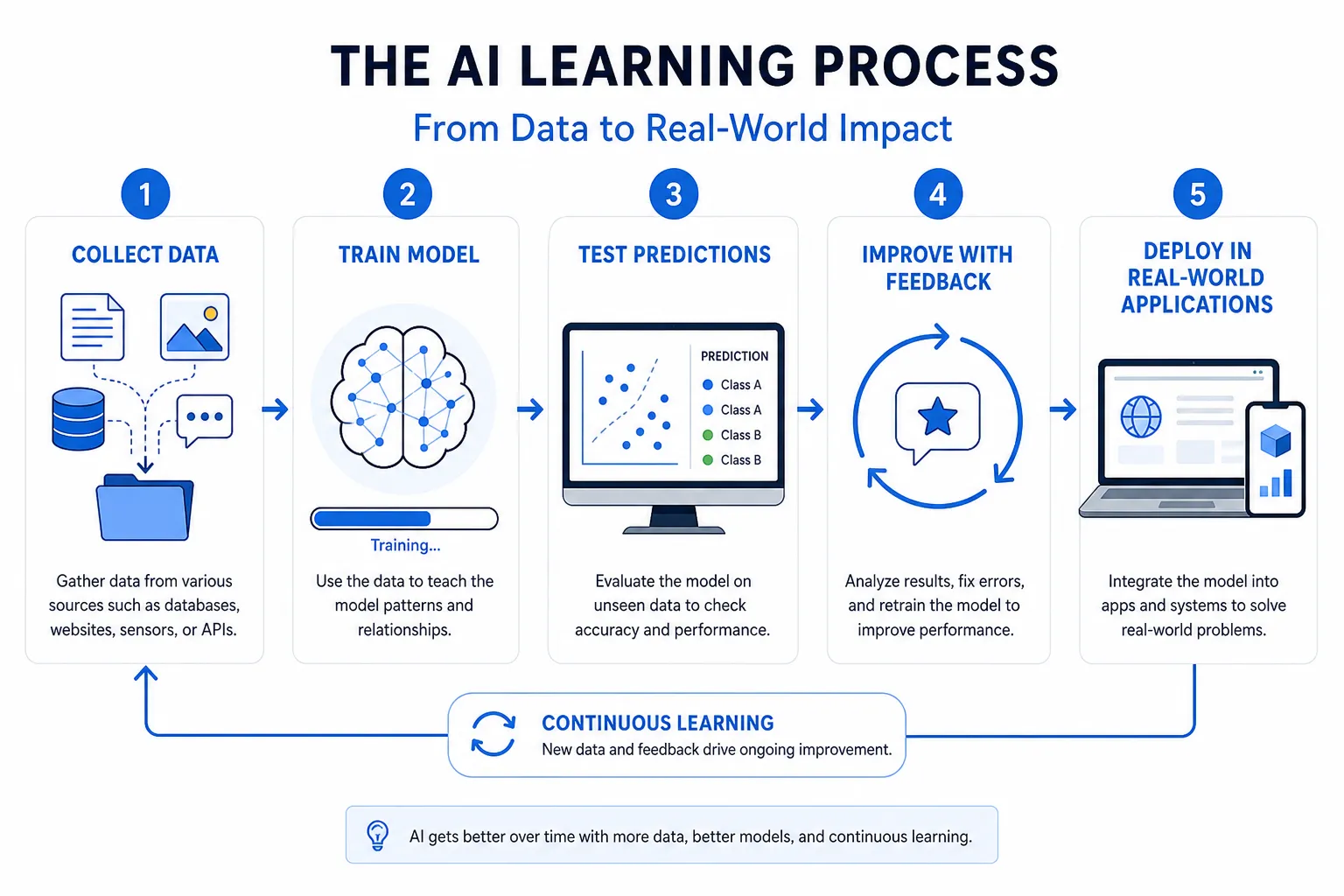
The AI Learning Process Step by Step
Step 1: Collect data
The system gathers examples relevant to the task.
For a language model, that may be books, articles, websites, and documents.
For a study platform, that may be PDFs, lecture recordings, slides, notes, and video transcripts.
Step 2: Prepare the data
Raw data is often messy. It may need to be cleaned, labeled, organized, or converted into a format the model can process.
This stage is often overlooked in beginner guides, but it matters a lot. Bad input creates bad output.
Step 3: Train the model
The model studies the prepared data and learns statistical relationships.
In text, it may learn that certain words often appear together.
In images, it may learn that certain visual features tend to indicate specific objects.
Step 4: Test the model
The system is checked using new data it has not seen before.
This reveals whether the model truly learned useful patterns or just memorized its training examples.
Step 5: Deploy the model
Once performance is good enough, the model is used in a real application.
This might be a chatbot, fraud detector, search tool, recommendation engine, or AI study platform.
Step 6: Improve continuously
Good AI systems do not stay static. They are monitored, updated, and refined over time.
In learning platforms, this is especially valuable. A student’s needs change as they progress. Adaptive systems can respond in real time rather than forcing everyone into the same revision path.
Machine Learning vs AI vs Deep Learning
These terms are often used interchangeably, but they are not the same.
Term | What it means | Beginner explanation |
|---|---|---|
Artificial Intelligence | The broad field | Any system built to perform intelligence-like tasks |
Machine Learning | A subset of AI | AI that learns from data instead of explicit rules |
Deep Learning | A subset of machine learning | Uses layered neural networks to learn complex patterns |
In plain English:
AI is the big umbrella
machine learning is one of the main ways AI works
deep learning is a more advanced version used for difficult tasks like image recognition, speech, and generative AI
How Generative AI Works
Generative AI is the kind of AI that creates new content, such as:
text
images
audio
code
summaries
flashcards
explanations
It works by learning patterns from huge amounts of existing content and then generating likely outputs based on your prompt.
For example, when you ask a chatbot to explain photosynthesis, it is not “looking up” a fixed answer in the way a search engine might. It is generating a response based on learned language patterns and knowledge representations.
This is useful, but it also introduces risk. Generative AI can sound confident even when it is wrong. That is why traceability is crucial in education.
CramAI addresses this by grounding answers in user-provided materials and showing source-linked reasoning. For learners preparing for exams, that is far more reliable than depending on generic outputs with no evidence trail.
Real-World Examples of How AI Works
Recommendation systems
Platforms like Netflix, YouTube, Spotify, and Amazon use AI to predict what you may want next.
They analyze patterns such as:
what you clicked
what similar users preferred
how long you engaged
what sequence of actions often leads to satisfaction
Voice assistants
Siri, Google Assistant, and Alexa combine several AI functions:
speech recognition
natural language understanding
intent detection
response generation
They convert your voice into text, interpret what you mean, and choose the most likely helpful action.
Spam filters
Email spam detection is a classic AI use case. The system learns patterns associated with unwanted mail and flags suspicious messages automatically.
Image recognition
AI systems in phones, security tools, and medical software can identify faces, products, objects, or abnormalities in images.
Personalized learning
This is one of the most meaningful applications for students and professionals.
An AI-powered learning system can:
analyze your source materials
summarize dense content
identify weak areas
generate assessments
connect related concepts
adapt your study plan as performance changes
That is the difference between generic AI and purpose-built educational AI. CramAI is designed for learning outcomes, not just content generation.
Why AI Sometimes Gets Things Wrong
Many beginner articles explain what AI can do, but not why it fails. That is a major gap.
AI can be wrong for several reasons:
Poor training data
If the input data is incomplete, low quality, or biased, the model learns flawed patterns.
Overfitting
Sometimes a model learns the training examples too closely and struggles with new situations.
Ambiguous prompts
In generative AI, vague prompts often produce vague or misleading outputs.
Lack of context
If the model does not have access to your exact source materials or domain context, it may guess.
Hallucination
Generative models sometimes produce false information that sounds plausible.
For exam prep, research, and knowledge work, this is a serious problem. Trust is everything. CramAI’s approach of grounding outputs in uploaded materials, linking answers back to sources, and organizing knowledge into structured study flows helps reduce this risk substantially.
What Makes AI Useful for Learning
AI becomes powerful in education when it helps learners do five things better:
Learning challenge | How AI can help | Why it matters |
|---|---|---|
Too much material | Summarize and prioritize | Reduces overload |
No clear plan | Build adaptive study schedules | Improves focus |
Hidden weak areas | Assess understanding dynamically | Exposes knowledge gaps |
Isolated facts | Link concepts across topics | Strengthens retention |
Low trust in answers | Anchor outputs to source material | Improves confidence |
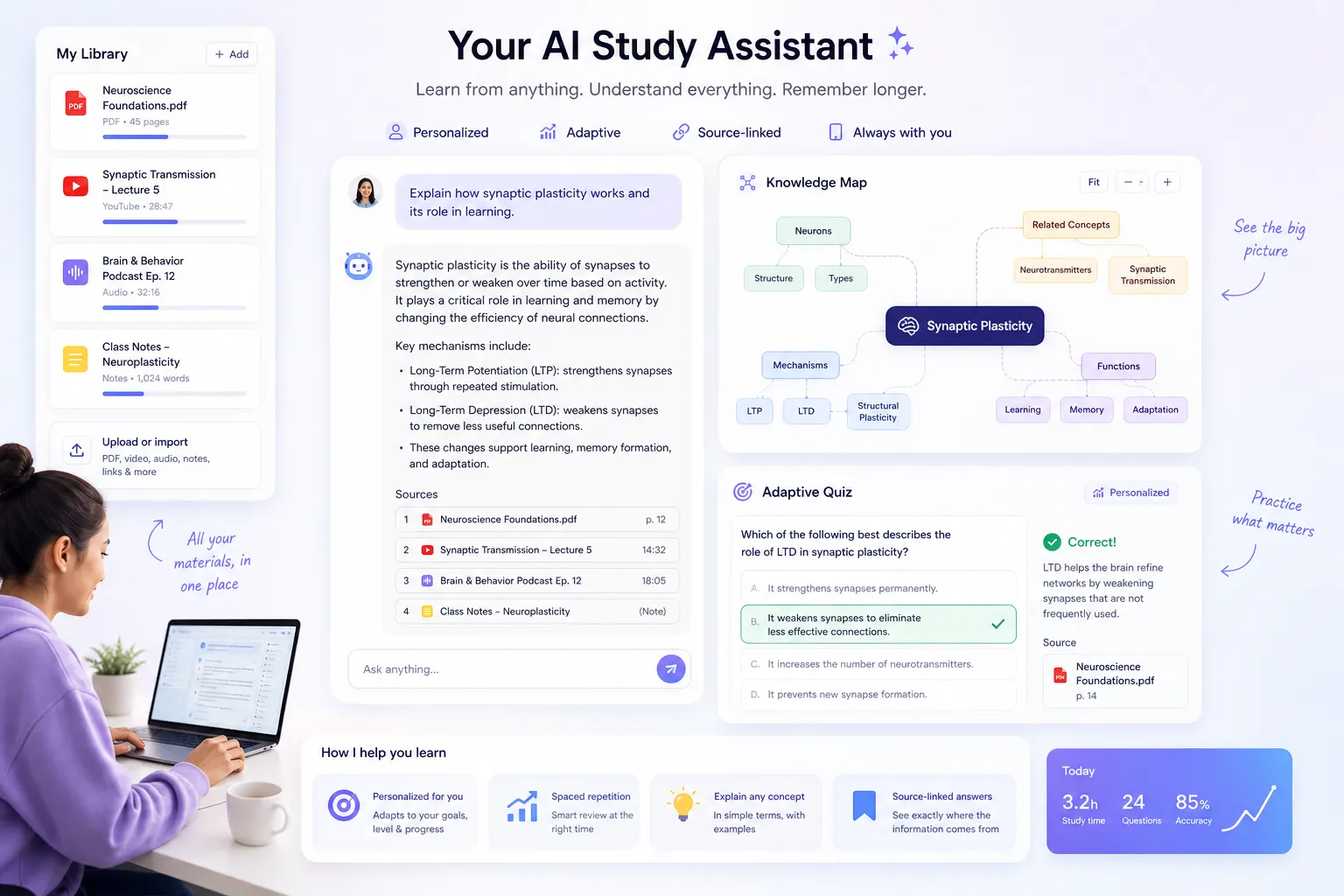
This is where CramAI’s model is especially compelling. It is not just an AI chat interface. It is an all-in-one AI study and exam prep support system that covers the full cycle:
learn
test
assess
guide
support
Users can upload PDFs, websites, YouTube videos, audio, slides, and documents. The platform then transforms those materials into personalized study plans, summaries, concept maps, and interactive learning experiences.
For organizations and educators, that also means scalability. Teams can create repeatable, structured learning systems without increasing manual effort. For creators, the same underlying intelligence can support knowledge organization and content generation.
Common Misconceptions About How AI Works
“AI thinks like a human”
Not really. AI detects patterns and calculates probabilities. It can simulate conversation or reasoning, but that does not mean it understands in the human sense.
“AI knows everything”
AI only knows what it was trained on or what it can access. Even advanced models have limits and can be wrong.
“More data always means better AI”
Not necessarily. Better data is often more important than more data.
“AI is objective”
AI can inherit bias from its training data, design choices, and human oversight.
“AI will replace learning”
The better view is that AI should improve learning. It can reduce friction, increase personalization, and surface insight faster, but real understanding still requires active engagement.
How to Think About AI Without Technical Jargon
If you want the simplest mental model possible, think of AI like this:
Data is the experience
Algorithms are the learning method
Training is the practice
Models are the learned ability
Predictions are the output
Feedback is the correction loop
That framework works whether you are thinking about chatbots, recommendation systems, fraud detection, or AI-powered studying.
What Competitor Guides Usually Miss
Most beginner articles cover the basics of narrow AI, machine learning, and real-world use cases. That is useful, but incomplete. They often gloss over the parts that matter most to readers trying to use AI responsibly:
Trust and traceability
Many explain outputs, few explain verification. In education and exam prep, this is crucial.
Cognitive load reduction
AI is not just about automation. For learners, one of the greatest benefits is deciding what not to focus on.
Adaptive learning strategy
Static summaries are not enough. Strong educational AI should adjust study guidance as learner performance changes.
Cross-topic understanding
Many tools help summarize one document. Fewer help connect ideas across multiple sources and formats.
Multimodal learning
Real learners do not study from one format alone. They use PDFs, videos, voice notes, web links, slides, and practice questions. AI needs to support that reality.
CramAI addresses these gaps directly, which is why it fits naturally into the future of AI-powered education technology.
A Practical Example: How AI Works in a Study Session
Let’s make this concrete.
Imagine a student preparing for an important exam. They upload:
lecture slides
textbook chapters in PDF
a YouTube lecture
class notes
audio revision recordings
An AI-powered platform like CramAI can then:
extract the core concepts from each source
identify recurring topics and dependencies
build a personalized study plan based on time available
generate summaries and linked concept views
quiz the learner dynamically
detect weak areas from assessment performance
adapt the next study steps in real time
answer questions with source-backed traceability
That is a much stronger use of AI than simply asking a chatbot for a generic summary. It brings structure, evidence, and adaptation to the entire learning process.
The Future of AI for Beginners, Students, and Professionals
AI is becoming a layer across almost every workflow, including learning, research, communication, planning, and knowledge management.
For learners, the biggest shift is not that AI can answer questions. It is that AI can increasingly help people:
study strategically
personalize revision
understand faster
retain more
act on feedback sooner
For professionals, the same logic applies to certification prep, upskilling, and ongoing development. For educators and creators, AI makes it easier to organize expertise, generate educational assets, and scale impact.
The winners in this shift will not be the people who simply use AI casually. They will be the ones who use it with structure, verification, and purpose.
Final Takeaway
If you came here asking ai how does it work, the essential answer is clear: AI learns from data, detects patterns through algorithms, improves through training, and produces outputs that help with prediction, classification, or content generation.
But the more useful answer is this: AI works best when it is applied to a real problem with high-quality inputs, transparent outputs, and an adaptive feedback loop.
That is especially true in learning.
CramAI brings those principles together in one platform. It helps students, exam candidates, professionals, educators, and organizations move beyond generic AI use into something far more effective: personalized study plans from uploaded materials, source-anchored answers with traceability, concept linking across topics, dynamic assessments, real-time study strategy adjustment, and creator tools for knowledge organization and content generation.
If you want AI to do more than impress you for a moment - if you want it to help you learn smarter, prepare better, and focus on what matters most - CramAI is the place to start.