
AI Quizlet: Smarter Study Tools for Recall
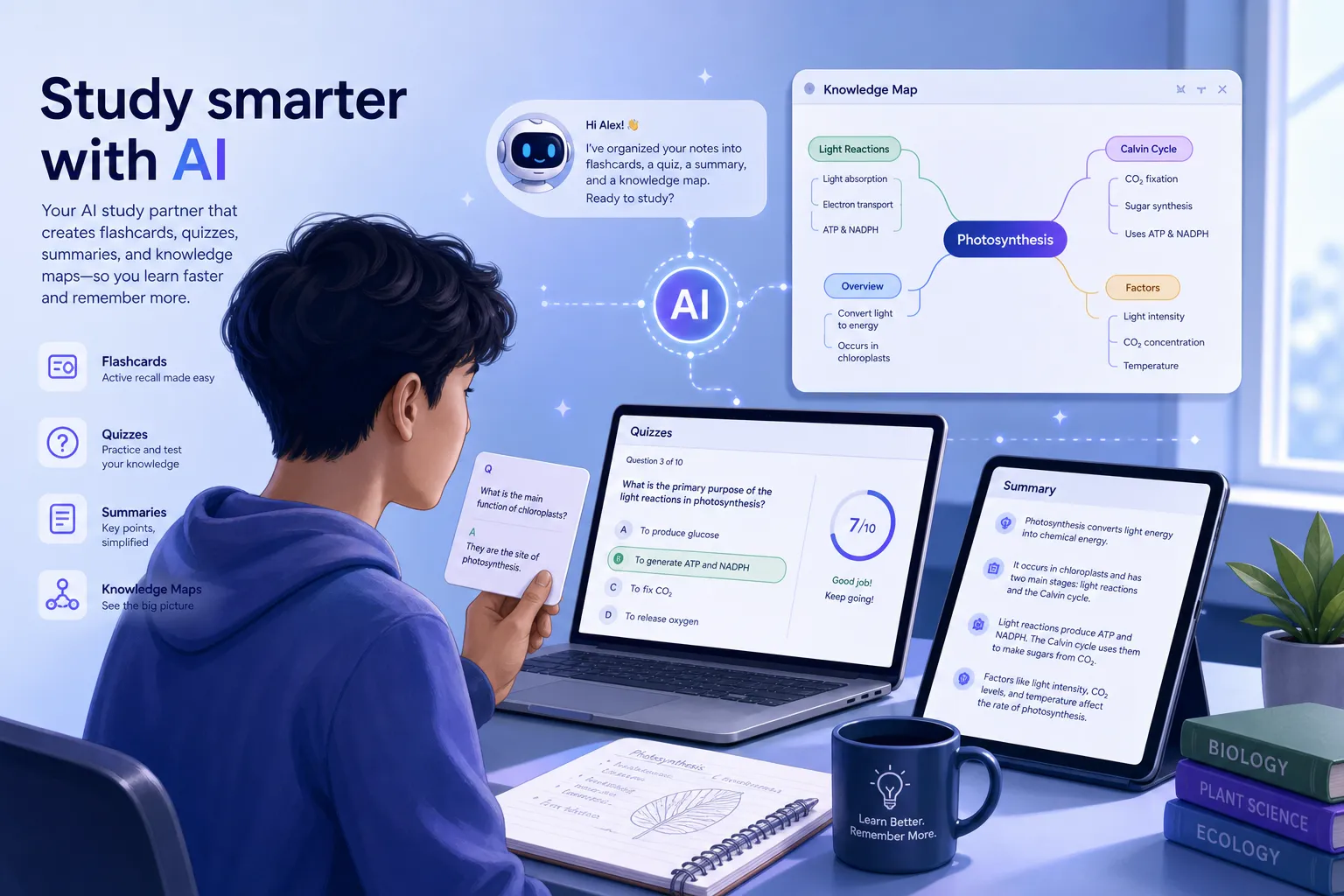
Studying has changed. What used to mean highlighting textbooks, rereading lecture slides, and making last-minute flashcards now increasingly means using AI to turn raw material into something more strategic: practice questions, summaries, concept maps, adaptive review sessions, and targeted feedback.
For students, exam candidates, professionals earning certifications, and even educators building learning content, the appeal of an AI Quizlet-style workflow is simple: less time organizing, more time actually learning. But the real question is not whether AI can help you study. It is whether the tool helps you remember, identify weak spots, and stay grounded in trustworthy source material.
That is where a more advanced platform like CramAI stands out. Instead of stopping at flashcard generation, CramAI supports the full learning cycle: upload materials, generate structured study plans, connect concepts across topics, assess knowledge gaps, and adjust strategy in real time based on performance. It is designed to reduce cognitive overload while improving recall quality.
What People Really Want From an AI Study Tool
Most competing articles focus on the obvious features: AI flashcards, quiz generators, summaries, and maybe spaced repetition. Those are useful, but they are only part of the picture.
What learners actually need is a system that can:
turn messy source material into structured study assets
prioritize what matters most
help them practice retrieval, not just recognize terms
explain confusing concepts in context
show where an answer came from
adapt the plan as weaknesses appear
work across multiple formats, not just typed notes
This is the content gap many study app comparisons miss. A modern learner is not only asking for a flashcard maker. They want an AI study partner that can move from ingestion to recall to assessment to improvement without breaking the workflow.
Why Recall Matters More Than Recognition
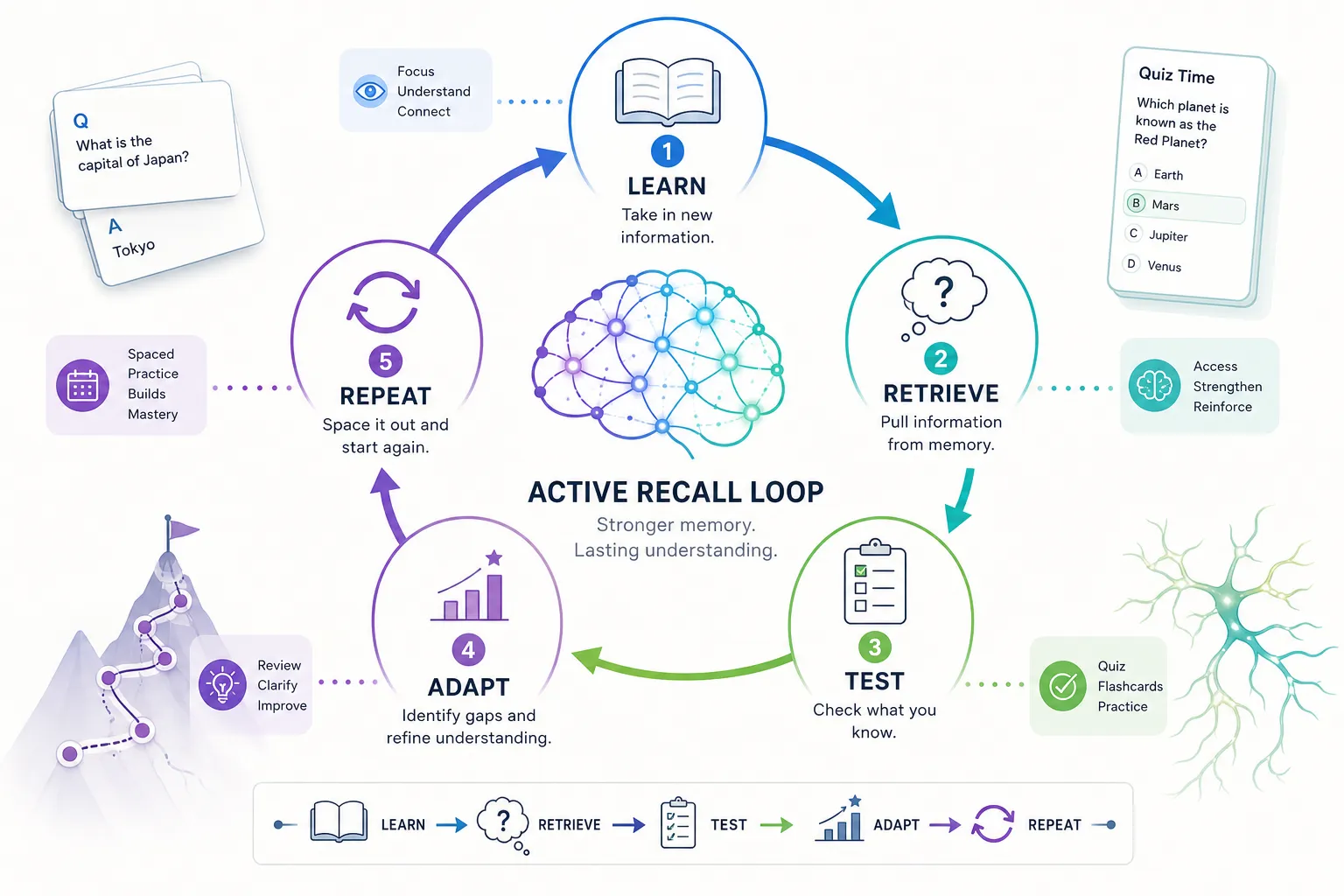
Many students mistake familiarity for mastery. If a term looks familiar on a page, that can feel like learning. But exam performance depends on retrieval, not recognition.
Active recall is the engine behind better memory
When you try to answer a question before seeing the solution, your brain strengthens the pathway needed to retrieve that information later. That is why flashcards, quizzes, and practice tests work best when they force effortful recall.
"Repeated testing during learning enhanced retention relative to repeated studying, with alternating study and test trials producing the best retention." - ScienceDirect
Spaced review makes that recall stick
AI tools become more powerful when they do not just generate content, but also help sequence it over time. Smart review intervals reduce wasted effort and help learners revisit information before it fully fades.
"Expanding retrieval practice promotes short-term retention, but equally spaced retrieval enhances long-term retention." - PubMed
What an AI Quizlet Workflow Usually Includes
The current generation of AI-powered study tools generally revolves around four core functions.
AI flashcard creation
You upload notes, paste text, or provide a document, and the system turns the material into question-and-answer cards. This saves time, especially for dense subjects like biology, law, history, or medicine.
Quiz and practice test generation
Instead of memorizing isolated facts, learners can test themselves with multiple-choice questions, short answer prompts, and mixed-format exams. This is especially useful for standardized test prep and certification study.
Summaries and study guides
Large PDFs, lecture slides, and reading packs can be condensed into digestible notes. This reduces study friction, especially when learners are juggling several modules at once.
Basic AI tutoring or homework help
Some platforms can explain concepts, generate examples, or walk through problems. The quality varies a lot depending on whether the explanations are grounded in your source materials or generated more loosely.
Where Basic AI Study Tools Fall Short
This is where many “AI flashcard” tools feel impressive at first but less effective over time.
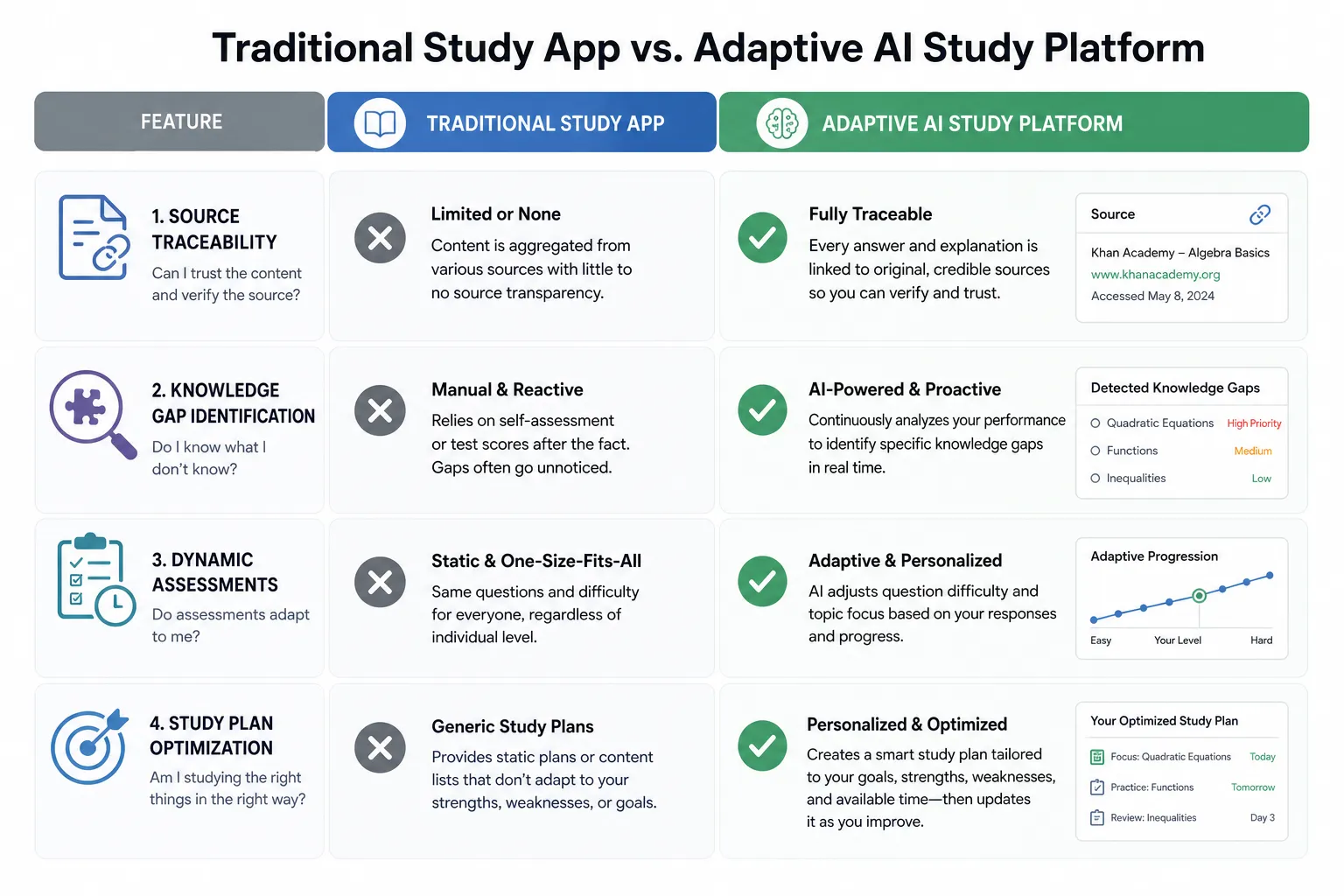
They generate content, but not a strategy
A large deck of flashcards is not automatically a good study plan. Without prioritization, learners end up reviewing everything equally, even though some topics are already strong and others remain weak.
They often lack source traceability
A polished answer is not always a reliable one. If the AI cannot show where a summary, explanation, or answer came from, learners may absorb inaccuracies without realizing it.
They treat topics as isolated chunks
Real learning depends on linking ideas across chapters, lectures, frameworks, formulas, and case studies. Many tools produce fragmented cards without helping the user understand the relationships between concepts.
They do not adapt deeply enough
Some apps generate a quiz, but fewer dynamically adjust the next steps based on actual performance. That means learners still have to manually decide what to revisit, what to skip, and how to change strategy.
What Makes CramAI More Effective for Recall
CramAI is built for learners who want more than one-off AI outputs. It is designed as an all-in-one study and exam preparation platform that supports learning, testing, assessing, guiding, and ongoing support.
Personalized study plans from your real materials
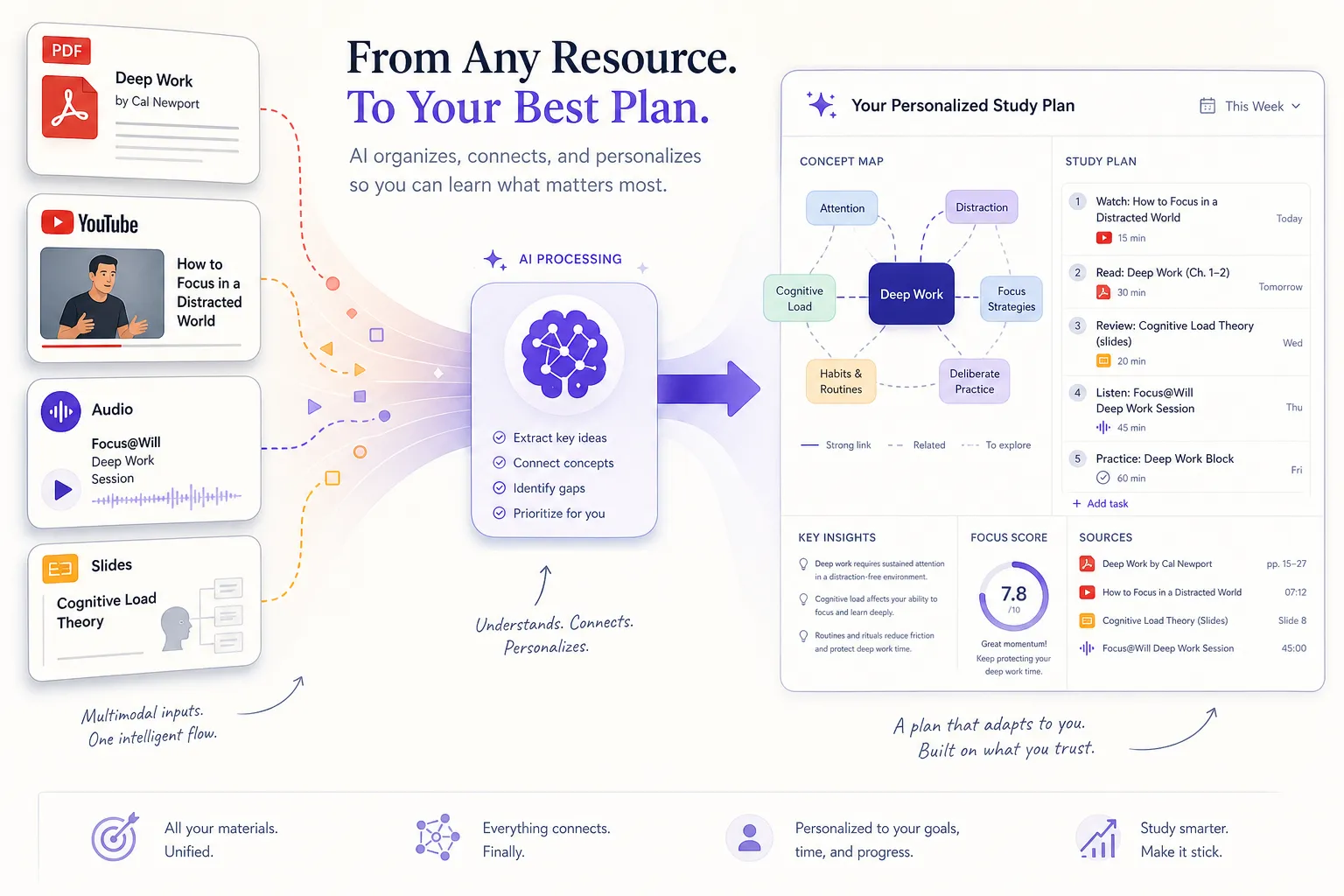
Instead of forcing you to rebuild everything manually, CramAI can work from PDFs, website URLs, YouTube videos, audio, slides, and documents. It transforms those materials into a personalized learning path rather than just isolated notes.
Trustworthy, source-anchored answers
One of CramAI’s strongest differentiators is traceability. Answers can be anchored back to the original source, which helps users verify claims, reduce hallucination risk, and build confidence in what they are studying.
Concept linking across topics
Learning improves when students can see how ideas connect. CramAI helps surface relationships between themes, chapters, and subtopics so that studying becomes a structured knowledge system rather than a pile of disconnected facts.
Dynamic assessments that expose knowledge gaps
CramAI does not just test recall once. It uses assessments to identify what you do not know well, then uses that information to guide what happens next.
Real-time strategy adjustment
As you study, the platform can adjust what to review, what to practice, and where to focus energy. This reduces cognitive load because you do not have to manually micromanage the entire study process.
Scalable for individuals, educators, and organizations
CramAI is useful not only for solo learners but also for institutions, teams, and knowledge creators that need organized, repeatable, AI-assisted learning workflows.
Quizlet AI vs a Full Learning Platform
Quizlet has clearly expanded into AI-powered studying, offering tools for study guides, PDF summarization, flashcard generation, and practice tests. For many users, that makes it a reasonable entry point.
Here is the bigger strategic difference:
Capability | Typical AI flashcard tool | CramAI |
|---|---|---|
AI flashcards | Yes | Yes |
AI quizzes and tests | Yes | Yes |
Summaries and study guides | Yes | Yes |
Source-anchored answers | Limited or inconsistent | Strong emphasis on traceability |
Multi-format input | Often partial | PDFs, URLs, YouTube, audio, docs, slides |
Concept linking across topics | Rare | Built into the learning experience |
Knowledge-gap detection | Basic | Dynamic assessment driven |
Adaptive study planning | Limited | Real-time strategy adjustment |
Cognitive load reduction | Mostly through automation | Through prioritization and adaptive guidance |
Creator and knowledge organization tools | Rare | Included via Creator Studio |
Organizational scalability | Limited | Suitable for individuals and teams |
A look at Quizlet’s AI study tools
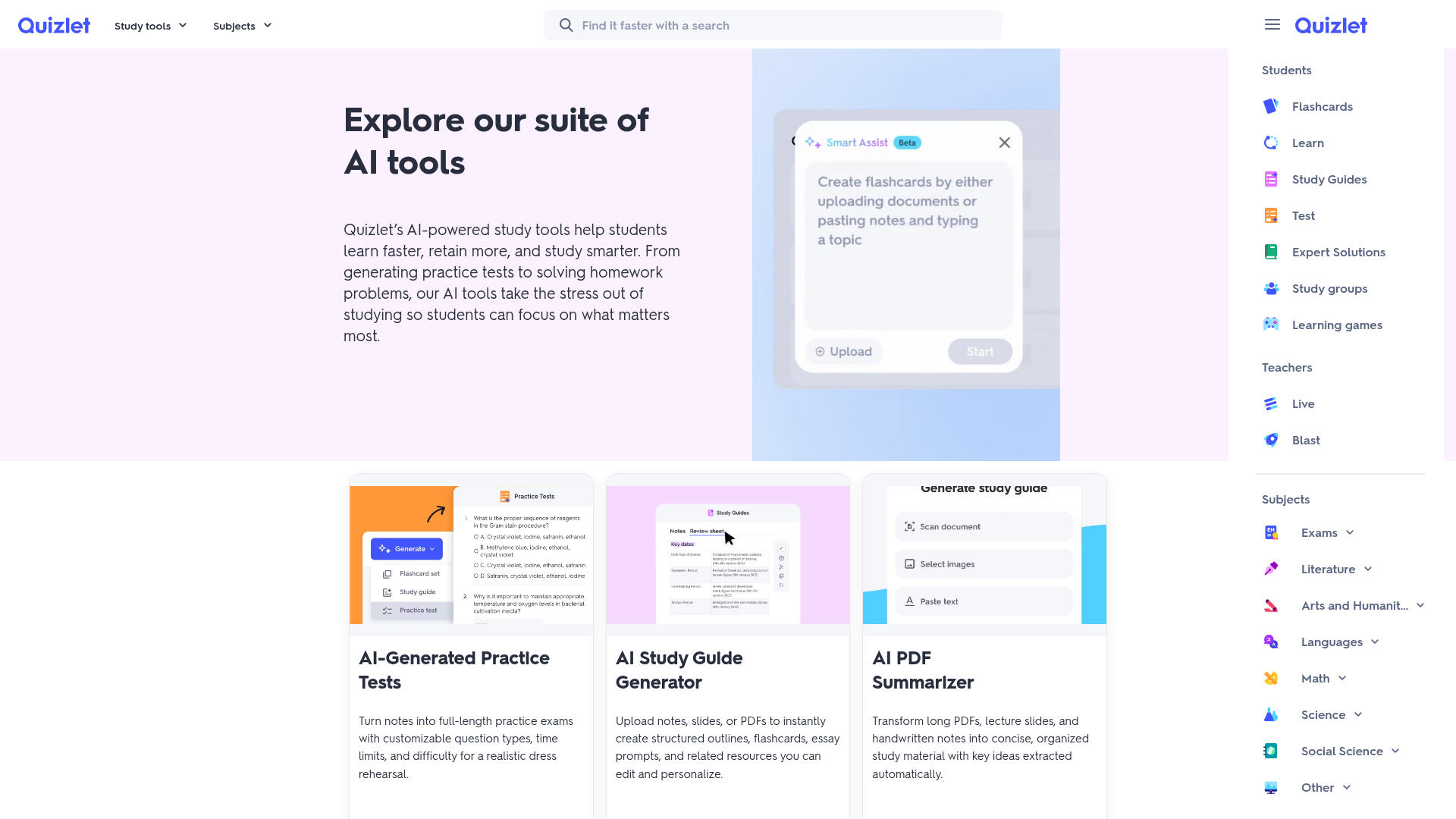
Quizlet remains a recognizable name in digital studying, especially for flashcards. But if your goal is not just content generation but a guided, trustworthy, adaptive system for exam prep and knowledge building, CramAI offers a broader and more strategic workflow.
Best Use Cases for AI-Powered Recall Tools
The biggest advantage of AI study technology is that it can adapt to different learner profiles.
Undergraduate and graduate students
Students often need to consolidate lecture notes, readings, and slides quickly. CramAI helps turn those inputs into structured plans, topic connections, and practice assets without endless manual setup.
Standardized test takers
Whether preparing for IELTS or another high-stakes exam, learners benefit from targeted practice, weakness detection, and rapid feedback loops. This is where dynamic assessment matters more than static flashcards.
Busy professionals and certification candidates
Professionals rarely have time for inefficient review. AI-assisted study planning helps them focus on the highest-yield material and track readiness more efficiently.
Educators and knowledge creators
CramAI’s Creator Studio adds another layer many competitors ignore. Beyond studying, it supports knowledge organization, educational content generation, and personal brand building for experts who want to package and share what they know.
Institutions and enterprise learning teams
Organizations can use AI-driven study systems to scale training, onboarding, and assessment support while keeping learning more personalized.
How to Study Smarter With AI Instead of Just Faster
Speed is useful, but speed alone does not guarantee retention. Here is how to use an AI Quizlet-style tool more effectively.
Start with source-rich material
Upload or connect the most authoritative materials you have: lecture slides, official PDFs, recorded lessons, structured notes, or reputable URLs. The better the source base, the better the outputs.
Generate multiple study formats
Do not rely only on flashcards. Use summaries for orientation, quizzes for retrieval, topic maps for structure, and targeted assessments for diagnosis.
Prioritize weak spots early
The ideal tool should tell you where you are vulnerable. CramAI’s dynamic assessment model helps direct effort where it will produce the highest return.
Use traceability to verify understanding
If an explanation matters, verify the source. This habit is especially important in technical, medical, legal, and exam-critical contexts.
Revisit connected concepts, not just isolated facts
Memorizing one definition may help on a quiz, but understanding how that definition interacts with broader frameworks is what supports transfer and long-term mastery.
A Better Model for Modern Studying
The next generation of learning tools is not just about automating flashcards. It is about creating an intelligent study environment that can:
ingest many content types
transform them into usable learning assets
assess performance continuously
adapt the path forward
keep outputs grounded in real source material
connect ideas for deeper understanding
That is the shift from “study app” to “learning system.”
Final Verdict
If you are exploring AI-powered study tools, Quizlet’s AI features show how mainstream this category has become. But for learners who want stronger recall, better trust, and a more complete exam prep workflow, the bigger opportunity lies in using a platform built around the full learning cycle.
CramAI is compelling because it goes beyond summaries and flashcards. It helps learners build personalized plans from multiple content formats, trace answers back to their sources, identify knowledge gaps, connect concepts across topics, and adapt strategy as performance changes. That makes it not just a productivity tool, but a smarter system for learning what matters and remembering it when it counts.
If you want to study faster and more strategically, CramAI is worth trying as your all-in-one AI study and exam prep partner.
FAQ
What is the best AI tool for active recall?
The best tool for active recall is one that does more than generate flashcards. A platform like CramAI stands out because it combines quizzes, adaptive assessments, source-anchored answers, and personalized study planning to improve memory over time.
Is Quizlet AI still a thing?
Yes, Quizlet AI is still part of Quizlet’s study experience, including tools for flashcards, summaries, study guides, and practice tests. However, learners who want deeper adaptation and stronger source traceability may prefer a broader platform like CramAI.
How do flashcards stimulate recall?
Flashcards work by prompting you to retrieve information from memory before seeing the answer. That retrieval effort strengthens recall pathways, especially when combined with spaced review and targeted feedback.
Is there a better study tool than Quizlet?
For learners who need more than simple card generation, yes. CramAI offers a more complete system with multimodal uploads, concept linking, dynamic assessments, and real-time study plan adjustments.
What is the recall AI tool?
A recall AI tool is software that helps users practice retrieval-based learning through flashcards, quizzes, tests, and adaptive review. The most effective versions also track weak areas and adjust future study sessions automatically.
What is the best way to study for active recall?
The best approach is to use question-based review, spaced repetition, and frequent self-testing from trusted source material. Tools like CramAI make this easier by generating study assets from your materials and adapting the plan based on your performance.