
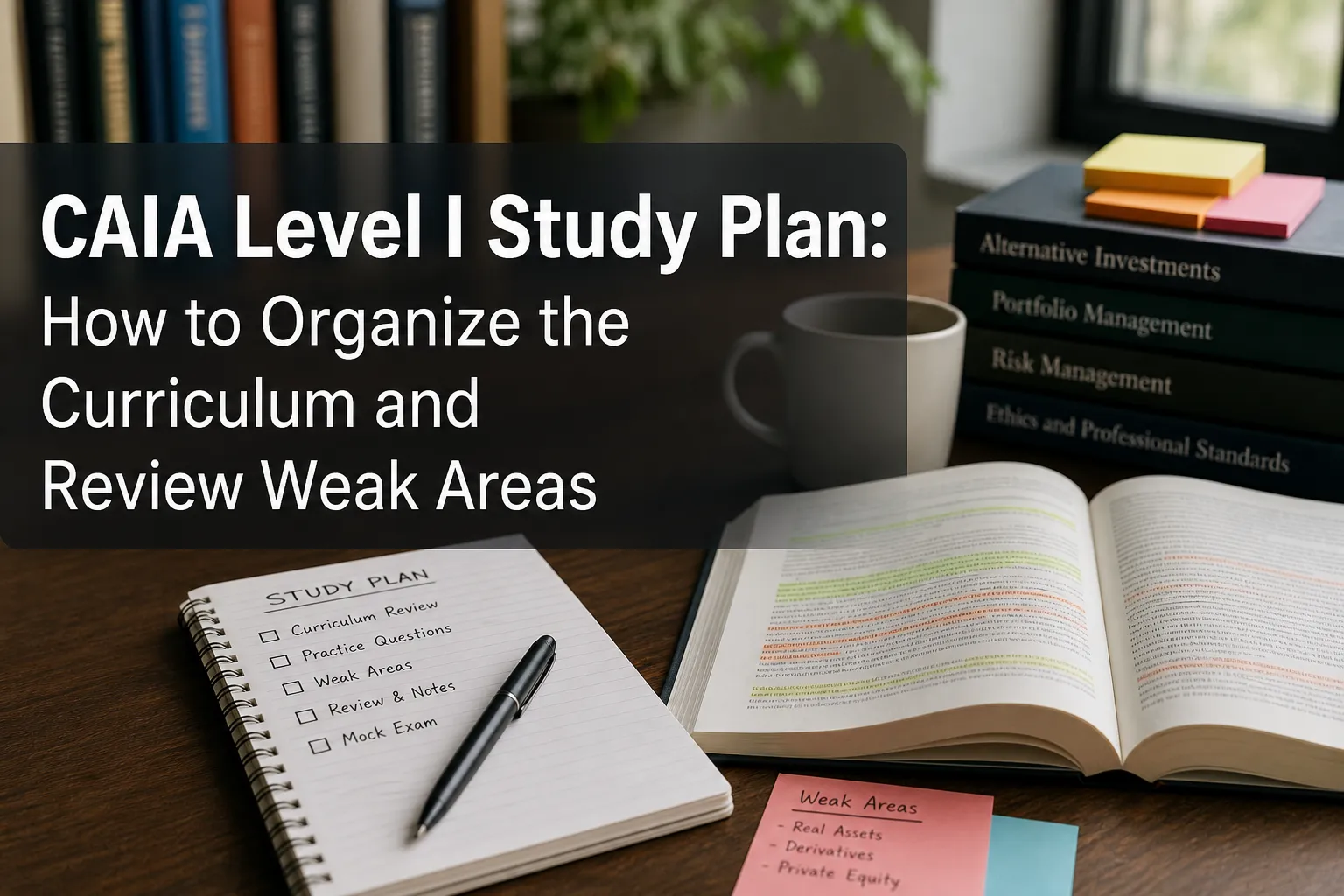
CAIA Level I Study Plan: How to Organize the Curriculum and Review Weak Areas
Preparing for CAIA Level I while working full time usually does not fail because of a lack of effort. It fails because the material lives in too many places at once: official curriculum readings, companion notes, PDFs, handwritten summaries, question banks, sample exams, and random bookmarks you swear you will revisit later.
This guide is built for that exact problem. Instead of offering a generic motivational routine, it gives you a practical system for organizing the syllabus, building a weekly study schedule, converting readings into active recall tools, and using mistakes to drive review. If you want a CAIA Level I study plan that is realistic for busy professionals, this is the framework to use.
"Included with your program registration, the official CAIA digital curriculum is available at no additional cost." - CAIA Association
"The CAIA curriculum is the only written preparation material endorsed by the CAIA Association." - CAIA Association
That matters for your workflow: whatever extra resources you use, your study system should anchor back to the official curriculum for structure, wording, and scope.
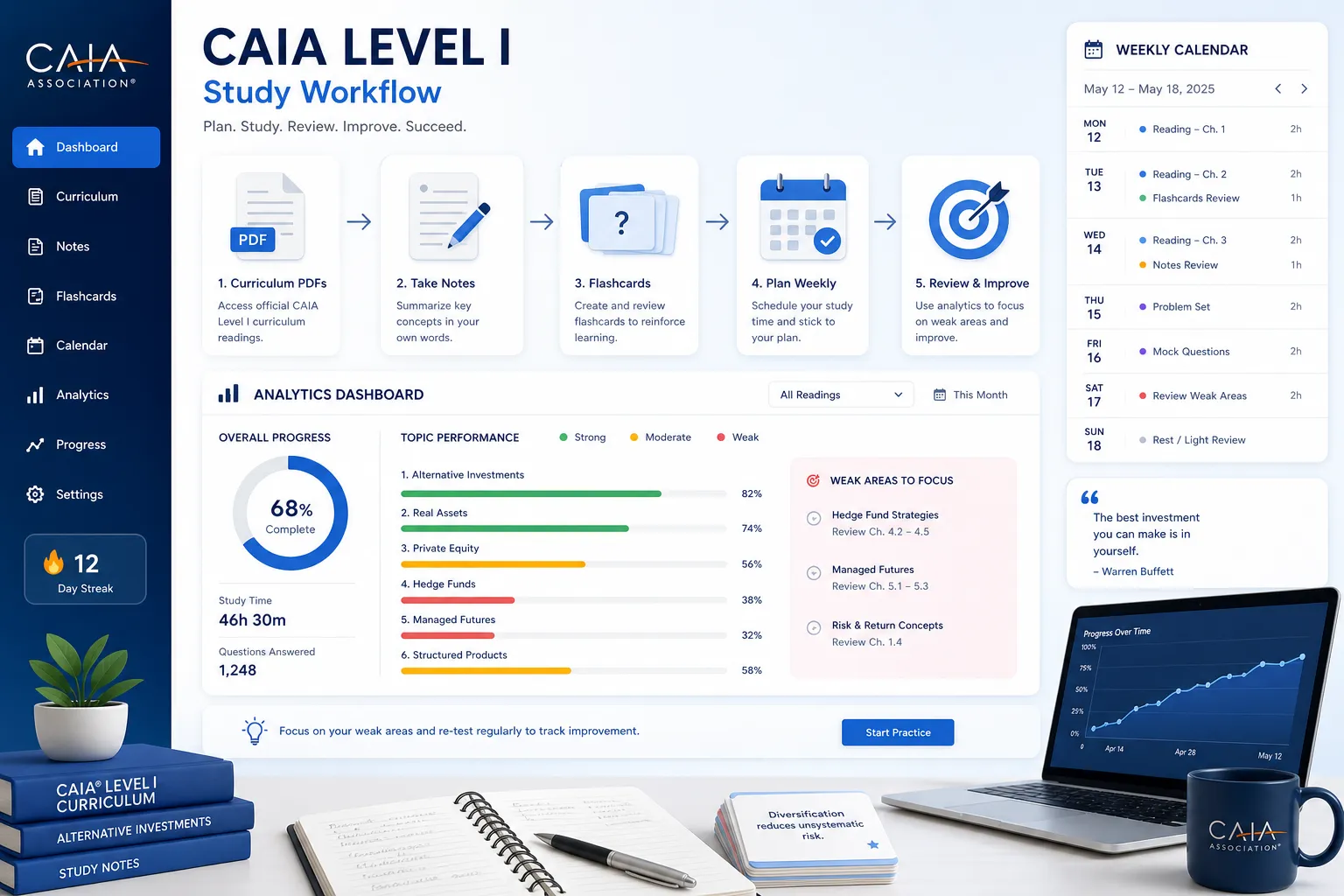
What Competitor Advice Gets Right - and What It Misses
Across leading CAIA prep content, a few themes repeat:
start early
use a structured plan
practice consistently
review weak areas
simulate the exam
All of that is sound. But most articles stop at the advice layer. They tell you to "have a plan" without showing how to manage multiple files and note sources. They tell you to "review weak areas" without explaining how to capture and classify mistakes. They recommend mocks but rarely show how to redesign your weekly workflow when progress slips.
That is the gap this article fills.
The Core Principle: Build One System, Not Five Parallel Systems
A lot of CAIA exam preparation becomes inefficient because candidates unconsciously build separate systems:
one place for reading
one place for notes
one place for flashcards
one place for practice questions
one place for error tracking
The better approach is to create one command center for each topic.
At minimum, every topic should have:
Component | What to store | Why it matters |
|---|---|---|
Source material | Official reading, notes, slides, PDFs | Keeps study anchored to examinable content |
Condensed summary | 1–2 page concept summary | Reduces rereading time |
Active recall tools | Flashcards, self-test prompts, short quizzes | Moves knowledge into memory |
Error log | Missed questions, reason missed, fix required | Turns mistakes into signals |
Review status | Green / yellow / red confidence rating | Helps allocate future time |
If you use CramAI, this is where it fits naturally. You can upload PDFs, notes, slides, URLs, and other materials into one environment, then turn them into summaries, linked topic maps, quizzes, and source-anchored answers. That reduces the mental overhead of jumping between disconnected tools.
Step 1: Organize the Curriculum and Study Materials by Topic
Before you worry about pace, fix your information architecture.
Create a master topic index
Set up one folder or workspace per topic. Inside each topic, keep the same structure every time:
Core reading
Quick summary
Definitions and formulas
Practice questions
Mistake log
Review notes
Consistency matters more than the exact platform.
A simple naming convention helps:
Topic 01 - ReadingTopic 01 - SummaryTopic 01 - Quiz ErrorsTopic 01 - Final Review
Separate “reference” from “revision”
Many candidates pile everything into notes. Do not do that.
Instead:
Reference notes = detailed, used when learning
Revision notes = compressed, used when reviewing
Your revision layer should be tiny compared with the original source. Think in terms of:
key definitions
critical distinctions
common traps
short examples
“if asked X, think Y” prompts
Keep source traceability
This is especially important in a dense curriculum. If a summary point cannot be traced back to the original source, it becomes harder to trust during final review.
One advantage of a platform like CramAI is that it can provide source-anchored responses with traceability, which is useful when you are summarizing from multiple readings and need to verify exactly where an explanation came from.
Step 2: Break the Syllabus Into Weekly Study Blocks
A strong CAIA study schedule is not just a list of readings by date. It should include four motions each week:
learn
compress
test
review
The 7-day study block model
Here is a practical weekly structure for working professionals.
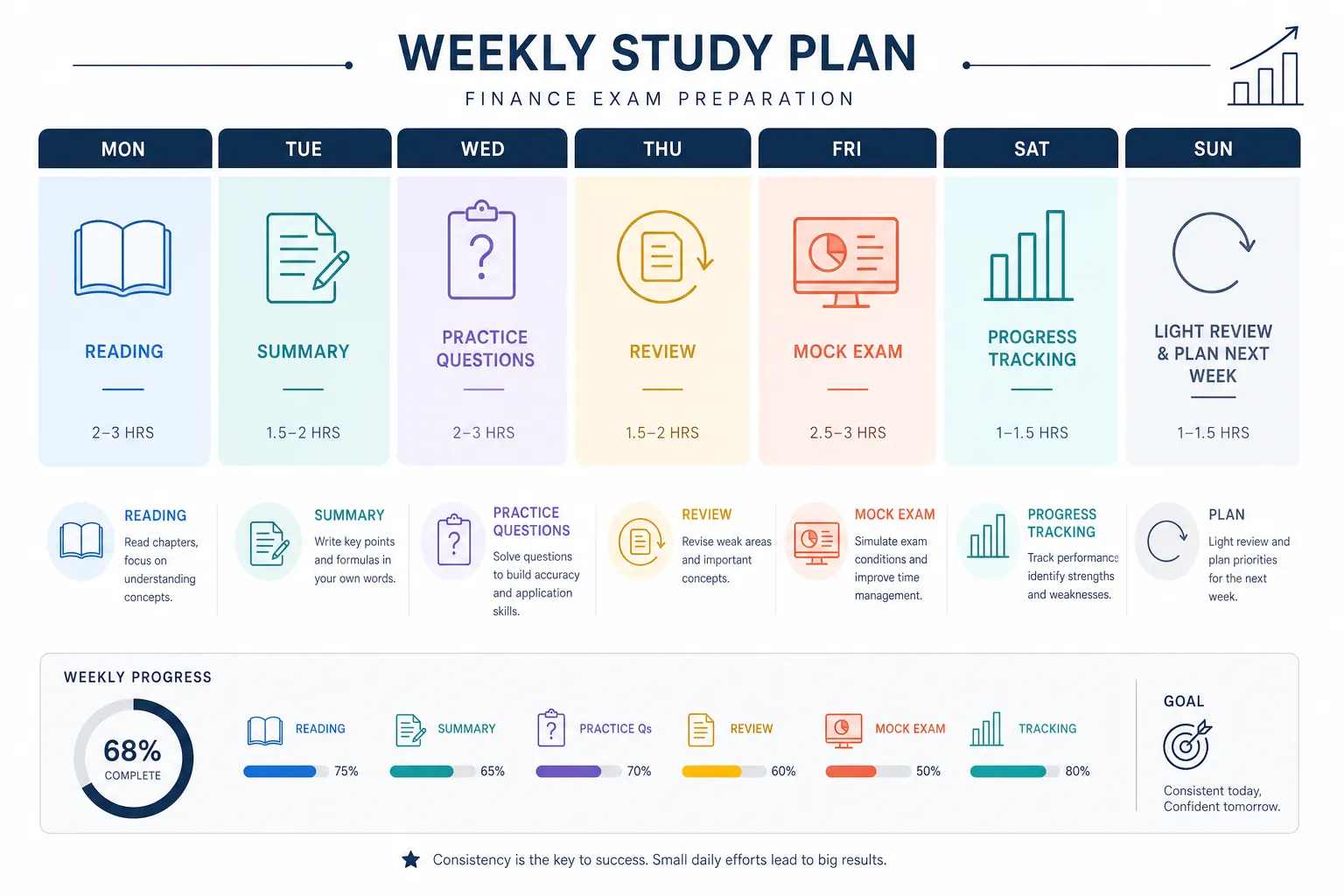
Day | Focus | Output |
|---|---|---|
Day 1 | Read new material | Mark key concepts and unclear areas |
Day 2 | Finish reading | Draft short topic summary |
Day 3 | Active recall | Build flashcards / self-test prompts |
Day 4 | Topic questions | Complete targeted practice set |
Day 5 | Error analysis | Log misses and classify weak areas |
Day 6 | Cumulative review | Review prior topics for retention |
Day 7 | Light reset or catch-up | Clear backlog and plan next week |
This structure works because it avoids the most common trap in how to study for CAIA: finishing readings without converting them into retrievable knowledge.
Use time budgets, not vague intentions
Instead of writing “study Topic 3 this week,” assign hours and outcomes.
Example:
Task | Time budget | Success condition |
|---|---|---|
Reading | 3 hours | Finished section and highlighted key ideas |
Summary | 1 hour | 1-page condensed notes completed |
Flashcards | 45 min | 15–25 cards created |
Practice questions | 90 min | One full topic set completed |
Error review | 30 min | Mistakes tagged and next-step action assigned |
Build buffers from the start
Do not plan every week at 100% capacity. Reserve at least one catch-up block per week. Working professionals lose time to meetings, travel, deadlines, and fatigue. A study plan that assumes perfect consistency usually collapses.
"CAIA Association recommends you aim to spend at least 200 hours preparing for the Level II exam." - Kaplan Schweser
Even if that quote is phrased broadly in prep-provider guidance, the takeaway is useful: serious certification prep requires meaningful time allocation, not last-minute compression.
Step 3: Summarize Long Readings Without Losing Key Concepts
The goal of summarization is not to rewrite the curriculum. It is to create a review asset that preserves what is examinable.
Use the 4-layer summary method
For each reading, create these layers:
Layer 1: The 5-sentence overview
Write:
what the reading is about
why it matters
the major moving parts
what can be confused on exam day
what you must remember
Layer 2: Key terms and distinctions
Focus on:
definitions
pairs that are easy to confuse
process steps
category differences
assumptions and limitations
Layer 3: Question triggers
Write prompts like:
“If the vignette describes X, what concept is being tested?”
“What would make this answer wrong?”
“What is the likely distractor here?”
Layer 4: Memory compression
End with:
5–10 bullet takeaways
any formulas or decision rules
one mini case or example
Do not summarize too early
A weak summary is often created before understanding exists. Read first, then compress. If a reading is complex, explain it aloud before summarizing.
Let AI compress carefully, not blindly
This is where AI can save time if used well. CramAI can help turn long PDFs and notes into concise summaries, but the real advantage is not just shortening text. It is the ability to:
connect related concepts across documents
preserve traceability to source material
reduce cognitive load by surfacing what matters most
That makes summarization faster without turning it into black-box note generation.
Step 4: Turn Study Materials Into Flashcards and Practice Questions
Reading creates familiarity. Questions create recall.
What to convert into flashcards
Best candidates for flashcards:
definitions
concept distinctions
lists and frameworks
formulas or logic sequences
common misconception pairs
Poor candidates for flashcards:
whole paragraphs
overly nuanced essay-length explanations
isolated facts with no context
A good flashcard tests one idea only.
What to convert into practice questions
Use practice questions for:
application
comparison
concept identification
mini case interpretation
error spotting
For each reading, try to generate:
5 easy recall prompts
5 medium concept/application questions
3 “trap” questions based on common confusion
If you use CramAI, this can be streamlined by uploading your source materials and generating:
flashcards
topic quizzes
mock-style questions
adaptive follow-up questions based on mistakes
That is more useful than a static flashcard generator because it supports the full loop: learn, test, assess, guide, support.
Step 5: Track Incorrect Answers and Weak Topics
This is the most important part of the system and the part most candidates underbuild.
Getting questions wrong is not the problem. Failing to extract meaning from wrong answers is.
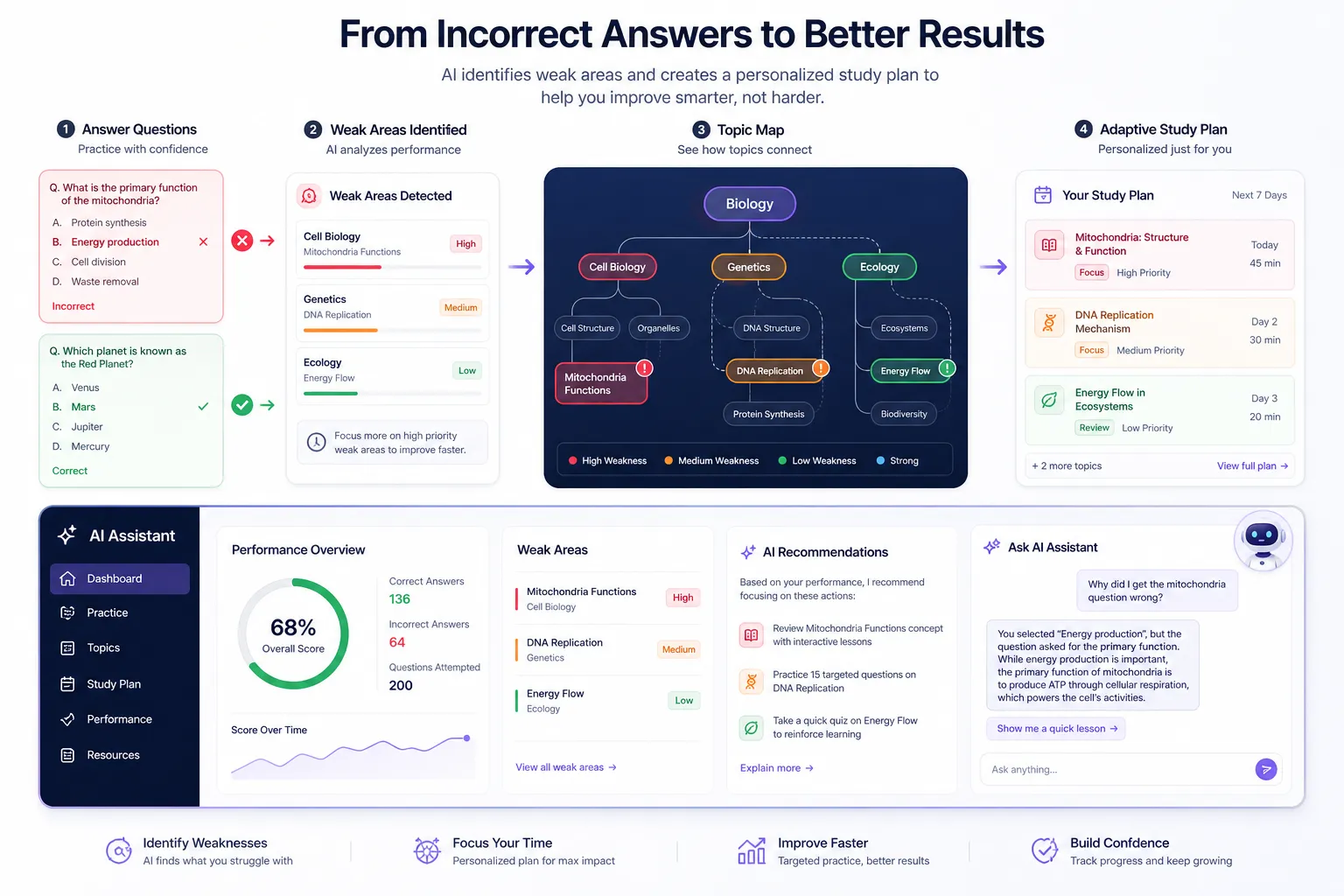
Create an error log with reasons, not just scores
Track every missed question using this structure:
Field | Example |
|---|---|
Topic | Topic 4 |
Subtopic | Risk/return interpretation |
Question source | Sample exam / QB / self-generated |
Error type | Concept gap / misread / rushed / confusion |
What happened | Chose near-correct distractor |
Correct takeaway | Need to distinguish A from B |
Fix action | Re-read summary + do 10 more questions |
Status | Open / reviewed / resolved |
Classify mistakes into four buckets
1. Knowledge gap
You simply did not know the concept.
Fix: go back to source, rewrite summary, retest.
2. Recognition gap
You knew the concept in notes, but did not recognize it in question form.
Fix: do more application questions.
3. Precision gap
You understood the idea, but missed wording, units, scope, or qualifier terms.
Fix: slow down, annotate stems, practice close reading.
4. Execution gap
You got careless, rushed, or mentally fatigued.
Fix: work on pacing, session length, and exam simulation.
Identify weak areas by pattern, not emotion
Candidates often think a topic is weak because it feels difficult. But difficulty is not the same as performance risk.
Flag a topic as weak if:
you miss the same concept more than once
your accuracy stays low after review
you confuse adjacent concepts repeatedly
you avoid the topic in revision
This is where dynamic assessment matters. CramAI’s adaptive workflow can help identify recurring gaps and automatically shift attention toward weaker zones instead of letting you overstudy what already feels comfortable.
Step 6: Plan Cumulative Review and Mock-Exam Sessions
A good CAIA Level I study plan is cumulative. If you only study linearly, early topics decay before exam day.
Use the 1-2-4 review rhythm
After finishing a topic:
review it after 1 day
review again after 2 weeks
review again after 4 weeks
Each review should be short and active:
summary scan
10 flashcards
5–10 questions
note any recurring misses
Schedule cumulative sessions every week
Your weekly block should include at least one cumulative review session covering older material. This prevents the “I finished it, but I forgot it” cycle.
Add mocks in phases
Do not save every mock for the end.
Phase | Goal | Format |
|---|---|---|
Early | Learn question style | Small topic-based sets |
Mid | Test integration | Mixed-topic timed blocks |
Late | Build readiness | Full mock or near-full simulation |
After every mock, run a mock autopsy
Review:
score by topic
time per section
repeated error types
topics missed despite prior review
decision errors under pressure
Then change the plan. A mock is only valuable if it modifies the next two weeks of study.
Step 7: Adjust the Plan When Progress Is Slower Than Expected
This is where most study plans break. Candidates fall behind and react emotionally instead of strategically.
First, diagnose why you are behind
Ask:
Are readings taking too long?
Are notes too detailed?
Are you spending too little time on questions?
Are you studying often but not retaining?
Are work demands reducing usable study energy?
Then choose the right adjustment
If readings are too slow
shorten annotation
summarize in bullet form
use AI support to condense first-pass material
prioritize high-value concepts over perfect notes
If retention is weak
cut rereading
increase flashcards and quizzes
add cumulative review earlier
If practice scores are low
review the error log by pattern
focus on the top 2–3 weak areas only for the next cycle
do smaller, more frequent targeted sets
If time is disappearing
move to minimum effective sessions
45 minutes reading
20 minutes recall
20 minutes questions
10 minutes logging mistakes
A smaller system you actually follow beats a perfect study schedule you abandon.
Use rolling replanning
Every Sunday, answer:
What got completed?
What slipped?
What weak areas emerged?
What must be deprioritized?
What is the one change for next week?
CramAI is especially useful here because it can automatically adjust study strategies in real time based on performance signals rather than leaving you to manually reorganize everything each week.
A Practical 12-Week Example Framework
This is not an official prescription, but a practical model for candidates building a CAIA study schedule around work.
Weeks | Primary focus | Secondary focus |
|---|---|---|
1–2 | Setup + first topics | Build summaries and flashcard system |
3–5 | Core topic coverage | First wave of topic questions |
6–8 | Continue coverage | Cumulative weekly review |
9–10 | Mixed practice blocks | Aggressive weak-area repair |
11 | Mock-heavy review | Error log triage |
12 | Final consolidation | Light revision + exam readiness |
If you have more time, expand the review phases. If you have less time, reduce note perfection and increase active recall density.
The Best Tool Stack Is the One That Reduces Friction
You do not need ten apps. You need a stable workflow.
Minimum viable setup
official curriculum
one notes system
one question source structure
one error log
one weekly tracker
Where CramAI can fit naturally
CramAI is useful when your challenge is not motivation, but study complexity. It helps by combining several tasks in one place:
upload PDFs, slides, URLs, videos, and notes
generate personalized study plans from your own materials
summarize long readings without losing traceability
create flashcards, quizzes, and mock-style questions
surface linked concepts across topics for deeper understanding
identify knowledge gaps through dynamic assessments
adjust review priorities as your performance changes
support individuals, educators, and organizations at scale
That makes it a strong optional layer for candidates who want an AI study planner for CAIA without losing control over sources or structure.
Practical Checklist: Build Your CAIA Level I Study System This Week
Use this checklist before you start your next study cycle.
Setup checklist
Create one master folder or workspace per topic
Store official readings and supporting notes in the same structure
Separate detailed learning notes from condensed revision notes
Create a simple weekly tracker
Build an error log with cause categories
Weekly execution checklist
Read new material
Write a short summary after each reading
Turn key concepts into flashcards
Complete topic-based practice questions
Review and classify every incorrect answer
Revisit one older topic in a cumulative review block
Replan the next week based on actual progress
Mock and review checklist
Start mixed-topic sessions before the final weeks
Run a full review of every mock
Track recurring weak concepts, not just low scores
Cut low-value note rewriting if you fall behind
Increase targeted practice where mistakes repeat
Final Takeaway
The strongest CAIA Level I study plan is not the most detailed one. It is the one that reliably converts reading into recall, recall into performance, and mistakes into better decisions.
If you are managing multiple curriculum readings, PDFs, notes, and question sources, your biggest advantage is not more effort. It is better study architecture.
CramAI can support that architecture by turning scattered materials into a unified, adaptive study system with source-anchored explanations, dynamic assessments, and personalized review workflows. If you want less friction, sharper prioritization, and a more intelligent way to review weak areas, it is a practical tool worth trying.
FAQ
Is CAIA level 1 difficult?
CAIA Level I can feel difficult if your study process is fragmented or too passive. For most candidates, the challenge is less about any single reading and more about consistently organizing materials, practicing retrieval, and repairing weak areas over time.
How long does it take to study for CAIA Level 1?
It depends on your background and schedule, but most candidates should plan for a multi-month study window rather than cramming. A realistic approach is to spread preparation across weekly study blocks that include reading, summarizing, practice questions, and cumulative review.
How to prepare for CAIA level 1?
The best approach is to use a structured study system: organize materials by topic, break the syllabus into weekly blocks, summarize each reading, generate flashcards and practice questions, and keep an error log to track weak areas. Then use cumulative reviews and mock exams to refine your plan.
Is CAIA harder than CFA?
They test different scopes, so there is no universal answer. For most candidates, CAIA is best judged on its own demands: alternatives-focused content, disciplined review, and effective execution under time pressure.
What is harder, CAIA or CFA?
That depends on your background, experience, and learning style. Instead of comparing labels, focus on building a workable exam preparation system that helps you manage readings, active recall, mock practice, and weak-topic review.
Is CAIA equivalent to a master's degree?
No, the CAIA designation is a professional credential, not an academic master’s degree. It is best viewed as a specialized certification pathway that validates knowledge in alternative investments rather than a substitute for a university degree.