

CFA: What It Is, Why It Matters, and How to Pass Smarter
If you are exploring the CFA because you want a stronger finance career, a globally respected credential, or a clearer route into investment analysis, portfolio management, or wealth advisory, you are in the right place.
The challenge is not just understanding what the Chartered Financial Analyst program is. It is figuring out whether it is worth your time, how hard it really is, what the exams test, and how to study without drowning in hundreds of hours of material. That is where a modern, AI-powered study system becomes a real advantage.
For students, certification candidates, career-switchers, and working professionals, the biggest pain points are familiar: too much content, unclear priorities, weak retention, and inefficient revision. A platform like CramAI helps solve those problems by turning dense finance materials into personalized study plans, source-anchored explanations, dynamic assessments, and connected concept maps that make the curriculum easier to master and review.

What Is the CFA?
The CFA, or Chartered Financial Analyst, is a professional credential offered by the CFA Institute. It is widely recognized in investment management, equity research, portfolio management, wealth management, and other areas of finance.
The program is designed to build deep competence in:
ethics and professional standards
quantitative methods
economics
financial statement analysis
corporate finance
equity investments
fixed income
derivatives
alternative investments
portfolio management and wealth planning
In simple terms, the CFA is for people who want to prove they can analyze investments rigorously and apply that knowledge ethically in real-world financial decision-making.
Why the CFA Still Carries So Much Weight
Many finance credentials are specialized. The CFA stands out because it combines breadth, depth, and credibility.
It is respected because the program requires candidates to demonstrate:
mastery across core areas of investment analysis
consistent performance across three exam levels
commitment to professional ethics
relevant work experience before becoming a charterholder
That combination makes it valuable to employers looking for professionals who can think analytically, communicate clearly, and operate within high standards of conduct.
"As of July 2026, there are over 200,000 CFA® charterholders worldwide, representing 97% of CFA Institute members." - CFA Institute
For candidates, that scale matters. It means the designation is not niche or local. It is part of a global professional network.
Who Should Consider the CFA?
The CFA is usually a strong fit for people pursuing roles such as:
investment analyst
equity research associate
portfolio manager
wealth manager
asset allocator
risk professional
institutional consultant
private markets professional
family office analyst
It can also benefit:
undergraduate or graduate students preparing for finance careers
professionals moving from accounting, banking, or consulting into investments
global candidates seeking a portable credential
lifelong learners who want structured mastery of modern finance
If your work depends on evaluating securities, constructing portfolios, advising clients, or understanding capital markets at a deep level, the CFA is highly relevant.
What Competitor Content Often Misses
Most CFA content explains the basics: three levels, hard exams, good career value. But it often glosses over the issues that matter most to real candidates.
The biggest content gaps
1. The CFA is not just an exam sequence
A lot of articles reduce the process to “pass three tests.” In reality, candidates are also building long-term professional judgment, discipline, and ethical reasoning.
2. Study strategy matters as much as study volume
People often assume success comes from reading more. In practice, success often depends on identifying weak areas early, adapting faster, and reviewing with better recall systems.
3. Modern learners need multimodal preparation
Candidates now use PDFs, videos, notes, slide decks, audio, and question banks. Most articles do not address how to unify those resources into one reliable workflow.
4. Trust in explanations matters
Generic AI tools can summarize content, but finance candidates need traceable answers anchored to source materials. That is especially important in high-stakes topics like ethics, valuation, and portfolio decisions.
5. Institutions and teams also need scalable prep systems
Most content is written only for solo candidates. But training providers, universities, and firms also need ways to organize content, monitor progress, and personalize learning at scale.
That is where CramAI creates a meaningful edge. Instead of forcing candidates to manually organize scattered content, it can transform uploaded materials into tailored study plans, knowledge maps, and adaptive assessments that focus effort where it matters most.
CFA Requirements at a Glance
To become a CFA charterholder, candidates generally need to:
meet the enrollment eligibility requirements
pass all three CFA exam levels
complete the required work experience
become a CFA Institute member
commit to the Code of Ethics and Standards of Professional Conduct
The exact rules can evolve, so candidates should always verify current details with the CFA Institute.
A quick overview
Requirement | What it means |
|---|---|
Education / eligibility | Bachelor’s degree, final-stage university status, or qualifying work/education combination |
Exams | Pass Level I, Level II, and Level III |
Work experience | 4,000 hours of relevant experience over at least 3 years |
Membership | Apply for membership with professional references |
Ethics | Commit to CFA Institute ethical standards |
"The CFA Program consists of three levels: Level I, Level II, and Level III." - CFA Institute
How the CFA Exam Is Structured
The CFA exam is designed as a progressive system. Each level tests a different stage of competence.
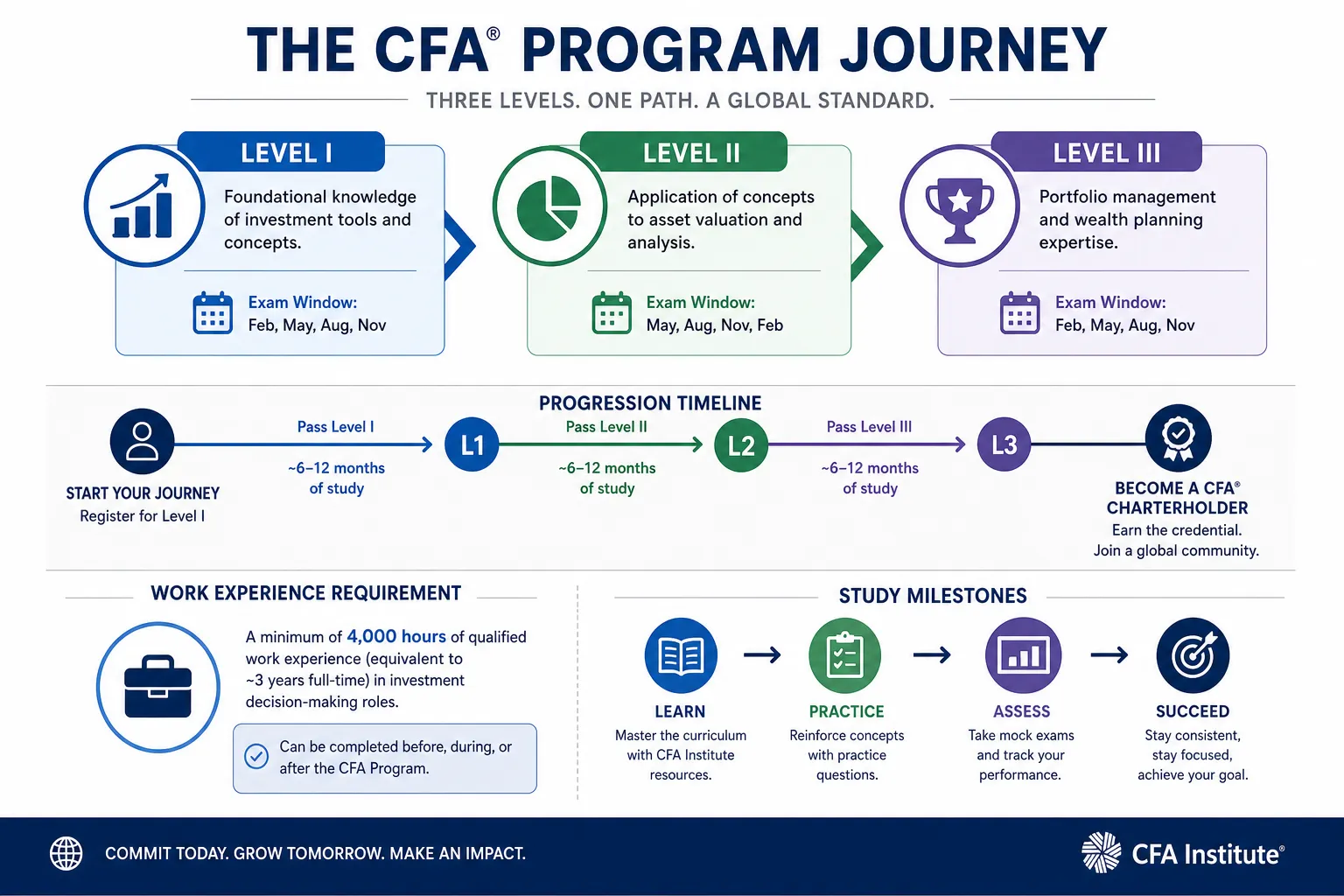
Level I
Level I focuses on core knowledge and foundational tools. It tests whether you understand the language, frameworks, and quantitative building blocks of finance.
This is where candidates encounter a wide mix of topics, often for the first time in a formal and standardized way.
Level II
Level II moves deeper into application and valuation. Instead of only knowing formulas or concepts, candidates must interpret data, analyze scenarios, and value assets with more sophistication.
This level is often considered a major jump in difficulty because it demands tighter integration across topics.
Level III
Level III emphasizes portfolio management and practical decision-making. Candidates are expected to synthesize concepts, justify choices, and apply judgment in individual and institutional contexts.
This final level is less about isolated facts and more about how well you can think like an investment professional.
CFA Curriculum: What You Actually Study
The CFA curriculum is broad by design. It prepares candidates for real investment work rather than a narrow technical specialty.
Core topic areas
Topic Area | Why it matters |
|---|---|
Ethics | Essential for professional judgment and compliance |
Quantitative Methods | Supports modeling, probability, statistics, and analysis |
Economics | Builds macro and micro context for markets and decisions |
Financial Statement Analysis | Critical for company evaluation and accounting interpretation |
Corporate Finance | Helps assess capital allocation and business decisions |
Equity Investments | Supports stock analysis and valuation |
Fixed Income | Covers bond markets, pricing, duration, and credit |
Derivatives | Adds hedging, pricing, and risk transfer concepts |
Alternative Investments | Expands into private equity, real estate, and more |
Portfolio Management | Integrates all topics into client and institutional decisions |
A common mistake is treating these as separate silos. The best candidates learn to connect them. For example:
economics influences rates and asset allocation
accounting affects valuation assumptions
derivatives support portfolio risk management
ethics shapes research, communication, and client duty
This is another area where CramAI is especially useful. Its concept-linking and knowledge visualization can help candidates see how topics reinforce one another instead of memorizing them in isolation.
How Hard Is the CFA, Really?
The CFA has a reputation for being difficult for good reason. It requires:
a wide content base
disciplined study over long periods
strong exam technique
analytical reasoning under pressure
retention across multiple connected subjects
But “hard” does not mean impossible. It means the exam punishes passive study.
Why many candidates struggle
Most underperformance comes from one or more of these problems:
reading without active recall
spending too much time on favorite topics
neglecting ethics until late
failing to diagnose weak areas early
relying on summaries without source mastery
not practicing under exam-like constraints
The CFA is less about intelligence alone and more about structured consistency.
The Smarter Way to Prepare for CFA Exams
A winning CFA study system should do more than deliver content. It should reduce friction, improve retention, and continuously reallocate effort toward the highest-impact areas.
What effective CFA prep looks like
Start with source-grounded learning
Candidates need explanations they can trust. This is why source traceability matters. When an answer points back to the exact uploaded reading, slide, transcript, or note, confidence increases and confusion drops.
Build a personalized study plan
Not every candidate starts from the same place. Someone with an accounting background may need less support in financial statement analysis but more in derivatives or portfolio theory.
Study across multiple formats
Real candidates use official readings, notes, question banks, videos, and audio reviews. An effective system should absorb all of that without creating chaos.
Assess constantly
You should not wait until the final month to discover your weak spots. Dynamic quizzes, gap analysis, and pattern tracking make revision far more efficient.
Adapt in real time
If you improve in fixed income but keep missing ethics questions, your study plan should change automatically.
How CramAI supports this workflow
CramAI fits naturally into CFA preparation because it supports the full study cycle:
upload PDFs, notes, slide decks, URLs, YouTube videos, and audio
generate personalized study plans from your actual materials
receive source-anchored answers with traceability
connect concepts across topics for deeper understanding
run dynamic assessments to identify knowledge gaps
automatically adjust study strategy as performance changes
reduce cognitive overload by prioritizing what matters most
For individuals, that means better efficiency. For institutions, tutors, and firms, it means scalable exam-readiness support across many learners.
CFA vs Other Finance Credentials
The CFA is often compared with credentials like the CPA, MBA, CAIA, or FRM. The best choice depends on your target role.
Quick comparison
Credential | Best for | Main focus |
|---|---|---|
CFA | Investment professionals | Asset valuation, portfolio management, ethics |
CPA | Accountants, auditors, tax professionals | Accounting, audit, compliance, tax |
FRM | Risk specialists | Financial risk management |
CAIA | Alternative investment specialists | Hedge funds, private markets, alternatives |
MBA | Broad business leadership | Management, strategy, operations, finance |
If your goal is investment analysis and portfolio-related work, the CFA is often the most directly aligned option.
Is the CFA Worth It?
For the right candidate, yes. But the return depends on fit.
The CFA is usually worth it if you want:
a long-term career in investments
stronger analytical credibility
a globally recognized signal of rigor
a framework for understanding capital markets deeply
access to a respected professional network
It may be less worth it if you want:
a fast credential with minimal study
a role unrelated to investments
a qualification primarily focused on tax or audit
a broad business degree experience rather than a specialist finance pathway
The key is strategic alignment. The CFA is powerful when it matches the career you actually want.
Common Mistakes First-Time Candidates Make
Underestimating the breadth
Many candidates are surprised by how much material must be retained simultaneously.
Overvaluing passive reading
Reading alone creates false confidence. Retrieval practice and application matter far more.
Ignoring ethics until the end
Ethics is not an afterthought. It is central to the program and often decisive.
Studying without a feedback loop
If you are not measuring progress, you are guessing.
Using disconnected resources
Scattered notes, screenshots, and bookmarks increase cognitive load. A unified learning environment is far more effective.
This is exactly why CramAI’s all-in-one approach stands out. Instead of bouncing between tabs, documents, and generic chat tools, candidates can centralize their preparation and keep every answer tied to the original source.
A Practical CFA Study Framework
Here is a simple structure candidates can adapt.
Phase 1: Map the curriculum
Identify all major topics, weightings, deadlines, and confidence levels.
Phase 2: Build a personalized plan
Allocate more time to weak areas and interleave easier topics with demanding ones.
Phase 3: Learn actively
Summarize, retrieve, explain, and apply. Do not just highlight.
Phase 4: Test frequently
Use short assessments to surface weaknesses before they become expensive.
Phase 5: Link concepts
Study relationships, not isolated chapters.
Phase 6: Revise strategically
Shift from content accumulation to selective reinforcement and exam execution.
With CramAI, much of this process can be automated or accelerated through adaptive planning, knowledge mapping, and real-time gap detection.
Why AI Is Becoming Essential in High-Stakes Exam Prep
The CFA curriculum is exactly the kind of challenge where AI can create leverage - if it is used correctly.
The right kind of AI support should provide:
trustworthy outputs anchored to source materials
personalization based on the learner’s current level
multimodal input support
ongoing diagnosis of weak areas
efficient condensation of dense content
flexible study strategy adjustments
The wrong kind of AI support creates risk
Candidates should be careful with tools that:
provide answers without citations or traceability
flatten nuance in technical finance topics
encourage overreliance on generic summaries
cannot connect explanations to the original learning source
That distinction matters. CramAI is built around trustworthy, source-anchored learning support rather than generic output generation, which makes it much better suited for exam preparation where precision matters.
CFA for Organizations, Educators, and Knowledge Creators
The CFA conversation usually centers on individual candidates, but there is a broader opportunity.
For universities and training providers
CramAI can help organize curriculum materials, generate structured learning pathways, and support cohorts with adaptive review systems.
For enterprise teams
Firms can scale finance training and certification support using centralized study assets, dynamic assessments, and personalized plans.
For educators and creators
CramAI’s creator tools support knowledge organization, educational content generation, and personal brand development around finance expertise.
That makes it more than a study helper. It becomes a learning infrastructure layer for modern finance education.
Final Verdict
The CFA remains one of the most respected credentials in finance because it signals analytical depth, ethical commitment, and professional seriousness. It is demanding, but for investment-focused careers, few designations offer the same combination of rigor and global recognition.
The real differentiator now is not just whether you study hard, but how you study. Candidates who use adaptive, source-grounded, multimodal systems can prepare more strategically, reduce wasted effort, and build deeper understanding across the curriculum.
If you want to tackle the CFA with more clarity, less cognitive overload, and a smarter path from material to mastery, CramAI is built for exactly that. Upload your readings, notes, videos, and slides, turn them into an intelligent study system, and prepare with the kind of evidence-based support today’s high-performing learners actually need.
FAQ
What does the CFA stand for?
CFA stands for Chartered Financial Analyst. It is a globally recognized professional credential offered by the CFA Institute for investment and finance professionals.
What does a CFA do exactly?
A CFA typically works in areas such as investment analysis, portfolio management, equity research, wealth management, or related finance roles. The designation signals strong capability in valuation, markets, portfolio decisions, and ethical practice.
Is CFA harder than CPA?
They are difficult in different ways, so there is no universal answer. In general, the CFA is often seen as more intensive for investment analysis and long-form study endurance, while the CPA is more specialized around accounting, audit, and regulation.
Is CFA so hard?
Yes, the CFA is considered challenging because it covers a broad curriculum, requires deep application, and demands sustained discipline across three levels. Most candidates struggle more from inefficient study methods than from lack of ability.
Is CFA harder than the CPA?
For many candidates pursuing investment careers, the CFA feels harder because of its breadth, cumulative structure, and heavy emphasis on valuation and portfolio thinking. But the better comparison is which credential aligns more closely with your target career path.
What is a CFA average salary?
CFA compensation varies widely by role, geography, and seniority, so there is no single universal average. In general, charterholders often pursue roles with strong earning potential in asset management, research, advisory, and portfolio management.