
Make Your Own Flashcards Online Free in 2026
If you want to learn faster in 2026, digital flashcards are still one of the smartest tools available - but only if you use them well.
A lot of learners try to make their own flashcards online, then end up with messy decks, passive memorization, and way too many cards that never get reviewed at the right time. The problem usually is not the flashcard format itself. It is the workflow behind it: what to include, how to structure cards, when to review, and how to connect memorization with real understanding.
That matters whether you are an undergraduate cramming for finals, a graduate student building long-term retention, an IELTS candidate improving recall, a professional preparing for certifications, or an educator creating scalable learning assets for a class or team.
The best modern approach is no longer just “flip cards and repeat.” It is a full study system: source-based notes, smart card generation, adaptive review, knowledge-gap detection, and study plans that update as your performance changes. That is exactly where AI-powered platforms like CramAI can create a major advantage - turning PDFs, videos, websites, slides, and documents into personalized study flows instead of isolated cards.
What the Top Flashcard Platforms Get Right in 2026
The leading flashcard platforms all converge around a few winning ideas:
spaced repetition improves long-term retention
mobile and web access matter because learners study in short bursts
importing content saves time
pre-made decks help beginners start faster
AI can accelerate flashcard creation
teachers and teams need easy sharing
From competitor analysis, three patterns stand out:
Platform | Core Strength | Best For | Limitation |
|---|---|---|---|
Brainscape | polished spaced repetition and curated content | serious learners and exam prep | stronger on flashcard study than full-source learning workflows |
Flashcards World | free access, FSRS scheduling, offline sync | budget-conscious self-studiers | lighter on broader study orchestration and source-traceable reasoning |
Cram | huge library of student-made sets and simple creation | quick discovery and casual study | quality can vary widely across public decks |
The content gaps most articles miss
Most “make flashcards online free” articles stop at app features. They rarely explain:
How to write high-retention flashcards
When to use flashcards vs summaries vs practice questions
Why source traceability matters in AI study tools
How to avoid cognitive overload from over-creating cards
How flashcards fit into a complete exam-prep workflow
How creators, teachers, and organizations can operationalize flashcards at scale
That is where this guide goes further.
Why Online Flashcards Still Work So Well
Flashcards succeed because they support two evidence-based learning principles: retrieval practice and spaced review.
"The findings indicated that spaced repetition significantly improved learner performance in objective tests compared to standard studying techniques, with a standardized mean difference of 0.78." - The Clinical Teacher
In plain English: reviewing the right information at increasing intervals helps knowledge stick better than standard review habits.
"A 2021 meta-analysis encompassing 218 studies with over 47,000 participants found that students who engaged in self-testing retained approximately twice as much material as those who merely re-read the content." - QuantaPrep
That is why learning flash cards online can outperform passive re-reading, highlighting, or endless note review.
The Best Way to Make Flashcards Online in 2026
The best way to make flashcards online is not to manually type every fact from scratch. It is to combine:
high-quality source material
selective card creation
active recall design
spaced repetition
continuous refinement based on weak areas
The old way
The old workflow usually looks like this:
Read a chapter
Copy definitions into cards
Review too many low-value facts
Forget to revisit the deck consistently
Cram before the exam
The new way
The better workflow looks like this:
Upload or collect your source materials
Extract key concepts, terms, and likely testable points
Generate draft flashcards quickly
Edit for clarity and difficulty
Study with spaced repetition
Diagnose weak spots
Adapt the next round of review based on performance
This is where CramAI becomes more than a flashcard tool. Instead of just helping you create flashcards online for free, it supports the full cycle: learn, test, assess, guide, and support. You can work from PDFs, URLs, YouTube videos, audio, slides, and documents, then turn them into personalized study plans, summaries, linked concepts, and dynamic assessments - not just isolated card decks.
How to Make Your Own Flashcards Online Free, Step by Step
1. Start with the right source material
The quality of your flashcards depends on the quality of your input. Use:
lecture slides
textbook chapters
syllabus points
class notes
past exam topics
article summaries
certification outlines
transcripts from lectures or videos
If you are using AI, source anchoring matters. CramAI’s traceable answers are especially valuable here because they help you verify where a concept came from, reducing the risk of studying hallucinated or decontextualized material.
2. Decide what deserves a flashcard
Not everything should become a card. The best candidates are:
definitions
formulas
anatomy labels
vocabulary
cause-and-effect relationships
short processes
laws, dates, and principles
common exam traps
distinctions between similar concepts
Avoid making cards for content that needs long-form explanation unless you can break it into smaller recallable chunks.
3. Use one question per card
Good flashcards are focused. A weak card tries to test too much at once.
Weak card:
“What are the causes, symptoms, diagnosis, and treatment of asthma?”
Better approach:
What is asthma?
What triggers bronchoconstriction in asthma?
What is a common symptom of asthma?
Which test is commonly used to assess asthma?
What is a first-line reliever medication?
4. Write cards that force recall, not recognition
Recognition is easy. Recall is what builds memory.
Instead of:
“Asthma is a disease of the ___”
Try:
“Which body system is primarily affected by asthma?”
Instead of:
“Photosynthesis definition”
Try:
“What is the primary purpose of photosynthesis in plants?”
5. Keep answers short
Short answers are easier to review at scale. If the answer needs a paragraph, split it into multiple cards.
6. Add context when confusion is likely
Short does not mean vague. If a concept is easily confused, include enough context to make the cue precise.
7. Review based on performance, not mood
This is why spaced repetition matters. Reviewing only the cards you “feel like” studying wastes time. Use scheduling that prioritizes weak material.
A Smarter Alternative to Manual Deck Building
Many learners still want to make their own digital flashcards manually, and that can work well for deep processing. But manual-only workflows do not scale.
If you are preparing for:
medical exams
bar exams
engineering certifications
language tests
large university finals
enterprise onboarding or compliance learning
You need faster systems.
CramAI helps reduce cognitive load by focusing attention on what matters most. Instead of dumping hundreds of random cards into your queue, it can help transform source materials into guided study paths, surface knowledge gaps, and adjust strategy in real time.
That means less time organizing and more time actually learning.
What to Look for in a Website to Make Your Own Flashcards
When choosing a website to make your own flashcards, do not just compare interface screenshots. Evaluate the learning system.
Essential features
Feature | Why It Matters |
|---|---|
Spaced repetition | Prevents forgetting and optimizes review timing |
Easy card creation | Reduces friction so you keep building |
Multimedia support | Helps for diagrams, pronunciation, and visual learning |
Cross-device sync | Lets you study anywhere |
Import options | Saves time when using notes, CSVs, or decks |
Searchable public library | Helps you start quickly |
Analytics or progress tracking | Shows what you know vs what you only think you know |
AI assistance | Speeds up card generation and content transformation |
Source traceability | Improves trust and verification |
Adaptive assessment | Identifies weak areas beyond simple card review |
Why this matters more in 2026
Modern learners do not just need online flashcards free. They need systems that fit into increasingly complex study environments: hybrid classes, self-paced upskilling, test-prep compression, multilingual content, and team-based knowledge sharing.
That is why a flashcard tool alone may not be enough. CramAI is built for the broader reality of how people study now - across sources, formats, and performance signals.
A Quick Look at Popular Flashcard Platforms
Brainscape
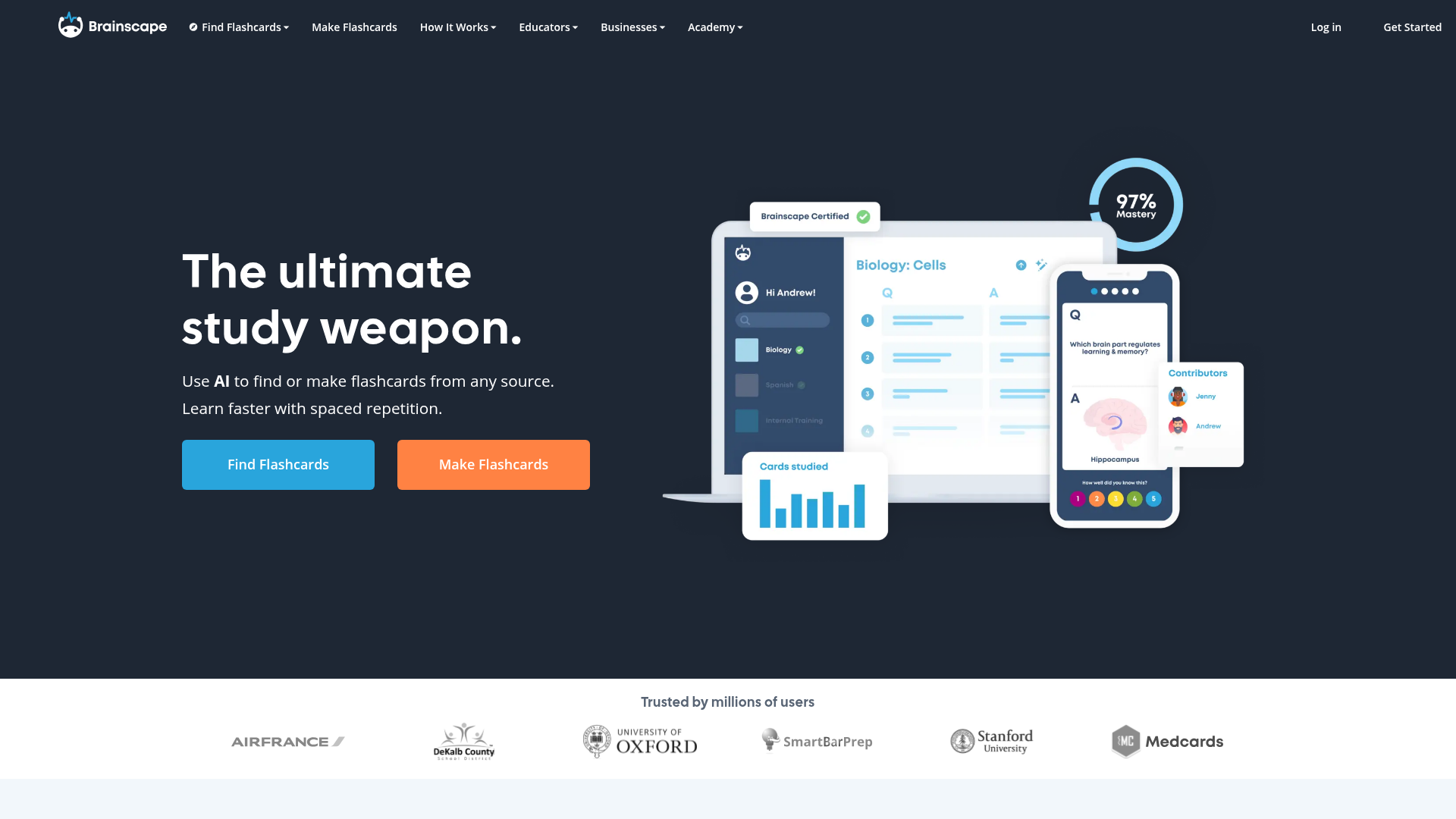
Brainscape is polished, serious, and built around confidence-based spaced repetition. It also offers certified flashcards across many subjects and strong AI-assisted card creation workflows.
Best if: you want a refined flashcard-first study experience.
Watch out for: limited support for deeper source-linked study orchestration compared with all-in-one AI learning platforms.
Flashcards World
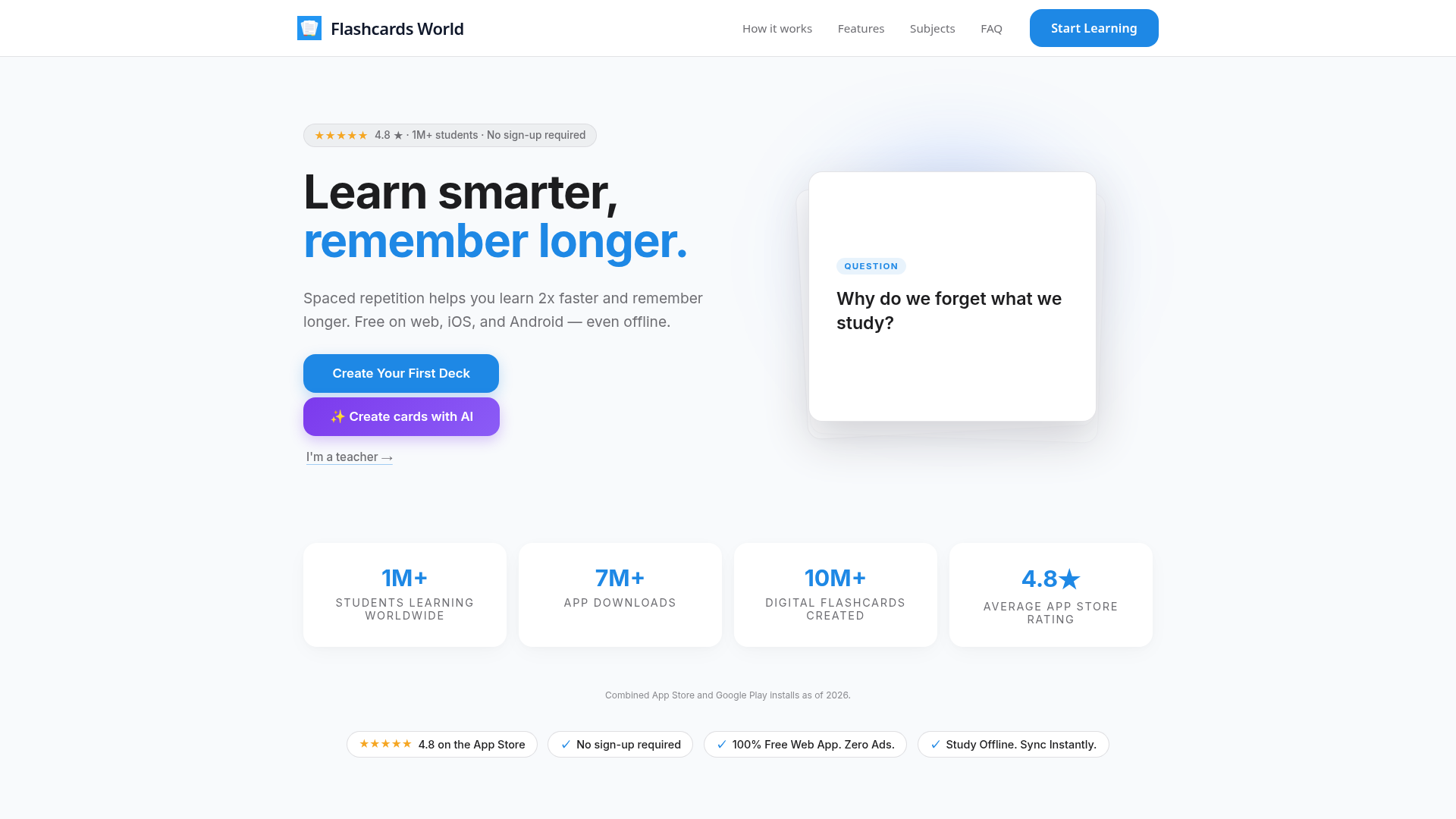
Flashcards World stands out for being free on the web, offline-friendly on mobile, and built around FSRS-style spaced repetition. It is approachable and practical for everyday studying.
Best if: you want free make your own flashcards functionality with solid scheduling.
Watch out for: a narrower focus if you need connected concept maps, traceable AI outputs, or adaptive study planning beyond cards.
Cram
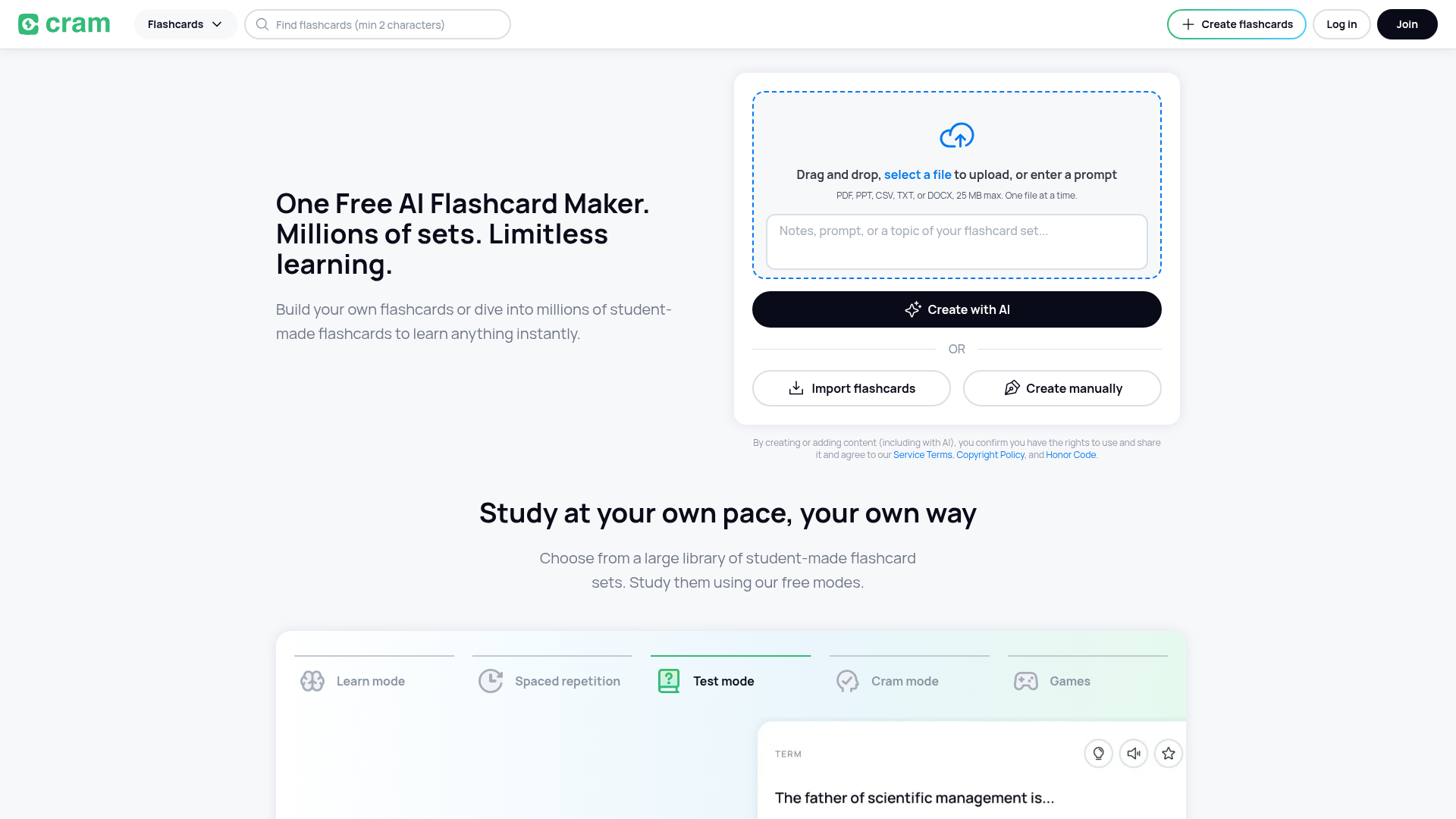
Cram has a massive public library and simple tools for building decks quickly. It remains useful when you want to browse student-made material and get started fast.
Best if: you want access to millions of sets and fast entry into a topic.
Watch out for: public deck quality can vary, so verification is essential.
Why CramAI Fits the Future of Flashcard-Based Learning
Most flashcard tools solve one part of the problem: card creation or card review.
CramAI solves a broader problem: how to turn raw information into a trustworthy, adaptive, and personalized learning system.
Where CramAI stands out
1. It starts with your real materials
Upload PDFs, documents, website URLs, YouTube videos, audio files, and slides instead of rebuilding everything from scratch.
2. It gives source-anchored outputs
When AI helps explain or generate study content, traceability matters. CramAI ties answers back to original materials, increasing trust and reducing blind memorization.
3. It links concepts across topics
This is critical for subjects where understanding relationships matters more than memorizing isolated facts - law, medicine, engineering, economics, and language learning.
4. It adapts as you study
A static deck does not know why you are struggling. CramAI’s dynamic assessments help detect knowledge gaps and automatically adjust strategy in real time.
5. It reduces cognitive overload
Many learners fail because they try to memorize everything. CramAI helps narrow focus to the most relevant concepts, next actions, and weak zones.
6. It scales beyond individual use
For educators, creators, and organizations, CramAI’s creator tools support knowledge organization, content generation, and system building at scale.
How to Create Better Flashcards for Different Goals
For exams
Prioritize:
frequently tested facts
error-prone concepts
formula recall
distinctions between similar answers
case-based prompts
For language learning
Prioritize:
bidirectional vocabulary cards
pronunciation audio
sentence-context recall
grammar transformations
verb forms
For certifications
Prioritize:
standards and frameworks
definitions with application
scenario-based prompts
exceptions and edge cases
compliance logic
For professional upskilling
Prioritize:
key frameworks
workflow steps
decision trees
acronyms and terminology
applied examples
For teachers and creators
Prioritize:
clean taxonomy
modular decks
reusable content blocks
difficulty progression
shared review structures
Mistakes to Avoid When You Create Your Own Flashcards Online
Making too many cards
More cards do not automatically mean better retention. A smaller, sharper deck usually wins.
Copying text directly from notes
Flashcards should transform information, not duplicate it.
Testing recognition instead of recall
If the answer is obvious at a glance, the card is too easy.
Ignoring review data
The point of digital flashcards is that performance can guide scheduling. Use that signal.
Using unverified AI output blindly
AI is fast, but trust matters. Always prefer systems that connect outputs to source material.
Keeping everything in one deck
Organize by course, topic, module, or exam objective so review stays intentional.
A Practical Workflow You Can Use Today
Here is a high-efficiency study workflow for anyone who wants to build your own flashcards without wasting time.
Phase 1: Gather
Collect:
lecture notes
PDFs
slides
textbook excerpts
video lessons
exam blueprint topics
Phase 2: Transform
Use AI to:
summarize content
extract concepts
generate draft cards
build topic maps
identify high-probability questions
Phase 3: Refine
Edit draft cards for:
one idea per card
concise answers
clear prompts
high exam relevance
Phase 4: Study
Review with:
spaced repetition
active recall
mixed difficulty
periodic self-testing
Phase 5: Diagnose
Look for:
recurring misses
weak topic clusters
overconfidence gaps
areas needing explanation rather than memorization
Phase 6: Adapt
This is where CramAI shines. Instead of leaving you with a flat deck, it can help re-route your study plan based on new evidence from your own performance.
Manual Flashcards vs AI-Assisted Flashcards
Approach | Strengths | Weaknesses | Best Use |
|---|---|---|---|
Manual only | deep processing while writing | slow, hard to scale | small classes, deliberate concept work |
AI only | fast generation | quality varies if unedited | first-draft production |
AI + human editing | speed plus accuracy | requires some review effort | best overall approach |
AI + source-traceable adaptive system | speed, trust, personalization, strategy | depends on platform quality | high-stakes exams and complex learning paths |
For most learners in 2026, the sweet spot is no longer purely manual. It is AI-assisted, human-reviewed, and performance-adaptive.
When Flashcards Are Not Enough
Flashcards are powerful, but they are not the answer to everything.
You also need:
summaries for first-pass understanding
practice questions for application
explanations for difficult concepts
study plans for time management
feedback loops for adjusting strategy
This is another reason CramAI is compelling. It supports the full learning cycle rather than forcing users to juggle disconnected tools for notes, cards, quizzes, and planning.
Final Verdict: The Smartest Way to Study Flashcards Online Free in 2026
If your goal is simply to make flashcards online free, there are plenty of workable options.
If your goal is to remember more, study more strategically, and build lasting understanding from real materials, you need more than a deck builder.
You need a system that can help you:
turn content into structured knowledge
generate and refine flashcards fast
tie answers back to trustworthy sources
identify what you do not know yet
adapt your study plan automatically
reduce wasted effort and cognitive load
That is the difference between using flashcards as a tool and using them as part of an intelligent learning workflow.
CramAI is built for that second path. Whether you are a student, exam candidate, professional learner, educator, creator, or organization, it gives you a more modern way to create your own flashcards online, study with purpose, and move from information overload to measurable progress.
If you are ready to stop memorizing blindly and start learning with traceable, adaptive, AI-powered support, CramAI is the platform to try next.