
Math Homework AI: Smarter Study Support
Math homework is rarely just about getting an answer. For many students, exam candidates, and lifelong learners, the real challenge is understanding why a method works, identifying where confusion starts, and building enough confidence to solve similar problems independently.
That is where math homework AI becomes genuinely useful. At its best, it does more than speed up problem-solving. It can break complex questions into manageable steps, explain concepts in context, reveal knowledge gaps, and guide learners toward stronger long-term performance. For undergraduates, graduate students, standardized test takers, certification candidates, busy professionals, and even institutions supporting large learner groups, AI-powered study support is quickly becoming part of a smarter learning workflow.
What many competing tools still miss, however, is the difference between a quick solver and a true learning system. A calculator-style assistant may help with tonight’s assignment, but a modern platform should also help learners organize source materials, connect related topics, adapt study strategies in real time, and reduce cognitive overload by focusing attention on what matters most. That is the space where CramAI stands out: as an all-in-one AI study and exam prep partner built not just to answer math questions, but to improve how people learn.
Why math homework feels harder than it should
Math challenges often compound. A learner may begin with one missed concept - fractions, functions, factoring, derivatives - and suddenly every new topic feels harder. Traditional homework help can also be inefficient: students bounce between notes, videos, worksheets, formula sheets, and search results, trying to piece together a solution.
This fragmented process creates several common pain points:
unclear starting points for multi-step problems
difficulty spotting the exact step where reasoning breaks down
low confidence caused by repeated mistakes
heavy cognitive load from too many disconnected resources
limited feedback on whether the learner truly understands the concept
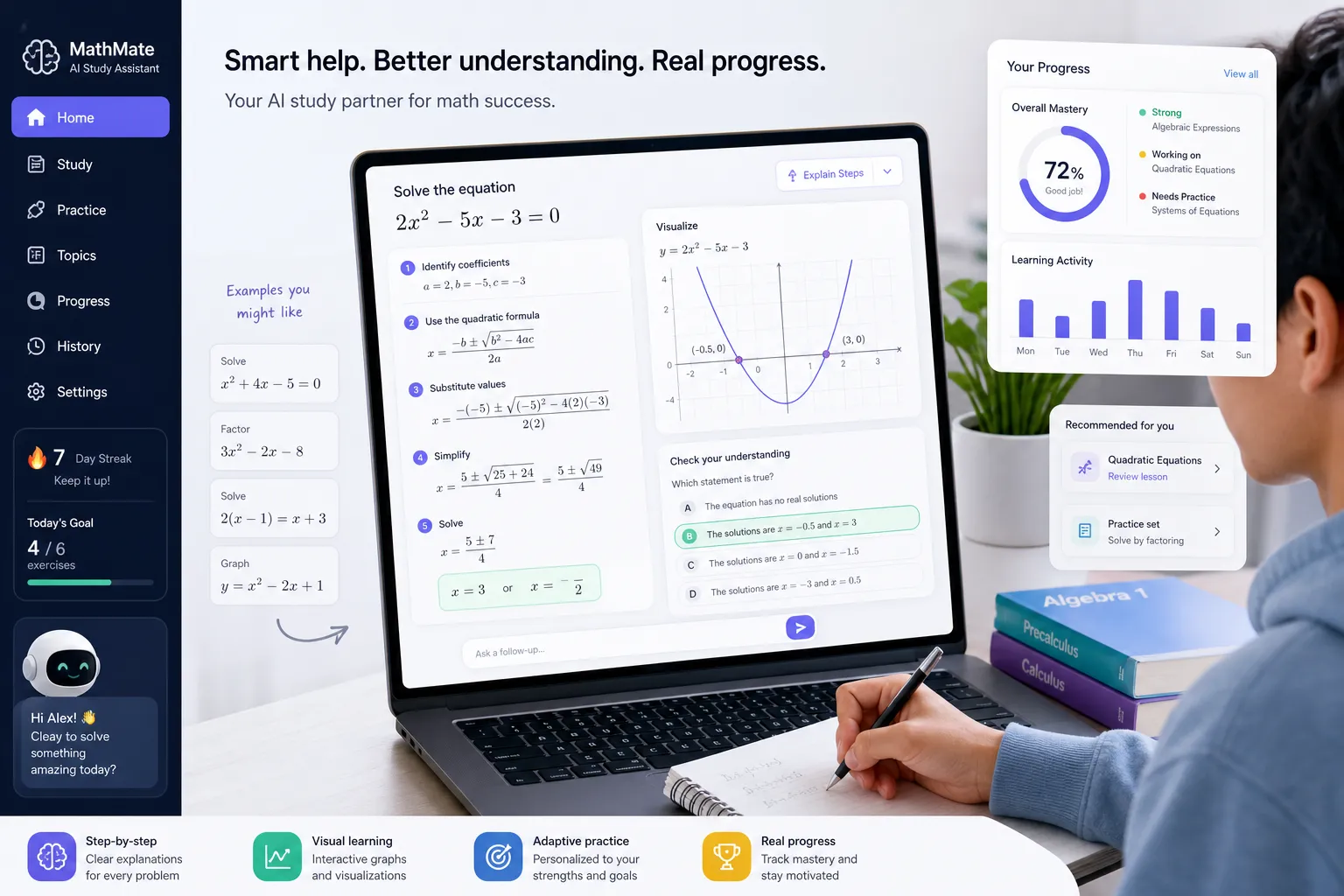
A good math homework AI addresses these issues by creating structure. Instead of simply returning an answer, it can analyze the problem, generate a step-by-step explanation, and guide the learner toward the underlying concept.
"Between May and December 2025, the percentage of middle school, high school, and college students in the U.S. using AI for homework rose from 48% to 62%." - eSchool News
That rapid growth is not surprising. Students are looking for tools that save time without sacrificing understanding. The real question is which tools actually support learning well.
What math homework AI does well
A strong AI study system for math can improve the learning experience in several ways.
Step-by-step problem solving
The most obvious advantage is procedural clarity. Instead of presenting only a final result, AI can show the sequence:
identify the problem type
choose the right formula or method
substitute values correctly
simplify carefully
verify the result
This makes the process visible, which is essential for subjects like algebra, geometry, calculus, and statistics.
Instant feedback
Students no longer need to wait for office hours or a graded assignment to discover an error. AI can point out mistakes immediately, helping learners correct misunderstandings before they solidify.
Personalized pacing
Not every learner needs the same explanation. Some need a concise hint; others need a full walkthrough with examples. Personalized AI support can adapt to both.
Reduced study friction
Instead of searching across multiple tabs and materials, learners can interact with one system that centralizes explanations, uploaded resources, and targeted practice.
Confidence building
When learners see how a problem unfolds step by step, math becomes less intimidating. Confidence grows when confusion becomes traceable and solvable.
"Across OECD countries, students who believe in their ability to solve math problems score 49 points higher in mathematics - equivalent to one year of schooling - than those who lack such confidence." - OECD
Where many math AI tools still fall short
Most competitor content focuses on speed, convenience, and answer generation. Those benefits matter, but they are not enough. There are several content gaps - and product gaps - that deserve more attention.
Answers without source traceability
A polished explanation is helpful, but learners also need confidence that the explanation is grounded in the materials they are actually studying. Many tools provide generic outputs with limited traceability.
CramAI takes a different approach by anchoring answers to original sources wherever possible. If a student uploads PDFs, slides, documents, audio, URLs, or videos, the platform can build learning support around those materials instead of floating above them. That matters for trust, especially in higher education, certifications, and test prep.
Weak concept linking
Math is interconnected. A learner struggling with limits may actually have a weaker foundation in functions. Someone missing probability questions may be confused about fractions or algebraic reasoning. Basic homework solvers usually treat each question as isolated.
CramAI is built to connect topics across a larger knowledge map, helping learners see the relationship between current mistakes and prior concepts. This is a major advantage for cumulative subjects like mathematics.
No dynamic assessment
Many tools explain a problem, then stop. But real progress requires diagnosis: what does the learner know, what do they misunderstand, and what should they study next?
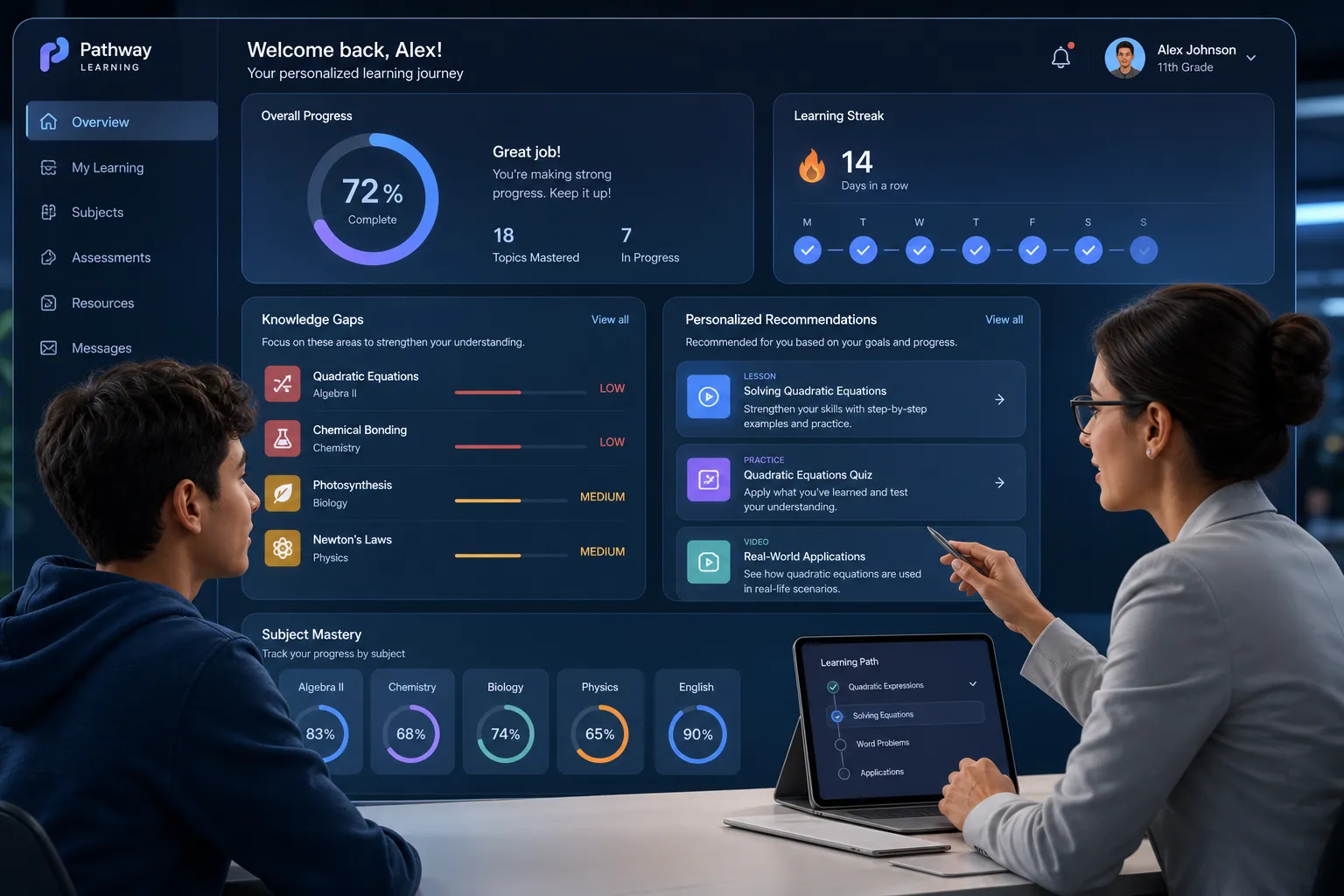
CramAI extends beyond solving into assessment and guidance. It can identify knowledge gaps, adjust study recommendations in real time, and create more strategic preparation plans. That turns one-off homework support into a full learning loop.
Limited support for multimodal studying
Math learning does not happen in one format. Students study from lecture slides, textbook scans, YouTube videos, class notes, audio reviews, and teacher handouts. A fragmented toolset increases mental load.
CramAI supports multiple content formats and transforms them into personalized study plans, summaries, visual knowledge maps, and connected insights - especially valuable for learners balancing several courses or preparing for high-stakes exams.

How smarter math homework AI supports actual learning
The best use of AI in math is not replacement. It is reinforcement.
It helps learners start faster
Students often waste time figuring out how to begin. AI can reduce that “blank page” effect by identifying the problem type and proposing the first step.
It highlights reasoning, not just results
Instead of giving only the destination, stronger systems show the logic behind each move. That is what helps students handle test variations later.
It makes review more strategic
A student who misses three related algebra problems should not keep doing random practice. They should revisit the exact concept cluster causing the errors. AI-driven gap analysis makes this possible.
It adapts when performance changes
Study needs are not static. If a learner improves on equations but struggles with graph interpretation, the plan should change. CramAI’s adaptive approach automatically updates recommendations, helping users focus energy where it produces the highest return.
What an effective math AI workflow looks like
A mature learning workflow goes well beyond “ask question, get answer.” Here is what smarter support should look like.
Stage | What the learner does | What strong AI support should do |
|---|---|---|
Upload | Add problem, notes, PDFs, slides, videos, or links | Parse multiple formats and identify key concepts |
Solve | Ask for help on a specific problem | Provide step-by-step reasoning, not just the answer |
Explain | Request clarification | Reframe the explanation based on the learner’s level |
Assess | Test understanding | Detect weak areas and recurring errors |
Guide | Plan next study steps | Generate personalized, adaptive study recommendations |
Reinforce | Review across topics | Build concept links and surface connected material |
This is where CramAI’s all-in-one positioning matters. Instead of forcing learners to switch between a solver, note app, quiz tool, and planner, it supports the full cycle: learn, test, assess, guide, and support.
Math homework AI for different types of learners
The phrase “math homework” can sound narrow, but the real audience is much broader.
Undergraduate and graduate students
Students in STEM, economics, business, social science, and health-related programs often rely on math-heavy coursework. They need more than quick solutions - they need source-based explanations tied to class materials and exams.
Standardized test takers
IELTS is not math-focused, but many test prep learners are simultaneously preparing for quantitative entrance exams, aptitude assessments, or graduate admissions. These users benefit from adaptive study plans that coordinate math practice alongside broader preparation goals.
Busy professionals earning certifications
Working adults preparing for finance, analytics, engineering, or technical certifications need efficient review. AI can compress study time by prioritizing weak areas and eliminating unnecessary repetition.
Institutions and enterprise learning teams
At scale, organizations need consistent, tailored learning support. CramAI’s ability to organize materials, personalize plans, and adjust strategies makes it attractive not just for individuals, but also for schools, training providers, and enterprise teams.
Educators and knowledge creators
Teachers, tutors, and creators can use AI not only to solve and explain math content, but to organize expertise, generate educational materials, and build structured knowledge systems through creator tools.
Why source-anchored AI matters in math
In many subjects, vague answers are frustrating. In math, they are dangerous. A small hidden mistake in method, assumption, or notation can derail the entire solution.
That is why source anchoring and traceability are so important. If learners can see how an explanation connects back to uploaded class notes, textbook excerpts, slide decks, or instructor materials, they gain:
stronger trust in the explanation
faster verification of formulas and methods
easier review before quizzes and exams
less dependence on generic, context-free responses
For CramAI, this is not a cosmetic feature. It is part of a more reliable study experience built around explainability and evidence-based learning.
The role of concept maps and connected learning
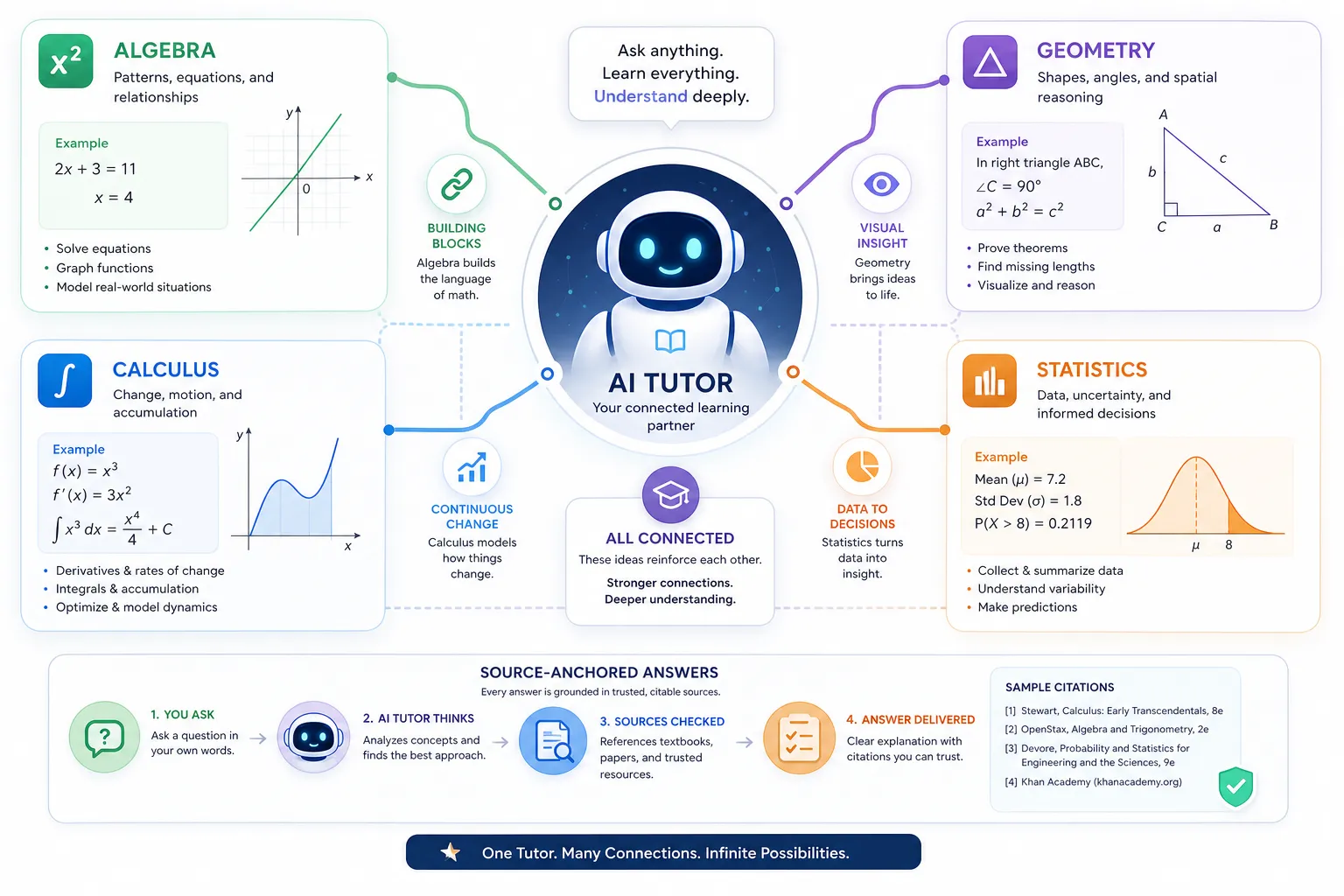
One of the biggest missed opportunities in standard AI homework tools is the failure to show how topics relate. Math mastery depends on structure. Learners do better when they understand not only a procedure, but where it sits in a larger network of ideas.
For example:
linear equations connect to graphing and systems
functions connect to limits, derivatives, and optimization
trigonometry supports calculus and physics
statistics often depends on algebraic fluency
CramAI’s connected topic insights and visual knowledge mapping reduce fragmentation. Instead of studying isolated questions, learners can understand the ecosystem around a concept.
How math homework AI can reduce cognitive load
Students are often not failing because they lack effort. They are overloaded. Too many tabs, too many disconnected explanations, too many materials, and too little prioritization.
A well-designed AI learning platform reduces cognitive load by:
surfacing the most relevant source material first
breaking problems into clear, ordered steps
focusing attention on the highest-impact weaknesses
adjusting study plans automatically as performance changes
turning messy resources into structured review assets
This is especially valuable for high-pressure learners: exam candidates, students taking multiple quantitative courses, and professionals studying after work hours.
Best practices for using math homework AI responsibly
AI is most effective when used as a learning amplifier, not a shortcut.
Ask for explanation before final answer
This encourages deeper engagement with method and reasoning.
Compare AI steps with class methods
Teachers may prefer a particular notation or approach. Source-anchored support makes this easier.
Use mistakes as diagnostic signals
Do not just fix an answer. Track the concept behind the error.
Turn solved problems into review material
Summaries, quizzes, and concept maps help move learning from short-term assistance to long-term retention.
Keep the human learning loop active
Write out steps by hand, explain the method aloud, or retry a similar problem without assistance. AI should support mastery, not replace it.
What makes CramAI a stronger choice than a basic solver
A solver answers. A study system improves outcomes.
Here is the practical difference:
Basic math solver | CramAI |
|---|---|
Solves isolated problems | Supports the full learning cycle |
Often generic responses | Source-anchored, traceable answers |
Minimal adaptation | Real-time adjustment based on knowledge gaps |
Limited content input | Works with PDFs, URLs, YouTube, audio, slides, and documents |
Little cross-topic insight | Builds concept links and visual knowledge structures |
Ends after explanation | Generates personalized study plans and assessments |
Student-only use case | Useful for individuals, educators, creators, and organizations |
This broader capability matters because math performance is not built on single interactions. It is built on repeated feedback, structured review, and strategic adaptation over time.
From homework help to exam readiness
The smartest way to use math homework AI is as an engine for exam preparation. Every homework question is data. It reveals what the learner understands, what remains fragile, and what needs reinforcement.
CramAI turns that data into action by helping users:
transform uploaded materials into tailored study plans
review concepts through summaries and connected insights
identify weaknesses with dynamic assessments
adjust preparation strategies as new performance signals appear
organize knowledge for faster revision and stronger recall
That makes it useful not only tonight, but throughout the entire study cycle.
Final verdict: smarter support wins
Math homework AI is most valuable when it helps learners think more clearly, not just finish faster. The strongest tools combine step-by-step problem solving with concept explanation, trusted source grounding, adaptive assessment, and personalized guidance.
That is why CramAI is positioned for the next generation of learning. It does not stop at answers. It supports the entire path from confusion to clarity, from scattered materials to structured study, and from homework help to measurable exam readiness.
If you want a platform that can handle multiple content formats, anchor explanations to real sources, connect concepts across topics, identify knowledge gaps, and automatically adapt study strategies in real time, CramAI is built for exactly that. Try CramAI to turn math homework from a recurring stress point into a smarter, more strategic learning advantage.