

MBA Admissions: What It Really Takes to Get In
MBA admissions can feel opaque from the outside: strong candidates get rejected, average-looking profiles get admitted, and advice online often oversimplifies what business schools actually evaluate. If you are applying to an MBA program, preparing for the GMAT or GRE, or trying to understand whether your GPA, work experience, essays, and interview readiness are competitive, this guide is built for you.
For most applicants, the real challenge is not just “checking the boxes.” It is building a coherent, evidence-backed story: why now, why this program, and why you are likely to contribute and succeed. That is where smart systems matter. Instead of juggling notes across PDFs, school websites, admissions webinars, test prep materials, and recommendation planning docs, many applicants now use AI-powered learning support to centralize the process. CramAI is especially useful here because it can turn uploaded materials into personalized study plans, source-anchored summaries, concept maps, adaptive assessments, and focused prep paths that adjust as your strengths and gaps change.
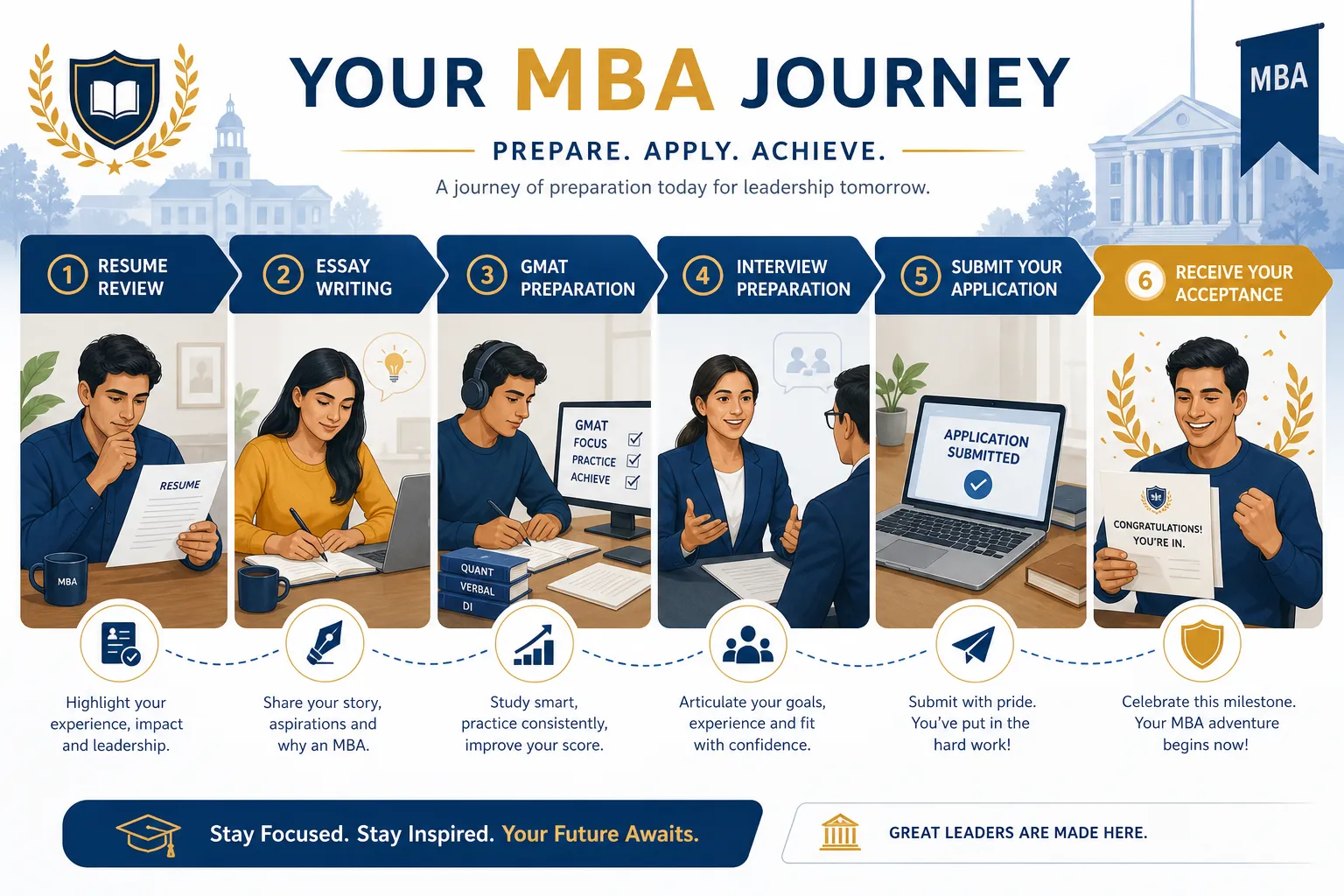
What MBA Admissions Committees Actually Look For
At a high level, most schools assess the same core dimensions:
Academic readiness
Career progression and leadership potential
Clarity of goals
Fit with the program
Communication skills
Personal character and contribution potential
Competitor articles tend to cover the mechanics: GPA, test scores, work experience, essays, recommendations, and interviews. What they often miss is that admissions decisions are usually made on pattern recognition. Schools are not merely scoring isolated inputs; they are asking whether your full profile makes strategic sense.
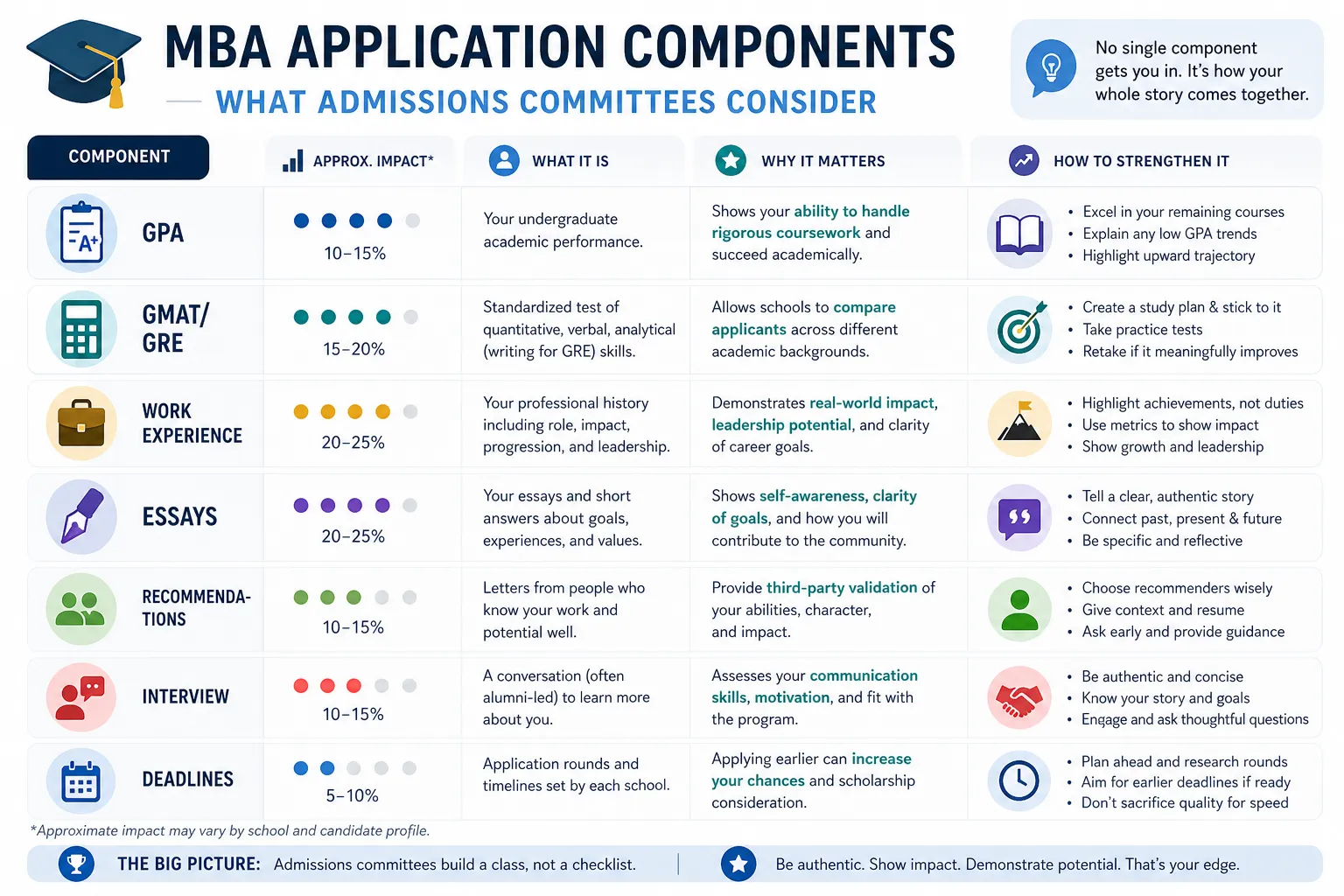
The six pillars of a competitive application
Component | What schools want to learn | Common mistake |
|---|---|---|
Transcript/GPA | Can you handle academic rigor? | Assuming a low GPA is fatal |
GMAT/GRE | Do you have current analytical and verbal readiness? | Choosing a test based on prestige instead of fit |
Work experience | Have you progressed, led, influenced, and delivered results? | Listing duties instead of impact |
Essays | Do you have self-awareness, goals, and school fit? | Writing generic leadership stories |
Recommendations | Do credible third parties validate your strengths? | Picking senior titles over strong advocates |
Interview | Can you communicate your story with clarity and presence? | Over-rehearsing and sounding scripted |
How Competitive Are MBA Admissions Today?
MBA admissions vary dramatically by school tier, round, and applicant pool. M7 programs and other elite schools are highly selective, but even beyond the top tier, competition is intense because applicants often look similar on paper.
"The 2025 Application Trends Survey analyzed responses from over 1,170 graduate business school programs worldwide." - GMAC
That matters because MBA admissions are not just competitive at the top; they are dynamic across the market. Schools constantly respond to shifts in employer demand, international mobility, AI-related skill priorities, and application behavior by round.
What this means for applicants
A solid profile is no longer enough. You need to show:
measurable impact at work
leadership beyond title
credible short- and long-term goals
evidence that you researched each school deeply
readiness for both academic and recruiting intensity
MBA Application Requirements, Decoded
Most articles list standard requirements but do not explain how each one is interpreted. Here is a more useful breakdown.
Academic Record: GPA, Transcript, and Coursework
Your GPA matters, but context matters too. Admissions committees look at:
overall GPA
trend over time
major difficulty
quantitative coursework
institution rigor
reasons behind anomalies
A 3.2 in engineering with strong quant performance may be more reassuring than a 3.8 with limited rigor in analytical coursework. Likewise, an upward trend can help.
What if your GPA is low?
A lower GPA does not automatically disqualify you. It simply creates a question you must answer elsewhere in the file.
Strong ways to offset a low GPA
High GMAT or GRE performance
Additional coursework in statistics, accounting, calculus, or finance
A concise optional essay with context, not excuses
Strong professional evidence of analytical ability
Recommenders who can speak to intellectual horsepower
When to address GPA in the optional essay
Address it if:
there is a clear anomaly
there were extenuating circumstances
your transcript does not reflect your current ability
Do not address it if you are simply uncomfortable with being below average and have no additional insight to offer.
GMAT vs GRE: Which Test Is Better for MBA Admissions?
For most MBA applicants, the better test is the one on which you can earn the strongest score. The old idea that the GMAT is always preferred is much less relevant today.
"92% of business schools accept GRE scores alongside the GMAT, including all top-ranked MBA programs." - ETS
How to choose between the GMAT and GRE
Consider these factors:
Factor | GMAT may fit better | GRE may fit better |
|---|---|---|
Career path | Traditional MBA-only focus, some finance-heavy goals | Broader graduate options or dual interests |
Test style | Strong data reasoning comfort | Stronger vocabulary/verbal flexibility |
Practice test results | Higher GMAT baseline | Higher GRE baseline |
Personal stamina | Comfortable with adaptive pressure | Prefer more familiar testing structure |
A practical decision framework
Take one official practice test for each. Compare not only the score, but also:
fatigue level
confidence by section
improvement potential
time-to-target score
This is where CramAI can help beyond standard prep tools. If you upload practice exams, error logs, tutoring notes, and official concept materials, it can organize them into a personalized study plan, connect recurring weak concepts across sections, and adapt the next study sprint based on knowledge gaps rather than intuition alone.
Work Experience: More Important Than Most Applicants Realize
Competitor content usually says “relevant work experience is helpful.” That is true, but incomplete. MBA admissions teams are not just counting years. They are evaluating trajectory.
What strong work experience looks like
Schools want evidence of:
progression or acceleration
ownership and initiative
leadership, formal or informal
problem-solving under ambiguity
collaboration and influence
outcomes tied to real metrics
A candidate with three years of fast growth and visible impact can be more compelling than one with seven years of stable but undifferentiated experience.
How much experience do you need?
For traditional full-time MBA programs, many candidates apply with roughly 3 to 6 years of work experience, though the range is wider. Deferred MBA programs, 2+2 programs, and some early-career pathways are exceptions.
If you have less experience
Emphasize:
internships with measurable results
fast-track promotions
student leadership with real outcomes
entrepreneurial work
military or nonprofit leadership
evidence of maturity and goals clarity
Essays: The Strategic Core of Your MBA Application
Essays are where your numbers become a narrative. They must answer three questions:
Who are you?
Where are you going?
Why is this school the right bridge?
The strongest MBA essays tend to do five things well
1. They connect past, present, and future
Your career goals should not feel invented for the application.
2. They balance ambition with realism
Big goals are welcome, but they need a believable path.
3. They show reflection, not just achievement
Schools want self-awareness, not a polished brag sheet.
4. They demonstrate school fit specifically
Mentioning courses and clubs is not enough; explain why they matter for your trajectory.
5. They sound human
The best essays are precise, memorable, and grounded.
A simple essay architecture
Essay section | Purpose |
|---|---|
Hook or context | Establish a meaningful starting point |
Career evolution | Show how your path has developed |
Goals | Explain short-term and long-term direction |
Why MBA / Why now | Justify the decision point |
Why this school | Demonstrate fit with program specifics |
Contribution | Show what you will add to the community |
How CramAI improves essay prep
MBA applicants often gather notes from admissions events, class visits, school websites, employment reports, rankings, and essay brainstorms. CramAI can reduce that cognitive load by organizing source material into connected themes, generating source-anchored summaries, and helping you compare program features across schools without losing traceability. That is particularly valuable when you are managing multiple applications and need your messaging to stay differentiated.
Letters of Recommendation: Validation, Not Formality
Recommendations are often underestimated because applicants do not control the final draft. But admissions teams use them to test whether your story holds up externally.
The best recommenders are not always the most senior
Choose people who can speak in detail about:
your leadership
your growth areas
your communication style
your resilience
your impact on others
specific moments that show judgment
A detailed letter from a direct manager is usually better than a vague note from an executive.
How to help your recommenders write better letters
Give them:
your current resume
career goals summary
reasons for pursuing an MBA now
examples of projects they might reference
deadlines and submission instructions
enough lead time
Do not ghostwrite the letter. Do shape the input.
The MBA Interview: Where Good Applicants Become Admits
Some applicants treat the interview as a final checkpoint. It is better understood as a live test of clarity, maturity, and fit.
What interviewers are actually evaluating
Can you communicate with structure?
Do your goals make sense?
Are you coachable and reflective?
Would classmates want to work with you?
Are you genuinely interested in this program?
Questions you should be ready for
Walk me through your resume.
Why MBA, and why now?
Why this school?
Tell me about a leadership challenge.
Describe a failure.
What are your career goals?
What will you contribute here?
A better way to prepare
Do not memorize scripts. Build flexible story blocks. Create a bank of experiences that can support multiple question types.
This is another area where CramAI can help. Upload your resume, essays, school notes, and mock interview feedback, and use the platform to identify recurring weaknesses, surface inconsistencies, and generate adaptive review prompts so you strengthen message alignment across the whole application.
Application Rounds and Timing Strategy
Many competitor pages mention rounds but do not explain the strategic implications.
Round 1 vs Round 2 vs Round 3
Round | Best for | Risks |
|---|---|---|
Round 1 | Well-prepared applicants with polished materials | Rushing before application quality is ready |
Round 2 | Strong default option for many candidates | More competition, less seat availability |
Round 3 | Special cases only | Fewer seats, scholarship constraints, heavier odds |
Apply early only if the application is truly ready
Submitting in Round 1 with average essays is not automatically better than submitting a much stronger package in Round 2. Timing matters, but execution matters more.
International MBA Applicants: Additional Challenges and Opportunities
International applicants face the same core evaluation criteria plus additional operational and narrative demands.
Additional considerations
English proficiency requirements
transcript evaluation or equivalency issues
visa and financing planning
international employability goals
geographic fit and post-MBA recruiting realism
What strong international applicants do differently
They connect their background to a global classroom contribution while showing a realistic employment path after graduation. They also prepare earlier because logistics can slow everything down.
Online MBA vs Full-Time MBA Admissions
Admissions requirements can overlap, but the evaluation lens often changes.
Full-time MBA programs tend to prioritize
career acceleration or pivot potential
immersive community participation
internship pathway relevance
broad leadership upside
Online or part-time MBA programs often emphasize
ability to balance work and study
immediate application of learning
employer context
sustained professional trajectory
If you are comparing formats, treat program fit as strategic, not secondary.
The Biggest Content Gaps in Typical MBA Admissions Advice
Most top-ranking articles cover the basics well. Here are the issues they often gloss over:
They under-explain narrative consistency
Admissions files are cross-checked. Your resume, essays, recommendations, and interview should reinforce one another.
They over-focus on credentials and under-focus on evidence
Schools care less about labels and more about impact, self-awareness, and future direction.
They do not teach applicants how to manage information overload
Modern MBA applicants must process rankings, employment reports, essay prompts, webinar notes, class visits, and test prep data. Without a smart system, quality drops.
They rarely address adaptive preparation
Applicants often keep studying what feels familiar. A dynamic approach that diagnoses gaps and changes strategy in real time is much more effective.
That is precisely where AI-assisted study and planning tools create an advantage. CramAI is not just for classroom learning or exam review; it is highly effective for admissions preparation because it supports the entire cycle: learn, test, assess, guide, and support.
How to Use CramAI for MBA Admissions and Business School Prep
CramAI fits naturally into the MBA journey before and after admission.
Before admission
Use it to:
upload school websites, essay prompts, PDFs, rankings reports, and notes
build personalized application workstreams
generate source-anchored summaries for each school
compare programs across career outcomes, curriculum, and culture
create adaptive GMAT/GRE study plans from your materials
identify weak spots in quant, verbal, or reasoning performance
organize recommendation guidance and interview prep centrally
During business school
MBA students can use CramAI to:
turn lecture slides, case packets, research PDFs, and YouTube explainers into study plans
link concepts across finance, strategy, marketing, operations, and economics
create summaries and knowledge maps for case discussions
run dynamic self-assessments before quizzes and exams
reduce wasted time by focusing on highest-value review areas
For educators, teams, and creators
Because CramAI also includes creator tools for knowledge organization and content generation, it is useful for:
admissions coaches building repeatable guidance systems
faculty creating structured learning assets
enterprise learning teams supporting certification readiness
knowledge creators building educational products and personal brands
A 12-Week MBA Admissions Preparation Plan
If you want a realistic framework, start here.
Weeks 1–2: Assess and choose strategy
Build school list
Audit strengths and risks
Take baseline GMAT/GRE practice tests
Map deadlines and round targets
Weeks 3–5: Test plan and school research
Choose GMAT or GRE
Begin structured study
Attend webinars and gather school-specific notes
Clarify goals narrative
Weeks 6–8: Essay development
Brainstorm stories
Draft core goals essay
Build school-specific fit notes
Prep recommender packets
Weeks 9–10: Application assembly
Refine resume
Complete forms carefully
Finalize essays
Track recommendation progress
Weeks 11–12: Interview readiness and QA
Prepare story bank
Practice mock interviews
Check consistency across all materials
Submit with time buffer
A tool like CramAI makes this plan more executable because it centralizes materials, preserves source traceability, and automatically adjusts focus areas as new information or performance data comes in.
Final Verdict
MBA admissions are difficult, but they are not random. Strong applicants win by combining self-awareness, execution quality, and strategic preparation. GPA, test scores, work experience, essays, recommendations, and interviews all matter, but what matters most is whether they add up to a credible, compelling case for your future.
If you want to approach the process with less chaos and more precision, CramAI offers a modern advantage: personalized study plans from your own materials, source-anchored answers you can trust, connected topic insights for deeper understanding, adaptive assessments that expose knowledge gaps, and real-time strategy adjustments that help you focus on what matters most. Whether you are preparing for MBA admissions, the GMAT or GRE, or the academic intensity of business school itself, it is built to help you study smarter, decide faster, and perform better.
FAQ
How hard are MBA admissions?
MBA admissions are competitive, especially at top programs, because schools evaluate far more than grades and test scores. Applicants need a strong mix of academic readiness, career impact, clear goals, and school fit.
What GPA is needed for an MBA?
There is no universal cutoff, but a strong academic record helps. If your GPA is lower, you can offset it with a high GMAT or GRE score, additional coursework, and solid professional evidence of analytical ability.
What is MBA admission?
MBA admission is the process business schools use to evaluate applicants for entry into their programs. It typically includes reviewing your transcript, test scores, work experience, essays, recommendations, and interview performance.
How do you get into an MBA?
You get into an MBA program by submitting a cohesive, high-quality application that proves academic readiness, leadership potential, and clear career goals. Strong essays, credible recommendations, and thoughtful school fit are often what separate admits from rejections.
What did Elon Musk say about MBAs?
Elon Musk has made skeptical comments about MBAs in some contexts, usually criticizing management that lacks practical product or engineering depth. But for applicants, the better question is whether an MBA fits your goals, industry path, and leadership development needs.
Is MBA a lot of math?
An MBA includes quantitative work, especially in finance, accounting, economics, statistics, and operations, but it is not pure math. Most applicants can succeed if they prepare well and strengthen any weak quantitative foundations before or during the program.