
PMP Certification in 2026: Requirements, Cost, Exam Format, Salary Impact, and the Smartest Way to Prepare
If you're researching the PMP, you're likely asking a practical question: Will this certification actually move my career forward enough to justify the time, cost, and study effort?
For many professionals, the answer is yes - but only if you approach it strategically.
The Project Management Professional (PMP)® from PMI remains one of the most recognized credentials for people who lead projects across industries. It signals that you can manage people, process, and business priorities in real delivery environments - not just memorize theory. But the real challenge is not deciding whether PMP matters. It’s figuring out eligibility, exam structure, prep strategy, and how to study efficiently when your schedule is already full.
That is where a modern AI-supported workflow changes the game. Instead of juggling disconnected notes, PDFs, videos, mock tests, and training materials, platforms like CramAI help turn your study inputs into a focused preparation system: personalized study plans, source-linked summaries, adaptive gap analysis, and concept maps that connect frameworks across predictive, hybrid, and agile topics.
What the top PMP pages usually cover - and what they often miss
Most high-ranking PMP content explains the basics well:
what PMP stands for
eligibility requirements
exam cost
number of questions
maintenance through PDUs
general salary benefits
But many pages gloss over the points that matter most to serious candidates:
Common content gaps
How to decide if PMP is right for your career stage
What “leading projects” actually means for eligibility
How to structure prep if you are balancing work and family
The difference between collecting materials and actually learning from them
How to convert PMBOK concepts, ECO domains, and mock exam errors into a system
How AI can reduce wasted study time without sacrificing trust and traceability
This guide fills those gaps.
What is the PMP certification?
The PMP is a globally recognized certification from the Project Management Institute (PMI) for professionals who lead projects. It is designed to validate your ability to manage projects across different ways of working, including predictive, agile, and hybrid approaches.
Unlike narrower certifications tied to one framework or sector, PMP is intended to show broad project leadership capability. That makes it relevant to professionals in:
IT
construction
healthcare
finance
manufacturing
consulting
government
operations
product and transformation teams
"PMP® certified professionals in the United States reported a median salary of $135,000, compared to $109,157 for those without the certification - a nearly 24% difference." - PMI
"As of July 2026, there are over 1.7 million Project Management Professional (PMP)® certification holders worldwide, making it the most widely held project management certification globally." - PMI
Is PMP worth it in 2026?
For the right candidate, PMP is still highly valuable in 2026 because it offers a rare combination of:
global recognition
employer familiarity
cross-industry portability
salary upside
stronger credibility in leadership conversations
That said, worth depends on fit.
PMP is usually worth it if you:
already lead projects or workstreams
want to move into project or program leadership
need a recognized credential for promotion or job mobility
work in organizations that value structured delivery
want proof of capability beyond years of experience alone
PMP may be less urgent if you:
are very early in your career with limited project leadership experience
work in highly specialized environments where another certification is more relevant first
have not yet built the experience needed to qualify
In those cases, a stepping-stone path such as CAPM or role-specific learning may make more sense before pursuing PMP.
Who should get PMP?
The PMP is best suited to professionals who are already operating with real delivery responsibility.
Good-fit profiles
project managers
project coordinators stepping up into ownership
scrum masters managing hybrid delivery environments
PMO professionals
implementation managers
operations leaders running cross-functional initiatives
consultants leading client-facing transformation work
engineers or analysts who now own outcomes, not just tasks
A simple decision lens
Situation | PMP Fit |
|---|---|
You lead projects and want formal recognition | Strong |
You want better salary leverage and mobility | Strong |
You need a globally recognized credential | Strong |
You are just starting and lack experience | Moderate to low |
You need a highly technical niche cert first | Depends |
PMP eligibility requirements
PMI’s current PMP eligibility model is built around education, experience leading projects, and project management training.
You need one of the following education-and-experience combinations
Education Level | Required Experience Leading Projects |
|---|---|
High school diploma or equivalent | 5 years |
Associate degree or vocational diploma | 4 years |
Bachelor’s degree or higher | 3 years |
Degree from a PMI GAC program | 2 years |
Training requirement
You also need 35 hours of project management training, unless you hold an active CAPM certification, which can satisfy that requirement.
What counts as project leadership experience?
This is one of the most misunderstood parts of the PMP process.
PMI is not asking whether you had the formal title “Project Manager.” It is asking whether you led projects. That can include:
planning work
coordinating stakeholders
managing risks or timelines
making decisions
driving delivery
owning outcomes
You do not need to have led every part of every project alone. But you should be able to describe your role in a way that clearly shows responsibility and leadership.
Practical examples of experience that may count
leading a system rollout for your department
managing a client implementation
coordinating a product launch across functions
running a compliance or transformation initiative
overseeing construction, operations, or procurement workstreams
Important reminder
PMI says not to double-count overlapping projects, and the experience should generally fall within the specified recent time window.
PMP exam cost
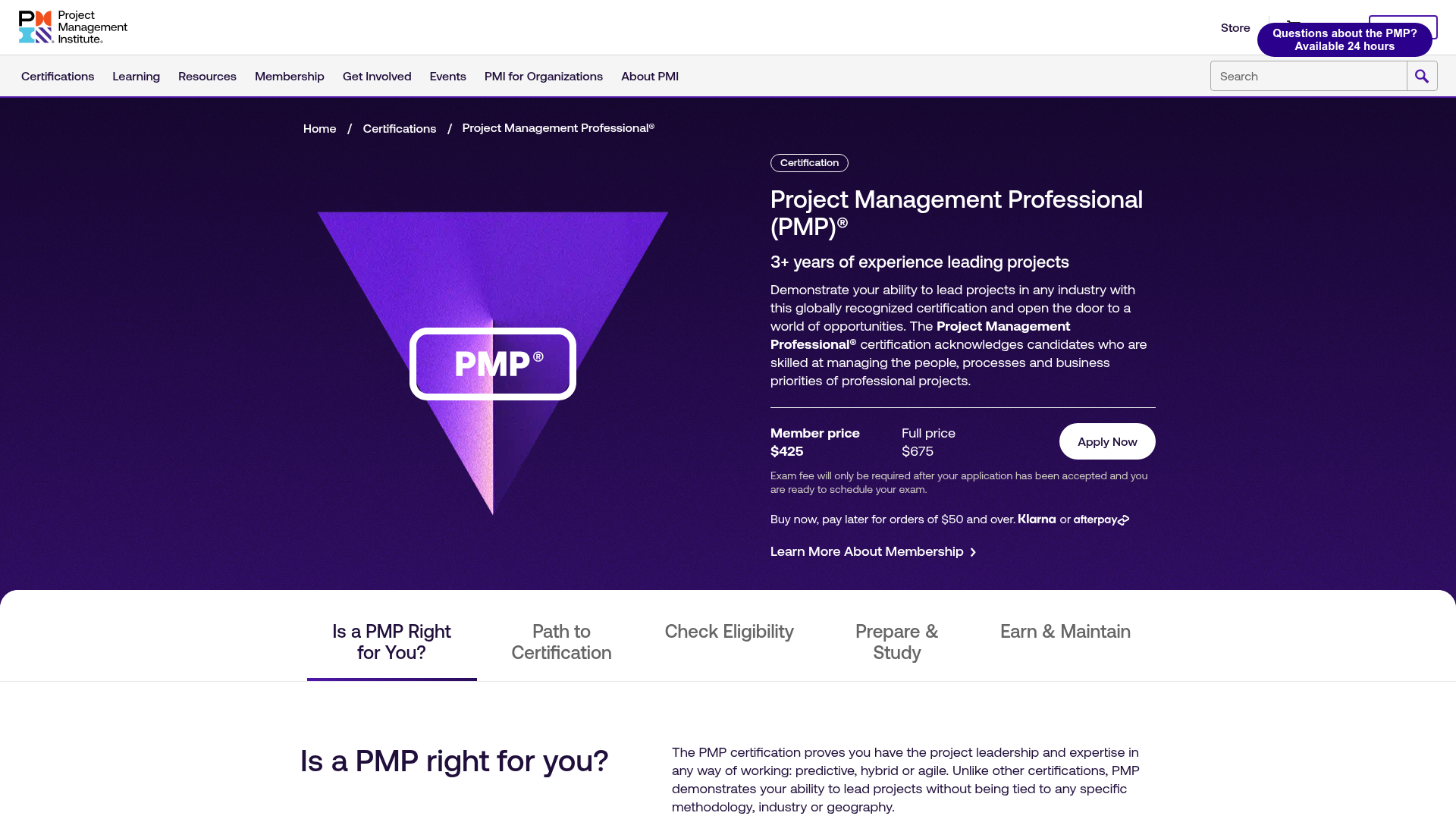
According to PMI’s current pricing shown on the official certification page:
Candidate Type | Exam Fee |
|---|---|
PMI Member | $425 |
Non-member | $675 |
Many candidates join PMI because the membership discount can reduce the total cost equation, especially if they also want access to standards, member resources, and ongoing professional development support.
PMP exam format in 2026
The PMP exam is designed to test practical decision-making, not just recall.
Key exam facts
Exam Element | Details |
|---|---|
Number of questions | 180 |
Time allowed | 240 minutes |
Breaks | Two 10-minute breaks |
Delivery options | Pearson VUE test center or online |
Question style | Scenario-based, application-focused |
Languages | Multiple languages available through PMI |
Domain weighting
Domain | Weight |
|---|---|
People | 33% |
Process | 41% |
Business Environment | 26% |
This structure reflects the real work of modern project leadership. You need to handle team dynamics, delivery mechanics, and strategic business alignment - not just one dimension.
What the PMP exam actually tests
A lot of candidates over-focus on memorizing terminology. That is rarely enough.
The exam is really testing whether you can:
respond to changing project conditions
choose the best next action as a project leader
balance stakeholder expectations with delivery realities
apply agile, hybrid, and predictive thinking appropriately
make disciplined decisions under constraint
In practice, many questions ask:
What should the project manager do first?
How should a leader respond to risk, conflict, or change?
Which action best aligns with governance and value delivery?
What is the most appropriate response in a hybrid or agile environment?
That means your prep should include judgment training, not just content review.
PMP syllabus and study areas
While the exam is structured around domains rather than the old process-group-only mindset, candidates still benefit from mastering the broader PMI ecosystem.
You should be comfortable with:
stakeholder engagement
schedule and cost thinking
risk and issue management
quality and governance
team leadership
communications
business value
change control
adaptive delivery
hybrid execution patterns
The strongest candidates can move fluidly between concepts rather than treating each topic as isolated.
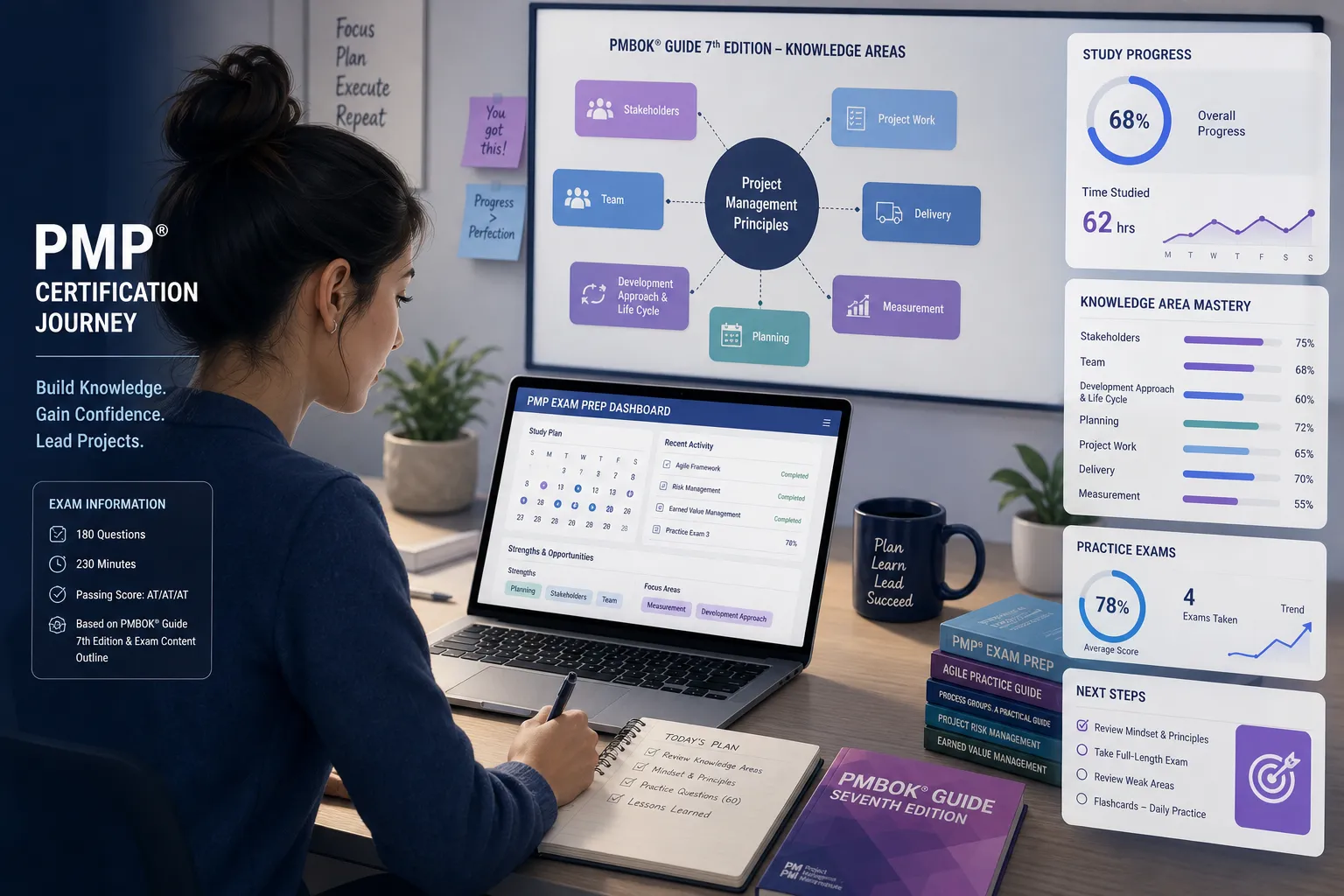
That is one reason CramAI’s connected topic insights and knowledge maps are especially useful. Instead of studying “risk,” “stakeholders,” and “change control” as separate boxes, you can see how they interact in realistic scenarios.
How hard is the PMP exam?
The PMP is challenging, but not impossible. It is best described as conceptually demanding and mentally fatiguing, especially for busy professionals who have been out of exam mode for a while.
Why candidates find it difficult
long exam duration
scenario-heavy questions
similar answer choices
need to think like PMI, not just like your employer
switching between predictive, agile, and hybrid logic
pressure from work-life-study balance
Why candidates fail
Not usually because they are incapable. More often because they:
study passively
rely too much on one source
skip mock exam analysis
memorize definitions without applying them
fail to diagnose their weak domains
That is exactly where an AI study workflow can help. CramAI can reduce cognitive overload by identifying what matters most, surfacing weak areas, and adjusting the study path in real time rather than forcing you through static content.
Best ways to prepare for PMP
There is no single perfect prep path, but there is a high-probability method.
A strong PMP prep stack usually includes:
a qualifying 35-hour training course
a reliable understanding of the ECO and exam style
one or more trusted source materials
realistic mock exams
structured review of mistakes
spaced repetition and targeted weak-area revision
The biggest mistake: collecting resources without a system
Many candidates download PDFs, save YouTube videos, buy a course, open a simulator, and still feel unprepared because the materials never become a coherent learning plan.
That is where CramAI fits naturally into PMP preparation.
How CramAI makes PMP prep more efficient
CramAI is especially useful for PMP candidates because the exam demands integration, not just memorization.
Here’s what that looks like in practice
Upload all your study materials
You can bring together:
PMI-aligned PDFs
training handouts
slide decks
notes
website URLs
YouTube lessons
audio explanations
internal team materials
Turn content into a personalized study plan
Instead of manually deciding what to study next, CramAI can organize your materials into a structured plan based on:
your timeline
current weak areas
exam goals
topic overlap
assessment performance
Get source-anchored answers with traceability
One major issue with generic AI tools is trust. For certification prep, vague answers are dangerous. CramAI emphasizes traceable responses linked back to source material, helping reduce hallucinations and improve confidence in what you’re learning.
Build deeper understanding with concept linking
PMP candidates often struggle because project management concepts are interdependent. CramAI helps connect topics such as:
risk and stakeholder communications
governance and business environment
agile ceremonies and team leadership
schedule pressure and change control
Use dynamic assessments to identify knowledge gaps
Rather than guessing what you do not know, dynamic assessment can reveal specific blind spots and adapt your plan accordingly.
Reduce wasted effort
Busy professionals do not need more content - they need better prioritization. CramAI lowers cognitive load by focusing attention on the highest-impact material.
Why this matters for organizations too
For enterprise teams, PMOs, and learning leaders, CramAI can support scalable certification readiness with structured plans, centralized knowledge, and more consistent preparation workflows across cohorts.
PMP study plan: a smarter 8-week framework
Below is a realistic structure for many working professionals.
Week | Focus | Output |
|---|---|---|
1 | Eligibility, exam blueprint, baseline assessment | Study roadmap |
2 | People domain fundamentals | Notes, scenario drills |
3 | Process domain core concepts | Practice sets, error review |
4 | Business environment + hybrid thinking | Concept links, summaries |
5 | Agile, stakeholder, risk, governance integration | Mixed scenario practice |
6 | Full mock exam + deep review | Gap analysis |
7 | Weak-area targeting + timed drills | Adaptive revision |
8 | Final review + endurance prep | Exam readiness check |
With CramAI, this plan becomes more than a spreadsheet. It becomes a living preparation system that can evolve when your assessments show new weaknesses or when your available study time changes.
Official PMP page and application flow
The most reliable place to confirm current pricing, eligibility, and application steps is the official PMI page.
Typical path to certification
confirm eligibility
complete training hours if needed
submit your PMI application
receive approval
pay exam fee
schedule exam
prepare and sit for the test
maintain certification through PDUs
How to avoid common PMP prep mistakes
Mistake 1: Studying only for knowledge recall
The exam rewards application and judgment. Use scenario-based prep early.
Mistake 2: Ignoring weak-area analysis
A mock score is only useful if you analyze the patterns behind missed questions.
Mistake 3: Using too many disconnected tools
Fragmentation slows learning. Centralize your materials and feedback loops.
Mistake 4: Underestimating endurance
Four hours of testing requires pacing and mental stamina.
Mistake 5: Waiting too long to practice
Candidates often “finish content first” and delay mock exams. That usually backfires.
How to maintain your PMP after passing
PMP is not a one-and-done credential. PMI requires ongoing renewal.
Maintenance requirement
You must earn 60 PDUs every three years to keep your certification active.
PDUs can come from:
learning
teaching
presenting
reading
volunteering
content creation
This is another place where a platform like CramAI can add long-term value - not only for exam prep but for ongoing professional learning, internal knowledge organization, and structured upskilling across teams.
PMP vs other options
If you are deciding between PMP and alternatives, the best choice depends on career timing and role requirements.
Credential | Best For | Typical Stage |
|---|---|---|
PMP | Experienced project leaders | Mid-career and above |
CAPM | Early-career candidates | Entry to junior |
Agile-focused certs | Agile delivery roles | Varies |
PRINCE2 | Method-specific environments | Varies |
PMP often stands out because it is broad, recognized, and portable across industries.
Final verdict: should you pursue PMP?
If you already lead projects and want a credential that improves credibility, mobility, and earning potential, PMP remains one of the strongest professional certifications available in 2026.
But the real differentiator is not just taking the exam. It is how efficiently and intelligently you prepare.
If you want to avoid fragmented study, wasted effort, and generic AI outputs, CramAI offers a more modern path: upload your materials, generate a personalized prep plan, identify knowledge gaps fast, connect concepts across domains, and study with source-anchored confidence.
For serious candidates, that means less noise, better judgment, and a clearer route to passing.
FAQ
What is a PMP salary?
PMP salary varies by country, industry, and seniority, but PMI reports that PMP-certified professionals in the U.S. earn a median salary of $135,000. In the same survey, certified professionals earned notably more than those without the credential, making PMP a strong compensation signal.
Is a PMP actually worth it?
For professionals who already lead projects or want to move into project leadership, PMP is often worth it because it combines employer recognition, global portability, and salary upside. Its value is highest when paired with a smart study strategy and real-world experience.
Is PMP still worth it in 2026?
Yes, PMP is still worth it in 2026 for many candidates because it remains one of the most recognized project management credentials worldwide. It is especially valuable for professionals working across predictive, agile, and hybrid delivery environments.
Is PMP very hard?
PMP is challenging, mainly because the exam is scenario-based, four hours long, and judgment-heavy. Most candidates struggle not with definitions, but with applying the right decision logic under pressure.
Is PMP still worth it in 2026?
Yes. With more than 1.7 million certification holders worldwide and continued employer recognition, PMP remains a strong credential for career growth, credibility, and advancement in project-driven roles.
Is PMP harder than CPA?
They are difficult in different ways. PMP is demanding because of its situational decision-making and breadth across project leadership, while CPA is typically more accounting-intensive and technically specialized, so the harder one depends on your background.