

How to Turn Your Own Study Materials Into a Full Practice Exam With AI
Studying from scattered notes, PDFs, lecture slides, videos, and bookmarked articles is one thing. Turning all of that into a realistic, exam-style experience is another.
That’s where a dedicated AI exam generator can make a real difference.
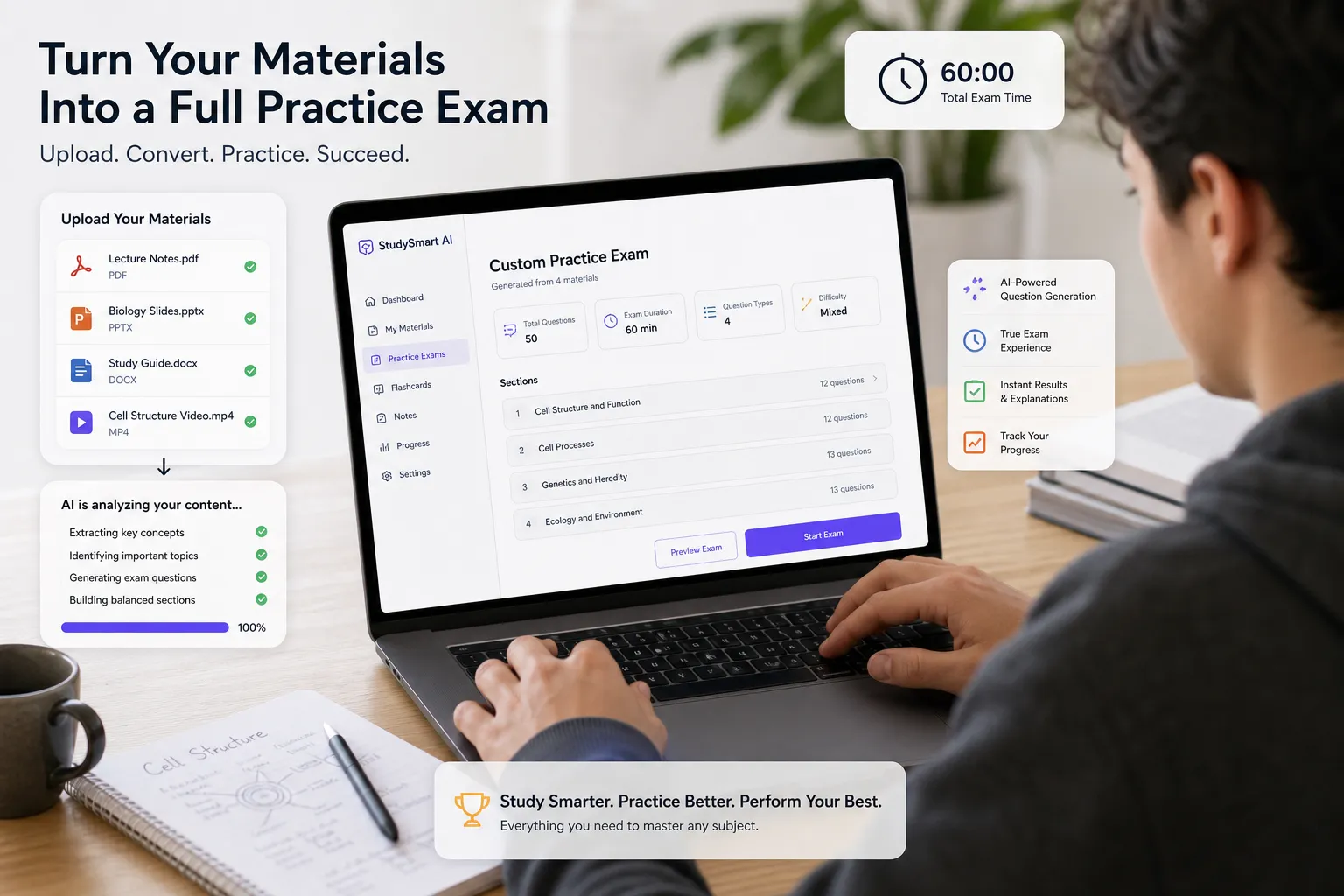
Instead of creating a few quick review questions, the right system can build a complete practice exam from your own materials: one that spans multiple topics, uses different question types, reflects your target difficulty, and helps you rehearse under timed conditions. For students, certification candidates, educators, and knowledge professionals, this is a much more strategic way to prepare than passive rereading.
CramAI is built for exactly this kind of workflow. Its exam mode supports the full preparation cycle: upload your materials, define your exam scope, generate a full assessment, complete it under realistic conditions, review performance, trace answers back to source material, and create follow-up practice based on actual weak areas. That means less cognitive overload, more focus, and better use of every study session.
A Full Practice Exam Is Not the Same as a Short Quiz
Many tools can generate a short quiz from a paragraph of text. That can be useful for quick revision, but it is not the same as a complete exam simulation.
A full practice exam should do more than check whether you remember a few definitions. It should:
cover multiple topics from your study materials
include a balanced mix of recall and application
reflect realistic exam structure and pacing
test your ability to move between concepts
reveal weak areas across the syllabus, not just in one section
A short quiz might ask 5 to 10 questions on one concept. A true practice exam generator should be able to produce a structured paper from your notes, documents, and other inputs with enough breadth to feel like meaningful rehearsal.
Quick Comparison: Quiz vs Full Practice Exam
Feature | Short Quiz | Full Practice Exam |
|---|---|---|
Scope | One topic or subtopic | Multiple topics across the syllabus |
Length | Usually 5–10 questions | Can include dozens of questions |
Purpose | Fast knowledge check | Realistic exam preparation |
Question variety | Often limited | Mixed formats and difficulty |
Timing | Usually untimed | Designed for timed completion |
Review value | Surface-level feedback | Deeper performance analysis |
Best use case | Daily revision | Final prep and mock testing |
If your goal is true exam readiness, generating a mock exam from PDF notes or mixed-source materials is far more valuable than stopping at a simple quiz.
Why AI-Based Practice Exams Work So Well
The value is not just speed. It’s alignment.
When you generate test questions from notes you already use, your practice becomes directly tied to the material you are expected to understand. That is especially useful when your learning sources are personalized: course handouts, your own annotations, internal training documents, certification prep guides, lecture recordings, or slides.
"Students who engaged in practice tests outperformed those in non-testing learning conditions." - Rethinking the Use of Tests: A Meta-Analysis of Practice Testing
"Retrieval practice showed a weighted mean effect size of 0.51 based on 334 studies involving 61,716 students." - Visible Learning – Retrieval Practice Details
These findings matter because a well-designed AI question generator is not only saving time. It is helping you apply one of the most effective learning methods available: retrieval practice.
What You Need Before You Generate a Full Exam
Before creating a full exam, define the inputs and constraints clearly. This is where the quality of the result is often won or lost.
1. Gather the Right Source Materials
Start with the materials that best represent what you need to know. These may include:
class notes
textbook chapters
lecture slides
PDFs
website URLs
recorded lessons
YouTube explainers
internal company documents
certification prep documents
CramAI supports multiple content formats, which is important because most learners do not study from a single source. You may have a PDF guide, a slide deck, a webinar recording, and handwritten notes all covering the same domain from different angles.
The more relevant and current the source set, the better the generated exam will reflect your actual preparation needs.
2. Define the Exam Scope
Do not ask the system to generate an exam from “everything” unless that truly matches your objective.
Instead, decide:
what exam or assessment you are preparing for
which topics should be included
which topics should be excluded
whether the goal is broad review or deep testing
how closely you want to simulate real test conditions
For example, a student preparing for a biology final might want an exam covering cell respiration, genetics, and ecology only. A certification candidate may want only domain 2 and domain 4 from the official blueprint, based on current weak areas.
The Ideal Workflow for Creating a Full Practice Exam With AI
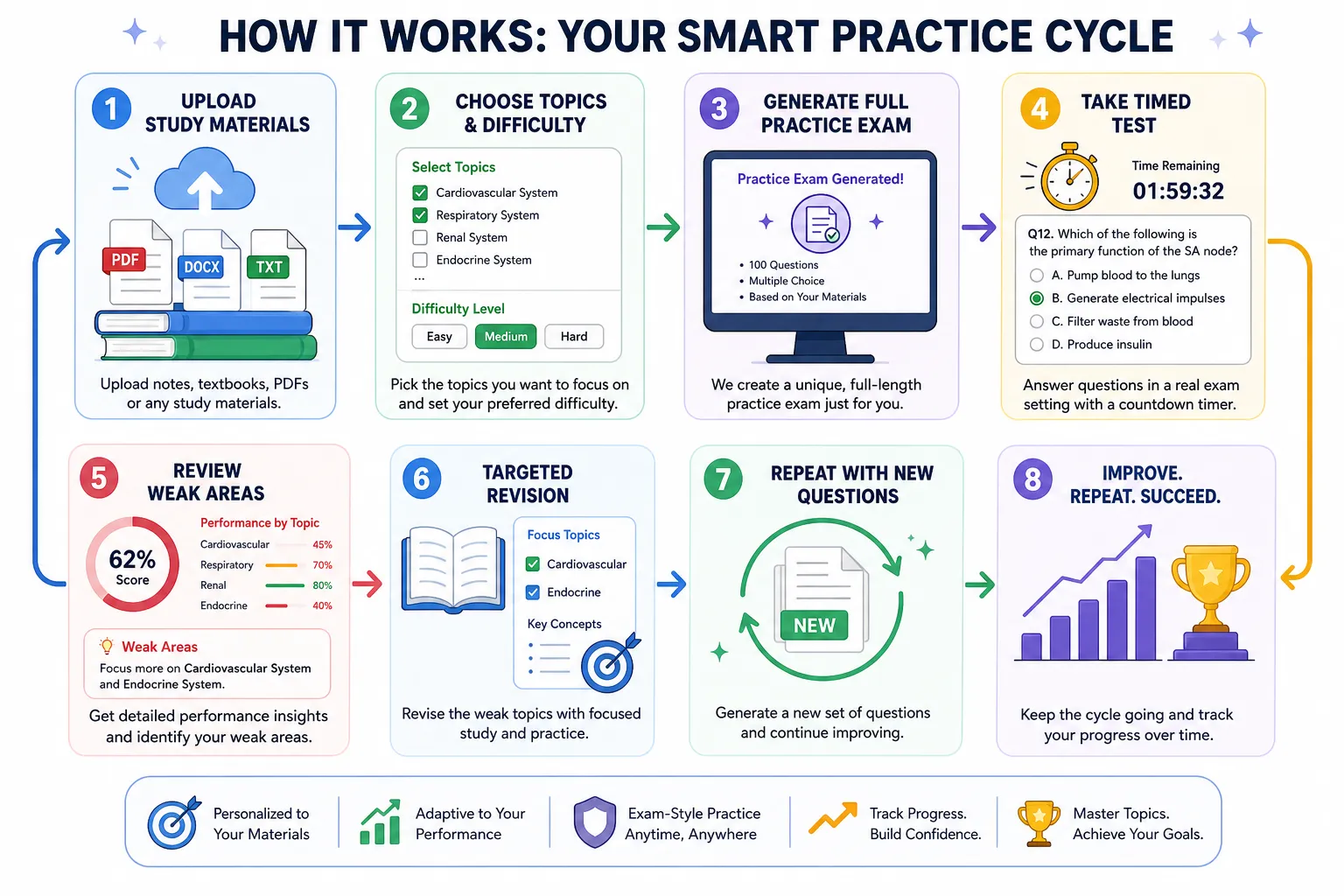
Step 1: Select the Source Materials and Exam Scope
Upload or link the materials you want the system to use. This is where CramAI’s all-in-one study workflow becomes especially useful. Rather than forcing you into one file type, it can work across PDFs, documents, slides, URLs, videos, and other formats.
At this stage, keep your source set intentional. If you are building a full exam, the materials should collectively represent the knowledge boundaries you want tested.
Best practice:
use clean, complete materials
remove irrelevant documents
group content by unit, module, or objective
prioritize the most exam-relevant sources first
What to Avoid
Avoid feeding the system a random pile of resources with conflicting depth and outdated content. AI is strongest when the study scope is thoughtfully curated.
Step 2: Choose Topics, Question Types, Difficulty, and Number of Questions
This is the step that separates a generic output from a useful exam simulation.
A robust practice exam generator should let you shape the assessment around real needs, including:
topic coverage
cognitive level
format mix
total number of questions
overall difficulty
Topic Coverage
Choose whether the exam should:
evenly cover all selected topics
prioritize high-weight topics
focus on areas you struggle with
emphasize integrated, cross-topic reasoning
CramAI’s concept-linking capability is especially valuable here. Instead of treating subjects in isolation, it can help surface relationships across ideas, which leads to more realistic application-based questions.
Question Types
A complete exam should include question types appropriate to your target assessment. Depending on context, that may include:
multiple-choice questions
true/false questions
short-answer questions
scenario-based questions
matching items
case interpretation prompts
If the goal is exam realism, a mix is usually stronger than a single format. Pure recall checks may feel productive, but they rarely reveal how well you can apply knowledge under pressure.
Difficulty Level
Set the difficulty intentionally:
Difficulty | Best For | What It Should Test |
|---|---|---|
Easy | Early-stage review | Core definitions and basic recall |
Moderate | Mid-stage practice | Understanding and accurate application |
Challenging | Final-stage prep | Judgment, interpretation, synthesis |
A good AI exam generator should not only produce more difficult wording. It should increase the thinking demand of the task itself.
Number of Questions
A short revision set and a full exam are different tools.
As a rough guide:
Goal | Suggested Length |
|---|---|
Quick topic check | 5–10 questions |
Section review | 15–25 questions |
Half-length mock | 25–40 questions |
Full practice exam | 40+ questions, depending on your target |
The ideal length depends on your real exam format and available time.
Step 3: Generate a Complete Practice Exam
Once scope and settings are defined, generate the full exam.
This is where learners often realize the difference between a lightweight AI question generator and an exam-focused system. A real exam mode should create a complete, coherent assessment rather than isolated prompts.
The output should feel structured:
clear instructions
grouped or ordered questions
sensible distribution across topics
progressive or balanced difficulty
answer key or review mode available afterward
In CramAI, this process is enhanced by source-anchored generation. That means the questions and answer support can be connected back to the original uploaded materials, improving traceability and reducing blind trust in unsupported outputs.
Important Note on Realism
AI-generated questions should be used as practice, not mistaken for official exam questions.
That distinction matters. Even when the format feels highly relevant, the purpose is preparation and diagnostic feedback, not prediction. No tool should claim to reproduce proprietary exam content or guarantee exam readiness.
Step 4: Complete the Exam Under Timed Conditions
A full practice exam only becomes truly useful when you take it like an exam.
That means:
sit in one focused session if possible
use a timer
avoid checking notes mid-test
complete questions in sequence unless your real exam allows navigation strategies
mark uncertainty honestly
This is the stage where timing friction appears. Many learners think they know the content until they must retrieve and apply it on demand. Timed completion reveals:
pacing issues
fatigue points
gaps in procedural confidence
topics that are understood in theory but not in action
CramAI’s adaptive assessment approach becomes powerful after this point because performance data can influence what happens next, rather than leaving you to interpret everything manually.
Step 5: Review Answers and Identify Weak Areas
Review is where the learning gain happens.
Do not stop at your score. A raw percentage tells you much less than a careful post-exam analysis.
Look for patterns such as:
repeated misses in one topic area
errors caused by misreading questions
strong recall but weak application
weak distractor analysis in multiple-choice items
inability to connect related concepts across sections
Review by Error Type
A smart review process classifies mistakes, for example:
Error Type | What It Usually Means | Next Action |
|---|---|---|
Fact recall error | Knowledge gap | Relearn key facts and definitions |
Concept confusion | Partial understanding | Compare similar concepts side by side |
Application mistake | Weak transfer skill | Practice scenarios and case questions |
Time-pressure error | Pacing issue | Retake shorter timed sets |
Source misunderstanding | Poor note interpretation | Return to original material and annotate |
CramAI is particularly effective here because it does not just show an answer. Its trustworthy, source-anchored response model helps you trace the explanation back to the original materials that informed it. That gives learners a more reliable path from mistake to correction.
Step 6: Return to the Original Materials for Targeted Review
This is one of the most overlooked parts of effective preparation.
Many learners generate questions, take the test, review the score, and then move on. But the real advantage of using your own materials is that every weak point can be linked back to the exact source that needs attention.
That means you can return to:
the specific PDF section
the relevant slide deck
a segment of a lecture video
a note cluster in your own study set
a linked concept map or summary
This reduces cognitive load dramatically. Instead of restudying everything, you focus on what matters most.
CramAI’s personalized study planning is built around that principle. After identifying weak areas, it can help reorganize the next study phase in real time so you spend more energy where it will have the biggest impact.
Step 7: Generate Additional Practice Where Necessary
Your first exam should not be your last.
Once weak areas are identified, generate targeted follow-up practice that is narrower and more strategic. This may include:
topic-specific mini exams
harder scenario-based questions
mixed review sets from weak domains
new question variations based on the same source material
cumulative retests after revision
This is where adaptive learning matters. The best results come when your study strategy changes based on evidence. CramAI’s dynamic assessments help support that loop: assess, diagnose, revise, regenerate, and reassess.
What a Great AI-Generated Practice Exam Should Include
Not every generated exam will be equally useful. The strongest ones share a few qualities.
Comprehensive Topic Coverage
The exam should represent the selected syllabus fairly. If one module dominates because it happened to be easier for the system to summarize, the assessment becomes less useful.
More Than One Cognitive Level
Good exams test both memory and use. You want some questions that check core knowledge and others that ask you to interpret, compare, prioritize, or solve.
Realistic Structure
Even if it is not an exact replica of a formal exam, the flow should feel intentional. A complete paper has rhythm, coverage, and challenge distribution.
Actionable Review
You should finish the exam knowing what to do next, not just how many answers you got wrong.
Example: Professional Certification Candidate
Imagine a project manager preparing for a professional certification exam while working full-time.
Their source materials include:
a certification handbook PDF
class notes from a prep course
webinar recordings
a slide deck summarizing process groups
a set of internal project governance documents
Using CramAI’s exam mode, they could:
Upload the full set of materials.
Select only the domains most relevant to the next study block.
Request a full-length practice exam with mixed multiple-choice and scenario-based items.
Set moderate-to-high difficulty to simulate decision-making pressure.
Complete the test in one timed sitting after work.
Review which domains produced the most errors.
Trace explanations back to the relevant source materials.
Generate a new exam focused only on weak domains for the following weekend.
This is much more effective than generic internet quizzes because the assessment is built from the candidate’s real study stack. It becomes personalized, traceable, and iterative.
Where Most Competitor Tools Fall Short
Many platforms promise to generate a quiz from notes. Fewer are designed to support full exam practice in a disciplined way.
Common gaps include:
Common Limitation | Why It Matters | What CramAI Does Better |
|---|---|---|
Focus on short quizzes only | Short sets do not simulate real assessment pressure | Supports full exam-oriented workflows |
Weak source traceability | Hard to verify why an answer is correct | Anchors responses to original materials |
Limited file support | Learners use mixed content, not just one format | Accepts multiple study material types |
Static feedback | Review stays descriptive, not strategic | Identifies gaps and adapts next steps |
Fragmented tools | Users switch between apps for notes, testing, and planning | Brings learning, testing, and study planning into one platform |
That all-in-one design is important for learners and organizations alike. Students can study more strategically, educators can organize knowledge more efficiently, and teams can scale training and assessment workflows without building everything manually.
Best Practices for Better Exam Generation Results
If you want stronger results from any mock exam from PDF or note-based workflow, follow these principles.
Be Specific About Scope
Broad prompts create diluted exams. Narrow, intentional prompts create better coverage.
Match Question Type to Goal
Use short-answer and scenario questions when application matters. Use objective formats when speed and breadth matter.
Separate Learning Mode From Testing Mode
Do not blur active study and realistic testing. First learn, then test under pressure.
Use Performance Data
If you miss the same concept in three different ways, that is a signal to change strategy, not just repeat the same content review.
Regenerate With Purpose
When you generate test from notes again, make the second version more targeted than the first.
When to Use a Full Practice Exam Instead of a Quiz
Choose a full exam when:
your assessment date is approaching
you need stamina and pacing practice
you want broad diagnostic feedback
you need to test multiple topics together
you want to simulate pressure before the real event
Choose a short quiz when:
you just finished learning one topic
you have only a few minutes
you want quick retrieval practice
you are checking one specific concept
Both are useful. They simply solve different problems.
Why CramAI Fits This Workflow Especially Well
CramAI is not just a practice exam generator. It supports the full study cycle around the exam itself.
That includes:
personalized study plans created from uploaded materials
support for PDFs, URLs, YouTube videos, documents, slides, and more
source-anchored answers for greater trust and traceability
concept linking across topics for deeper understanding
dynamic assessments that uncover knowledge gaps
study strategy adjustment in real time
reduced cognitive load through focused review
scalable workflows for individuals, educators, and organizations
creator tools for organizing knowledge and generating educational content
That combination matters because exam success is rarely about questions alone. It is about how well your materials, assessments, review loops, and study decisions work together.
Final Verdict
If you want to prepare seriously, do not settle for a handful of auto-generated review questions.
A true AI exam generator should help you build a complete practice experience from your own materials, with realistic scope, meaningful difficulty, timed execution, and review that drives targeted improvement. That is the difference between casual quizzing and strategic exam preparation.
CramAI’s exam mode is designed for exactly that use case. It helps you turn notes, PDFs, videos, slides, and other study resources into full practice exams that are personalized, source-aware, and adaptable. For students, certification candidates, lifelong learners, and teams, that means a faster path from content overload to focused, evidence-based preparation.
If you are ready to study smarter, generate a complete practice exam from your own materials and let CramAI guide what to do next.