
Study With AI: Smarter Learning Strategies for 2026
Studying in 2026 is no longer just about working harder. It is about learning with more precision, less wasted effort, and better feedback loops. Students, exam candidates, professionals, and lifelong learners are all facing the same challenge: too much information, not enough time, and no room for inefficient study habits.
That is exactly why more people now study with AI. The right AI learning system can turn scattered notes, PDFs, lectures, slides, videos, and recordings into a structured path forward. Instead of guessing what to revise next, learners can get personalized study plans, faster review cycles, gap analysis, and source-based answers they can trust.
CramAI is built for this new reality. It goes beyond generic chat by helping users learn, test, assess, guide, and refine their preparation across the full study cycle. Whether you are preparing for university exams, IELTS, certifications, or organizational training, AI can reduce cognitive load and help you focus on what matters most.

Why studying with AI matters in 2026
The biggest change is not that AI exists. It is that learners now expect support that is adaptive, immediate, and personalized.
Traditional study methods still matter, but they often break down when:
materials are spread across multiple formats
revision time is limited
learners do not know their weakest areas
generic summaries miss course-specific nuance
feedback arrives too late to change outcomes
AI helps solve these problems when it is used as a learning system instead of a shortcut.
"In 2025, approximately 70-85% of U.S. college students used AI for schoolwork, up from about 30% in 2023." - Presenc.ai
That adoption curve tells a clear story. AI is no longer experimental in education. It is becoming core study infrastructure.
What it really means to study with AI
To study with AI effectively means using intelligent tools to improve how you absorb, organize, recall, and apply knowledge.
That includes:
converting raw materials into a coherent study plan
generating summaries without losing source context
identifying knowledge gaps before test day
receiving tailored practice questions
linking concepts across topics for deeper understanding
adjusting study intensity based on real performance
This is where CramAI stands out. Instead of acting like a one-off chatbot, it supports the full learning journey with multimodal inputs, traceable answers, adaptive guidance, and dynamic assessments.
The shift from information overload to guided learning
Most learners do not fail because they lack content. They struggle because they lack structure.
A better way to study with AI is to treat it as a decision-support layer for learning. That means the tool should help answer questions like:
Study challenge | Old approach | Smarter AI-supported approach |
|---|---|---|
Too many materials | Manually sort files and notes | Upload PDFs, slides, audio, websites, and videos into one system |
Unsure what to revise | Re-read everything | Prioritize based on gaps and exam goals |
Weak retention | Passive reading | Active recall, quizzes, and concept linking |
Low trust in answers | Generic AI response | Source-anchored answers with traceability |
Static study plan | Same routine every week | Real-time strategy adjustment based on performance |
When AI is used this way, it becomes a force multiplier rather than a distraction.
The biggest benefits of AI-powered study support
Personalized learning paths
One of the strongest advantages of AI in education is personalization. Different learners need different pacing, different reinforcement, and different sequencing.
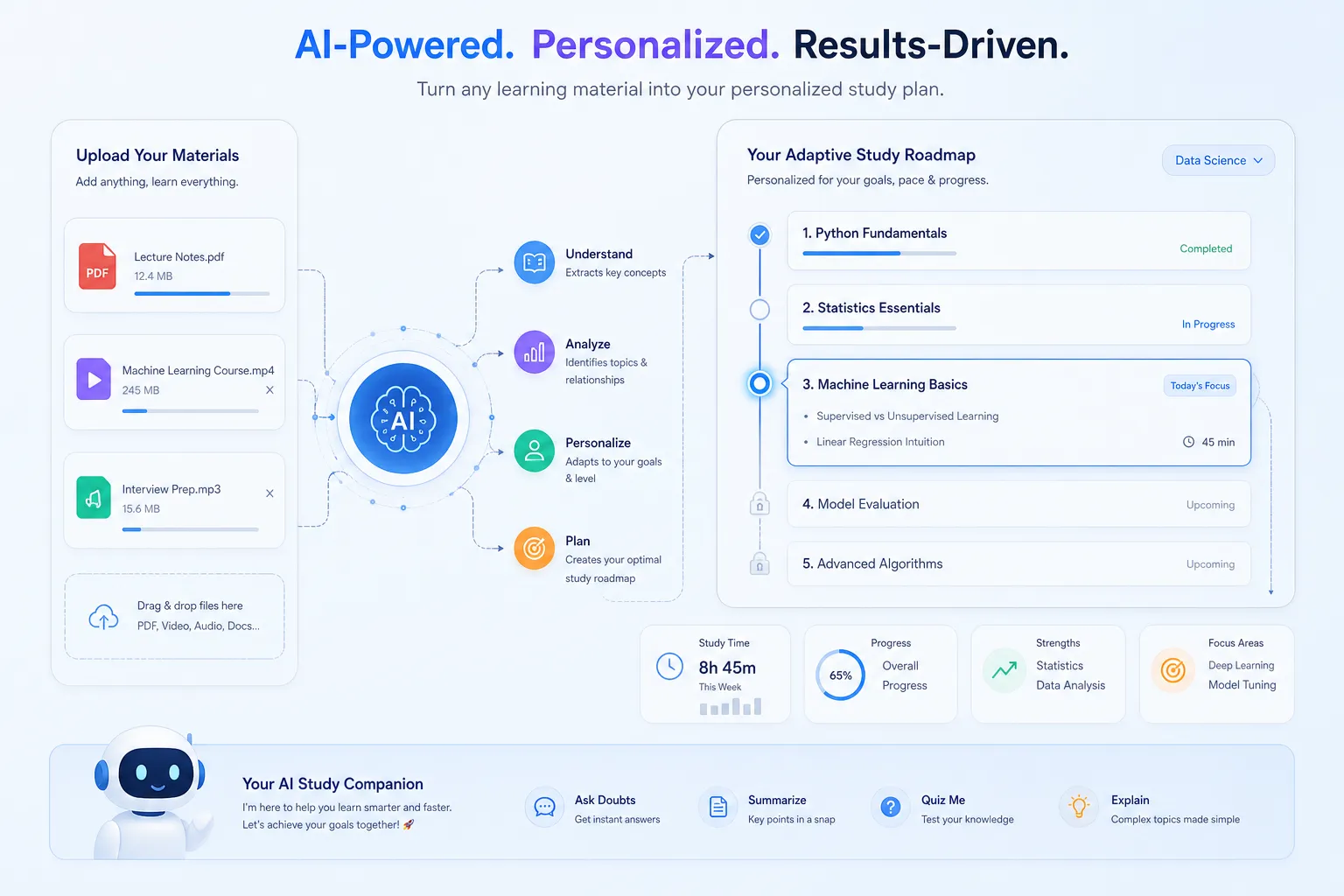
CramAI can transform uploaded materials into personalized study plans based on goals, topic difficulty, and performance signals. That means a medical student, an IELTS candidate, and a finance professional can all use the same platform in very different ways.
Faster review and better retention
A common problem with traditional revision is time waste. Learners spend too long summarizing, rewriting, and reorganizing before they even begin active learning.
AI compresses that setup time. Instead of spending hours preparing to study, learners can move directly into recall, practice, and reinforcement.
Trustworthy answers with source traceability
One content gap in many articles about AI learning is trust. They celebrate speed, but rarely explain how to reduce hallucinations or verify outputs.
This matters. If you are studying for an exam, a certification, or a professional qualification, the answer must be reliable.
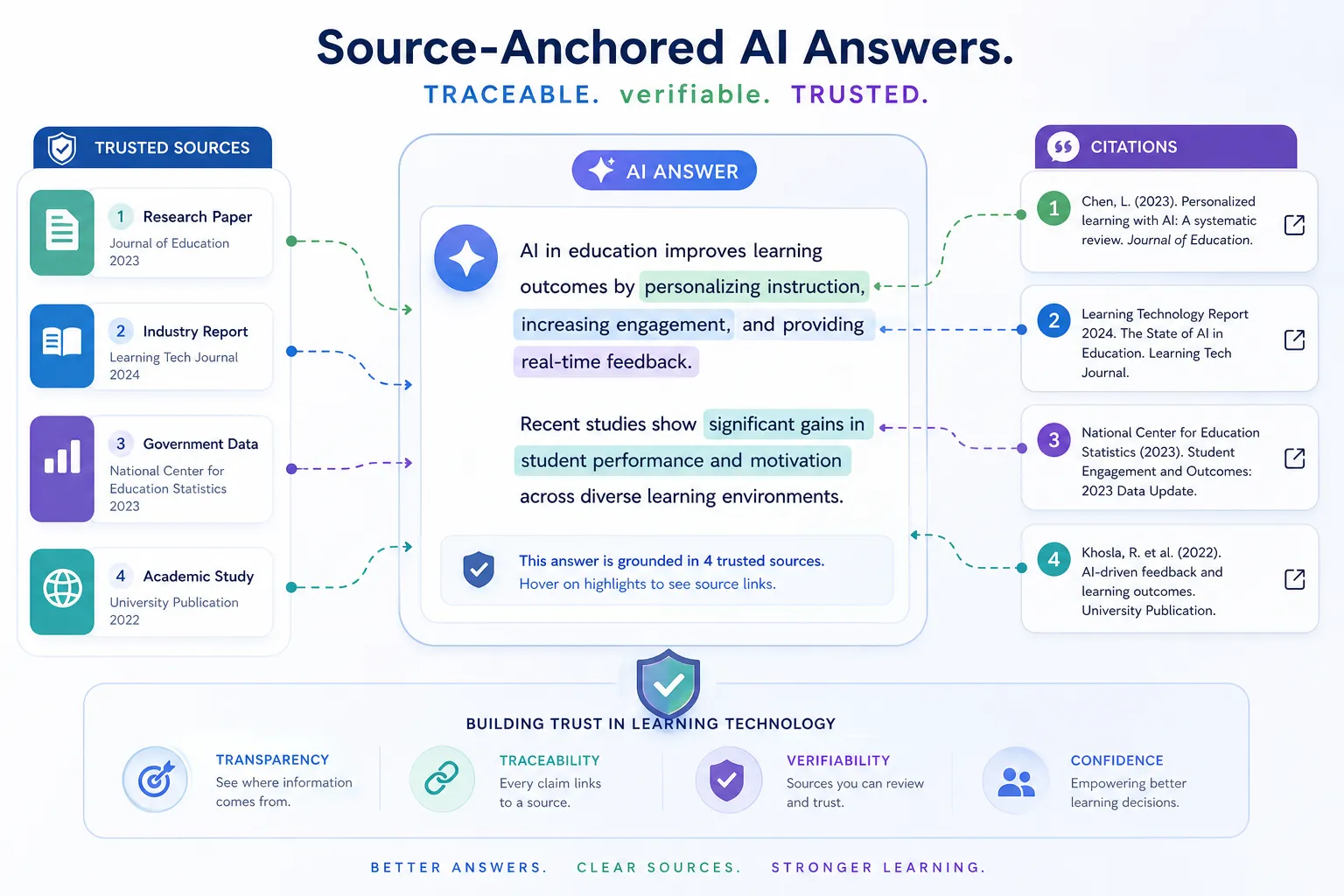
CramAI addresses this with source-anchored responses and traceability. Learners can track explanations back to original materials, which improves confidence and supports deeper verification.
Dynamic assessment and real-time adaptation
Most learners do not know what they do not know. That is why dynamic assessments are so powerful.
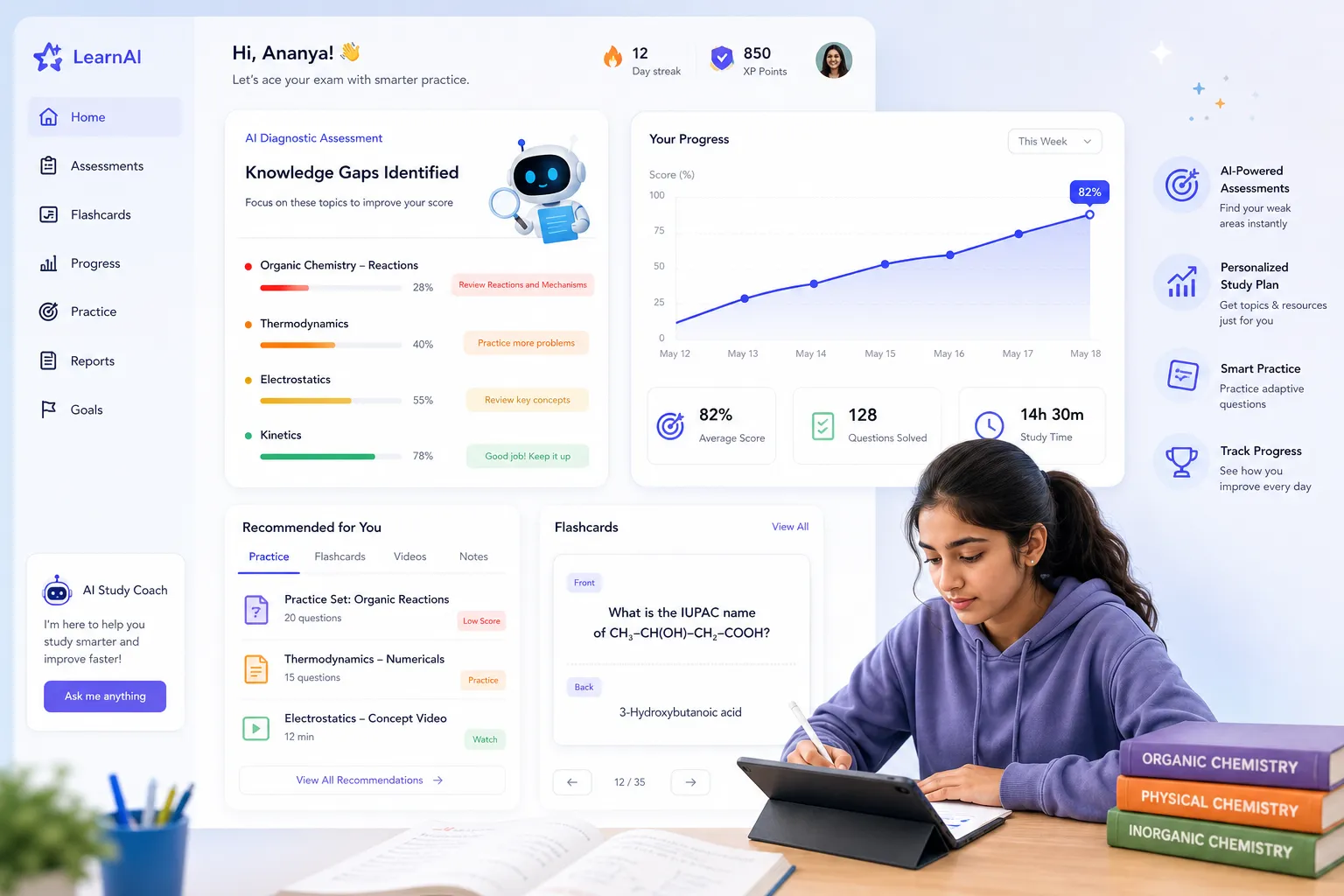
Instead of following a fixed revision plan, AI can continuously identify weak spots, test understanding, and adjust the strategy. If a learner masters one topic quickly but struggles with another, the system should respond immediately.
This makes preparation more efficient and more evidence-based.
Lower cognitive load
Another often-overlooked benefit is mental clarity. AI can reduce the friction of planning, organizing, and locating relevant information, so learners preserve their energy for actual thinking.
That is especially valuable for:
graduate students handling dense research
busy professionals studying after work
standardized test takers under time pressure
teams managing large-scale upskilling programs
Where many AI study tools still fall short
Not every AI tool is built for serious learning. Many competitors focus on generic chat or single-use productivity features, but they gloss over what learners actually need for outcomes.
Common limitations in the market
no support for multiple content formats
no source traceability
weak assessment capabilities
limited concept mapping
static outputs that do not adapt over time
no scalable workflow for institutions or teams
That is the gap CramAI fills. It combines study support, exam prep, knowledge organization, adaptive testing, and creator tools in one environment.
Smart ways students and professionals can study with AI in 2026
Turn raw content into an organized study engine
Start by uploading everything relevant: lecture slides, class notes, PDFs, web pages, YouTube lessons, audio recordings, and supporting documents. A strong AI platform should unify these into one structured knowledge base.
CramAI does this across multiple content formats, making it easier to centralize learning instead of juggling disconnected tools.
Use concept linking to deepen understanding
Memorization alone is fragile. Deeper understanding comes from seeing how ideas connect.
For example:
economics links to policy, statistics, and history
anatomy links to physiology and pathology
IELTS writing links to vocabulary, structure, and argumentation
project management links to communication, risk, and operations
CramAI’s connected topic insights can help learners see these relationships, which strengthens recall and transfer.
Shift from passive review to active diagnosis
Reading notes again feels productive, but it often creates an illusion of competence. AI is most useful when it pushes learners into active retrieval and targeted self-correction.
Use it to:
generate practice questions
simulate exam conditions
spot recurring errors
rank topics by urgency
focus revision on the biggest return areas
Adapt weekly, not just once
A static study plan created on day one is rarely enough. Learners change. Deadlines shift. Some topics click quickly; others stay difficult.
The smartest use of AI is ongoing adaptation. CramAI can automatically adjust study strategies in real time based on what the learner has mastered and what still needs work.
How CramAI supports the full learning cycle
Many tools help with one phase of learning. CramAI is designed to support the whole cycle.
Learn
Upload materials from multiple sources and formats. Get summaries, explanations, knowledge maps, and connected insights that make complex subjects easier to navigate.
Test
Generate targeted practice from real materials, not just generic prompts. This creates better alignment between what you study and what you are likely to be assessed on.
Assess
Use dynamic assessments to identify weak areas early. This is critical for exam prep, where unknown gaps often cause avoidable score loss.
Guide
Receive adaptive study recommendations that change with performance, available time, and study goals.
Support
Get trustworthy answers that remain grounded in your original sources, reducing hallucinations and improving accountability.
AI for different learner types
Undergraduate and graduate students
Students need structure, speed, and confidence. AI can help them condense readings, prepare for exams, understand dense concepts, and prioritize where to focus.
Standardized test takers
For IELTS and similar exams, learners need repetition, feedback, timing discipline, and skill-specific practice. AI can personalize these loops more efficiently than static prep books.
Busy professionals
Certification prep often happens around full-time work. AI helps professionals study efficiently by focusing on high-impact topics, automating organization, and adjusting plans around limited time.
Institutions and enterprise teams
Organizations need scalable learning systems. CramAI can support individuals and groups with tailored AI study frameworks that improve consistency and reduce administrative overhead.
Educators and knowledge creators
A major gap in competitor content is the creator side of educational AI. CramAI’s Creator Studio gives experts tools for knowledge system building, content generation, and personal brand development. That makes it useful not only for learners, but also for those packaging and distributing expertise.
Study with AI vs traditional study methods
The future is not AI or human effort. It is human effort amplified by intelligent systems.
Dimension | Traditional study | AI-supported study |
|---|---|---|
Planning | Manual and time-consuming | Automated and adaptive |
Review | Broad and repetitive | Targeted and efficient |
Feedback | Delayed | Immediate |
Personalization | Limited | High |
Source verification | Manual cross-checking | Built-in traceability when platform supports it |
Gap detection | Often subjective | Data-driven |
Scalability | Hard for teams and institutions | Strong with centralized systems |
The governance and readiness issue learners should not ignore
There is another critical issue missing from many optimistic articles: institutions are still catching up.
"In 2026, a Coursera survey of 4,200 university educators and students across five countries revealed that while 95% of students and educators use AI tools in their academic work, only 26% of institutions have formal policies governing AI use." - Coursera
This matters because effective AI learning is not only about access. It is about responsible use, transparency, and academic integrity. Learners need tools that support understanding rather than shortcuts, and institutions need platforms that can scale with accountability.
CramAI is well positioned for this environment because its source-traceable approach, knowledge mapping, and adaptive assessments support rigorous learning rather than opaque output generation.
Best practices for using AI without weakening critical thinking
A common fear is that AI will make learners passive. That risk is real if the tool is used badly. The solution is not avoiding AI. It is designing better study behavior.
Use AI to challenge your thinking, not replace it
Ask for:
comparisons between concepts
counterarguments
practice scenarios
oral explanations
error analysis on your own answers
Verify with source grounding
Whenever possible, use AI outputs that point back to original notes, documents, or lectures. This creates a healthier study process and improves trust.
Keep retrieval at the center
The final learning signal is whether you can recall, explain, and apply knowledge without support. AI should help you reach that state faster, not bypass it.
What smarter learning strategies look like in 2026
A modern AI-powered study workflow often looks like this:
Upload all relevant learning materials.
Generate a personalized study map.
Review key summaries and linked concepts.
Complete dynamic assessments.
Identify knowledge gaps.
Revise only what matters most.
Re-test and adapt.
Repeat until exam readiness is strong.
This is more efficient than rereading everything, and more reliable than using a general AI chat tool with no memory of your materials.
Final verdict: the future of studying is adaptive, source-aware, and outcome-driven
The question in 2026 is no longer whether AI belongs in learning. It is which kind of AI actually improves outcomes.
The best systems do more than summarize. They organize knowledge, personalize study paths, identify weaknesses, preserve trust through traceability, and adapt in real time. That is the difference between novelty and real educational value.
If you want to study with AI in a way that is faster, more strategic, and more evidence-based, CramAI is built for exactly that. It gives learners, educators, creators, and organizations an all-in-one study and exam preparation environment that reduces friction and increases focus.
If your current study process feels scattered, slow, or hard to trust, this is the moment to upgrade it. Try CramAI and turn your materials into a smarter path to mastery.
FAQ
What are the AI skills to learn in 2026?
In 2026, the most valuable AI skills include prompting with intent, evaluating outputs for accuracy, working with source-grounded answers, using AI for research synthesis, and building adaptive learning workflows. Learners also benefit from understanding AI ethics, traceability, and how to combine AI support with critical thinking.
What are the three new AI breakthroughs shaping 2026?
Three major shifts shaping 2026 are multimodal learning systems, real-time adaptive study planning, and source-anchored AI responses that improve trust. Together, these advances make AI more useful for serious education rather than just quick content generation.
What is the best AI for studying in 2026?
The best AI for studying in 2026 is one that combines personalized study plans, dynamic assessments, content support across multiple formats, and trustworthy source traceability. CramAI stands out because it supports the full study cycle from learning and testing to guidance and gap analysis.
What is the latest AI research in 2026?
Recent 2026 research focuses on AI adoption in education, institutional readiness gaps, and the difference between using AI to complete tasks and using it to produce durable learning. The strongest findings emphasize adaptive systems, active recall, and grounded outputs over generic chatbot use.
Which 3 jobs will survive AI?
Jobs most resilient to AI are those requiring human judgment, relationship-building, and complex contextual decision-making. Examples include educators who guide learning, healthcare professionals, and strategic leaders who interpret information and make accountable decisions.
Which is the smartest AI in 2026?
There is no single smartest AI in every category, because intelligence depends on the task. For studying, the smartest systems are those that offer accuracy, traceability, personalization, and adaptive guidance rather than just fluent answers.