
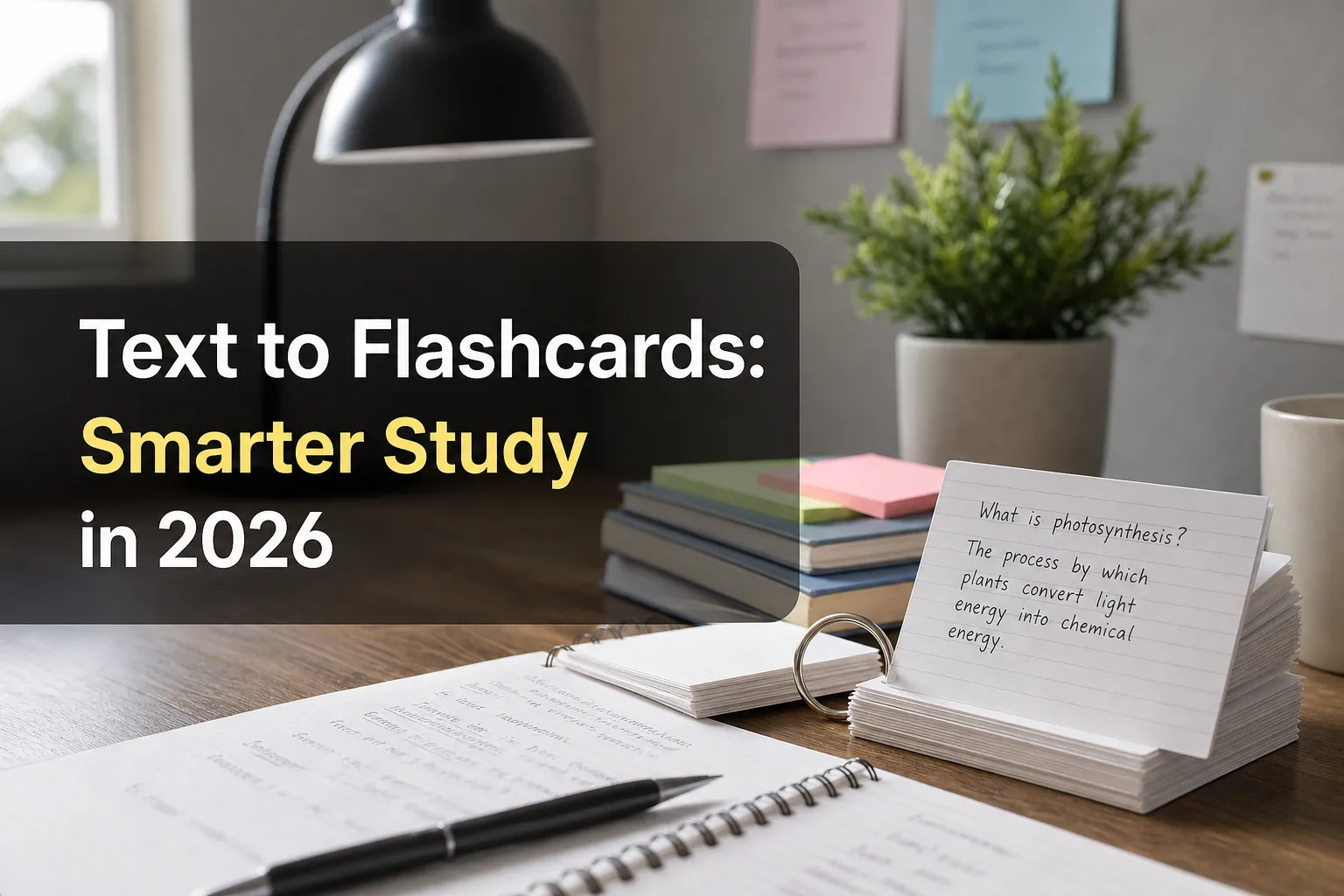
Text to Flashcards: Smarter Study in 2026
Text to flashcards is no longer a niche productivity trick. In 2026, it has become one of the most practical ways to turn passive study materials into active recall practice that actually improves retention.
Students, certification candidates, lifelong learners, and training teams all face the same bottleneck: too much content, too little time, and no reliable system for deciding what to review next. Notes pile up. PDFs stay unread. Highlighted textbooks feel productive but often do not transfer into durable memory.
That is exactly why text to flashcards matters. It converts raw material into questions and answers you can practice, revisit, and refine. And when AI is used well, the process becomes faster, more adaptive, and much easier to scale across subjects and formats.
CramAI is built for this shift. Instead of treating flashcards as isolated memorization objects, it approaches learning as a full cycle: upload material, extract key concepts, generate study assets, assess what you know, identify gaps, and adjust the plan in real time. That means less cognitive overload and more attention on the concepts most likely to move your exam performance.
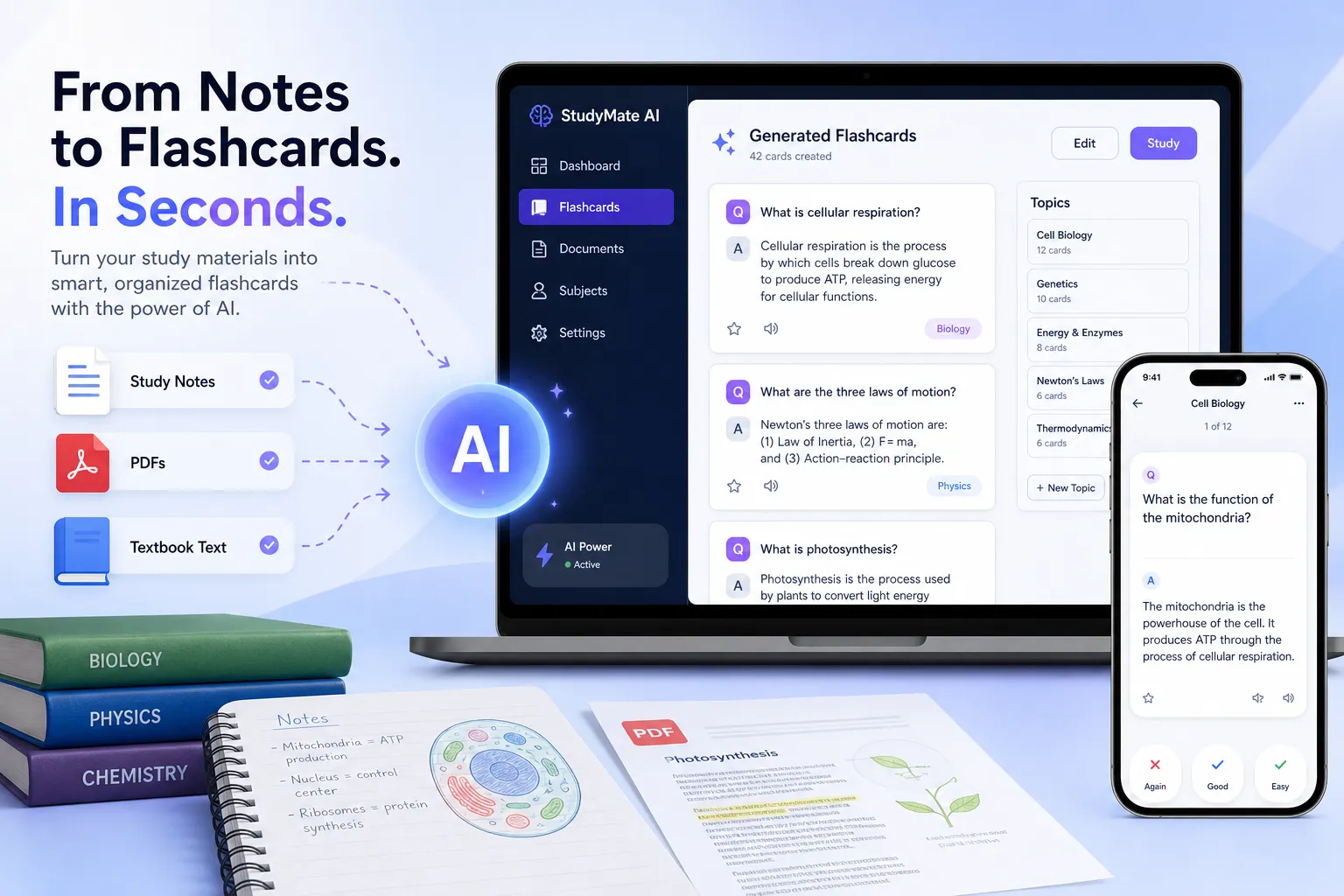
What text to flashcards really means
At its simplest, text to flashcards means taking written study material and converting it into prompt-based memory practice.
That text can come from:
class notes
textbooks
study guides
journal articles
PDFs
website pages
slide decks
transcripts
lecture summaries
The end goal is not just digitization. The goal is transformation. Instead of rereading information, you engage with it as a question, cue, case, definition, comparison, or applied scenario.
A useful flashcard system usually includes:
Component | Why it matters |
|---|---|
Clear prompt | Forces recall, not recognition |
Concise answer | Reduces overload and ambiguity |
Topic grouping | Keeps review organized |
Repetition logic | Brings back weak cards at the right time |
Editability | Lets learners refine weak AI output |
Source traceability | Helps verify accuracy and context |
Many competing articles focus on speed alone: upload a file, click generate, done. That is only half the story. The stronger approach is to combine generation with verification, concept linking, and adaptive review. That is where modern platforms like CramAI create more value than a simple card generator.
Why text to flashcards is growing so fast in 2026
The popularity of AI study tools is not just about novelty. It reflects a real change in how people learn under time pressure.
Three things are happening at once:
Study content is more fragmented
Learners now study from mixed sources, not a single textbook. A typical exam prep stack might include lecture slides, YouTube explainers, a PDF pack, audio notes, web articles, and practice questions. Manually converting all of that into flashcards is slow and inconsistent.
Passive review is losing credibility
Students have become more aware that highlighting and rereading feel useful but often produce weak recall under exam conditions. Flashcards push the brain to retrieve, discriminate, and self-check.
"Repeated retrieval enhances long-term retention and spaced repetition further improves this effect." - Spaced retrieval: absolute spacing enhances learning regardless of relative spacing - PubMed
AI can now handle multimodal input
The best tools no longer depend only on pasted text. They can process PDFs, images, slides, transcripts, web pages, and video-based content. CramAI extends that logic further by building personalized study plans from uploaded materials and anchoring responses back to the source, which helps reduce trust issues around hallucinated answers.
The science behind better flashcards
Flashcards work best when they are tied to proven learning principles rather than simple repetition.
Active recall
A flashcard is effective because it forces you to retrieve an answer from memory instead of simply recognizing it on a page.
Spaced repetition
You should not review every card equally. Strong cards need less attention. Weak cards need more. Timing matters.
"Spacing out repeated encounters with material over time leads to superior long-term learning compared to massed repetitions." - Spaced Repetition Promotes Efficient and Effective Learning - Sean H. K. Kang, 2016
Retrieval over elaboration alone
Concept maps and summaries have value, but recall practice often produces stronger learning gains when the goal is remembering and applying knowledge later.
"Retrieval practice led to greater gains in meaningful learning compared to elaborative studying with concept mapping." - Retrieval practice produces more learning than elaborative studying with concept mapping - PubMed
This is the big opportunity in text to flashcards. The format itself supports the science. AI simply helps you build and manage the system faster.
How AI improves the text-to-flashcard workflow
Manual flashcard creation can still be useful. In fact, writing your own cards often deepens processing. But manual-only workflows break down when the volume is high.
AI improves the process in several practical ways.
1. It reduces setup time
Instead of spending hours formatting cards from a textbook chapter, you can upload the source and generate a first draft in minutes.
2. It helps identify what matters
Good AI systems do not just extract random sentences. They surface definitions, comparisons, processes, cause-effect relationships, formulas, and likely testable ideas.
3. It supports multiple formats
This is essential for real-world learners. CramAI supports PDFs, website URLs, YouTube videos, audio files, documents, and slides, which makes it easier to centralize fragmented study content.
4. It adapts based on performance
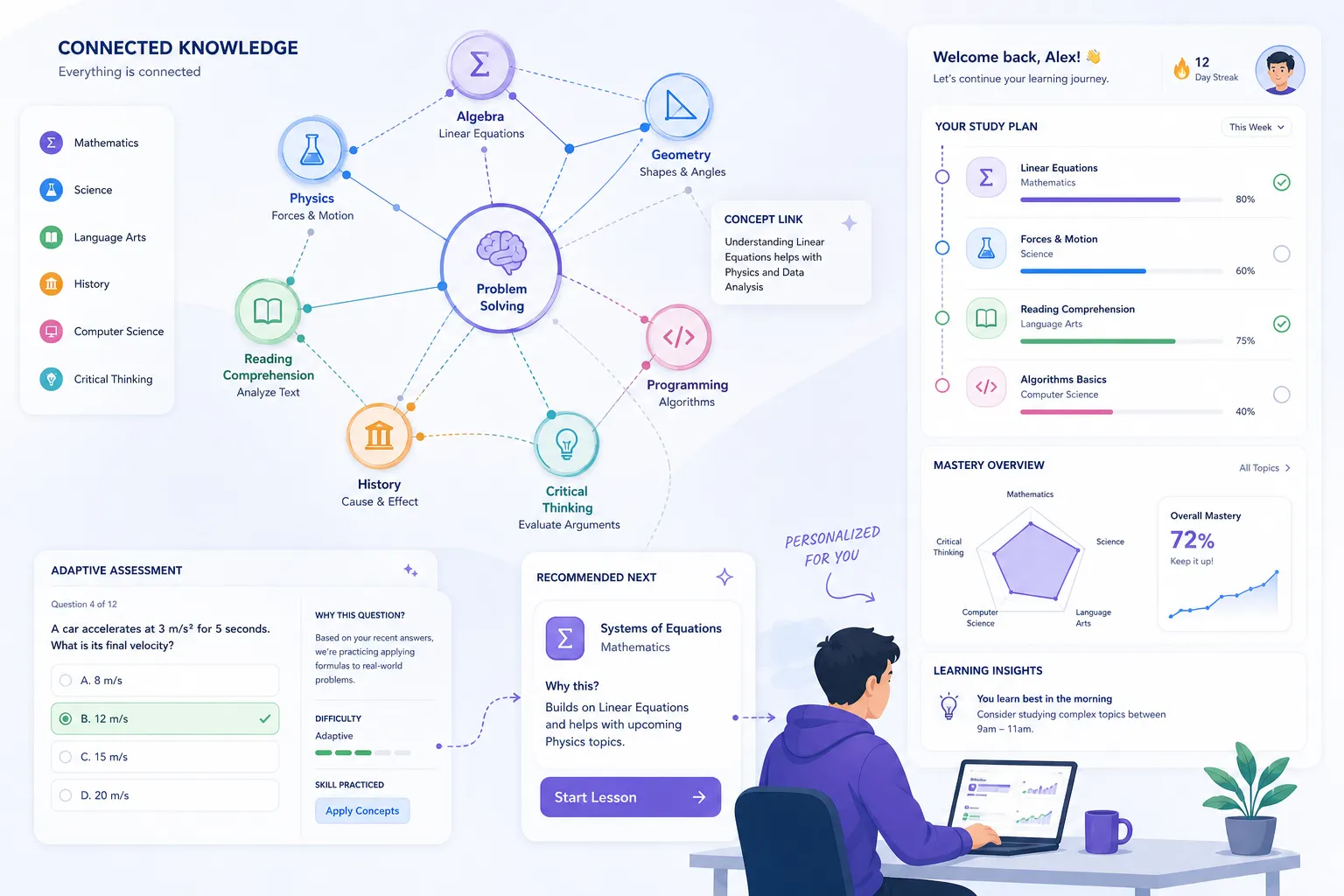
Static flashcards are useful. Adaptive flashcards are better. When a platform detects your weak areas and changes what appears next, studying becomes more efficient.
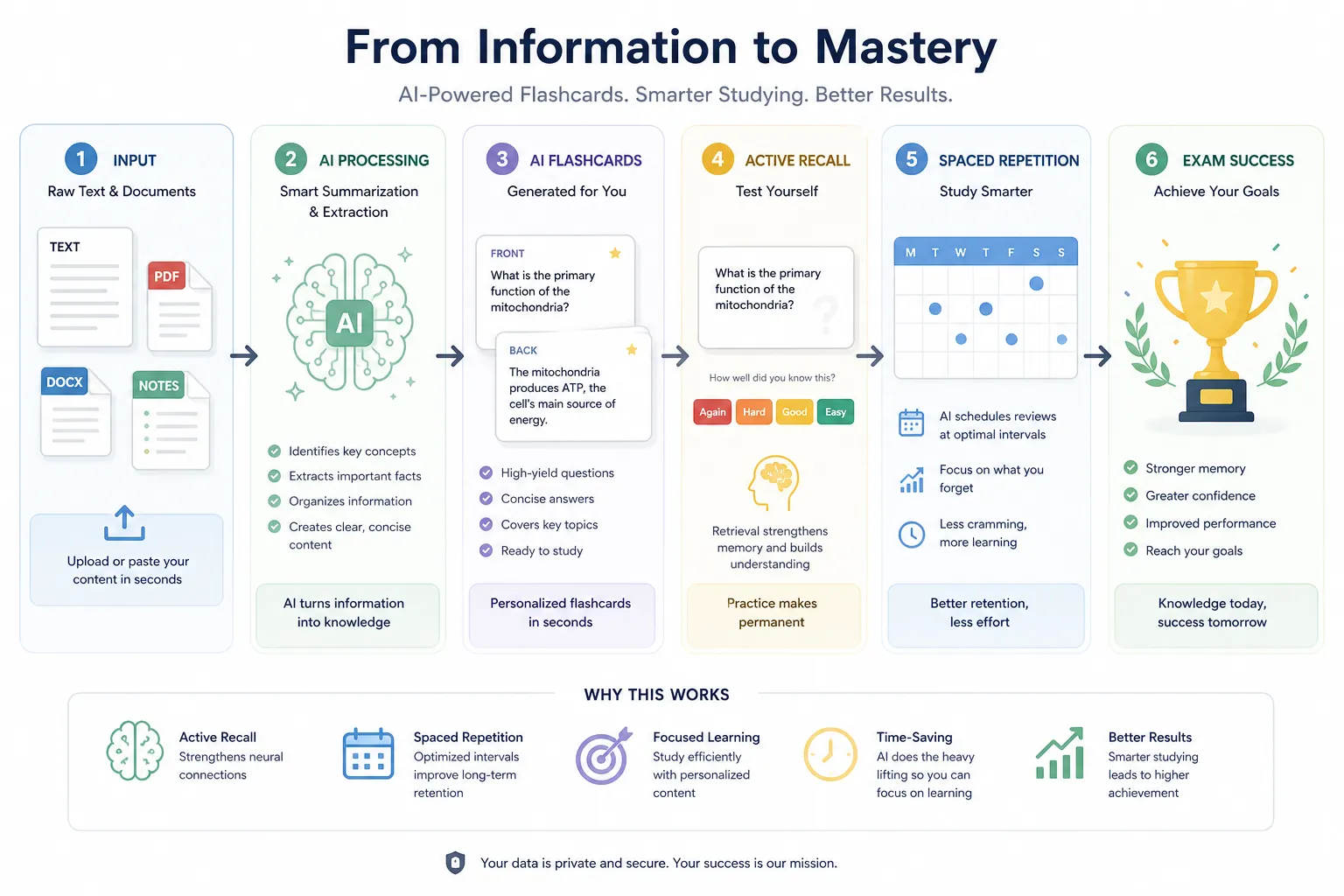
5. It can connect isolated facts into concepts
One of the biggest limitations in many competitor tools is that flashcards remain disconnected. Learners memorize fragments without understanding relationships. CramAI addresses this by linking concepts across topics, which is especially valuable in cumulative subjects like medicine, law, language learning, engineering, and test prep.
What the top competitors get right - and where they fall short
The leading articles and product pages tend to agree on a few points:
AI flashcards save time
spaced repetition improves review
multiple file formats are now expected
free plans help users test the workflow
exam prep is a major use case
Those are valid points. But there are also clear content gaps.
Common strengths in competitor coverage
Brainscape emphasizes spaced repetition and long-term retention. StudyFetch highlights ease of creating flashcards from textbooks, notes, and PDFs. Cybernews compares major tools based on speed, accuracy, supported formats, and extra learning features.
That gives readers a solid surface-level overview.
Major gaps competitors often miss
Accuracy without traceability is not enough
Several tools promise AI-generated flashcards, but fewer explain how users can verify where answers came from. This is especially important in high-stakes learning. CramAI’s source-anchored responses and traceability model directly address that trust problem.
Flashcards alone do not solve planning
Most tools stop after content generation. But learners also need prioritization: what to study first, what to skip, what to revisit, and what remains weak. CramAI’s adaptive study planning goes beyond card creation by adjusting strategy in real time.
Memorization should connect to understanding
Competitor pages often frame flashcards as standalone memory objects. That works for vocabulary and definitions, but not for more complex knowledge. CramAI’s topic linking and visualized knowledge maps help learners move from fragments to structures.
Organizations and creators are under-served
Most competitors write for individual students. Few explore how AI flashcard workflows scale for tutors, institutions, internal training teams, or content creators. CramAI’s creator tools and knowledge organization capabilities make the model more useful in professional and organizational settings.
What makes a high-quality flashcard from text
Not all generated cards are worth keeping. Fast generation means nothing if the output is vague, bloated, or misleading.
A strong flashcard usually has these qualities:
Weak card | Better card |
|---|---|
"Explain photosynthesis" | "What are the two main stages of photosynthesis?" |
"What is marketing?" | "How does market segmentation improve campaign performance?" |
Long paragraph answer | Short answer with one core idea |
Generic recall only | Includes comparison, application, or distinction |
No source link | Traceable to the source material |
The best flashcards are atomic
Each card should test one idea. If a learner fails, they should know exactly what was weak.
The best flashcards are test-shaped
If your exam requires scenarios, comparisons, short explanations, or problem solving, your flashcards should reflect that. This is where AI customization becomes powerful.
The best flashcards remain editable
AI should generate the draft, not define the final version. Learners should be able to simplify wording, split overloaded cards, and add personal cues.
A smarter workflow for turning text into flashcards
If you want text to flashcards to genuinely improve performance, use a workflow that balances automation with human judgment.
Step 1: Gather the right source material
Start with the content most likely to appear in assessments:
lecture notes
assigned readings
teacher slides
official prep documents
transcripts from important videos
problem explanations
Step 2: Organize by topic, not by file type
Do not keep everything trapped in separate folders called “PDFs” or “videos.” Organize around concepts, units, modules, and test objectives.
Step 3: Generate a first pass with AI
Use AI to extract questions, key terms, distinctions, formulas, and applied prompts.
Step 4: Review for quality
Check for:
factual accuracy
overlong answers
duplicate cards
weak phrasing
missed concepts
wrong difficulty level
Step 5: Add adaptive review
This is where the gains compound. A system like CramAI can identify what you are missing and dynamically shift your study focus instead of forcing equal review across all material.
Step 6: Link concepts across units
Many exams reward integration, not isolated recall. If a system can show how one concept relates to another, you are more likely to transfer knowledge under pressure.
Where CramAI fits in the 2026 study stack
CramAI is not just a flashcard maker. It is better understood as an all-in-one AI study and exam prep partner.
That distinction matters because most learners do not need one more isolated feature. They need one coordinated workflow.
What makes CramAI different in practice
Capability | Why it matters for modern learners |
|---|---|
Multiformat upload support | Lets you study from PDFs, URLs, YouTube, audio, docs, and slides |
Personalized study plans | Turns raw materials into a structured path, not just assets |
Source-anchored answers | Improves trust and reduces hallucination risk |
Concept linking | Supports deeper understanding across topics |
Dynamic assessments | Detects knowledge gaps earlier |
Real-time strategy adjustment | Keeps study sessions efficient as performance changes |
Lower cognitive load | Helps learners focus on what matters most |
Creator Studio | Useful for educators, experts, and teams building knowledge systems |
For students, this means less time deciding what to do next.
For exam candidates, it means more targeted review.
For educators and creators, it means turning expertise into reusable, scalable learning content.
For organizations, it means study support that can expand beyond one subject or one learner.
Comparing common text-to-flashcard approaches
Traditional manual flashcards
Best for deep processing in small volumes. Poor for scale.
Basic AI flashcard generators
Best for speed. Often limited by generic output and weak verification.
Adaptive AI learning platforms
Best for learners who need both creation and guidance. Stronger when accuracy, planning, and performance feedback all matter.
Approach | Speed | Accuracy control | Personalization | Planning support | Best for |
|---|---|---|---|---|---|
Manual cards | Low | High | High | Low | Small topics, highly personal study |
Basic AI generator | High | Medium | Medium | Low | Quick conversion of source material |
Adaptive platform like CramAI | High | High | High | High | Exam prep, ongoing study, scaled learning |
What good competitor tools teach us
There is still plenty to learn from the current leaders.
Brainscape shows the value of disciplined repetition
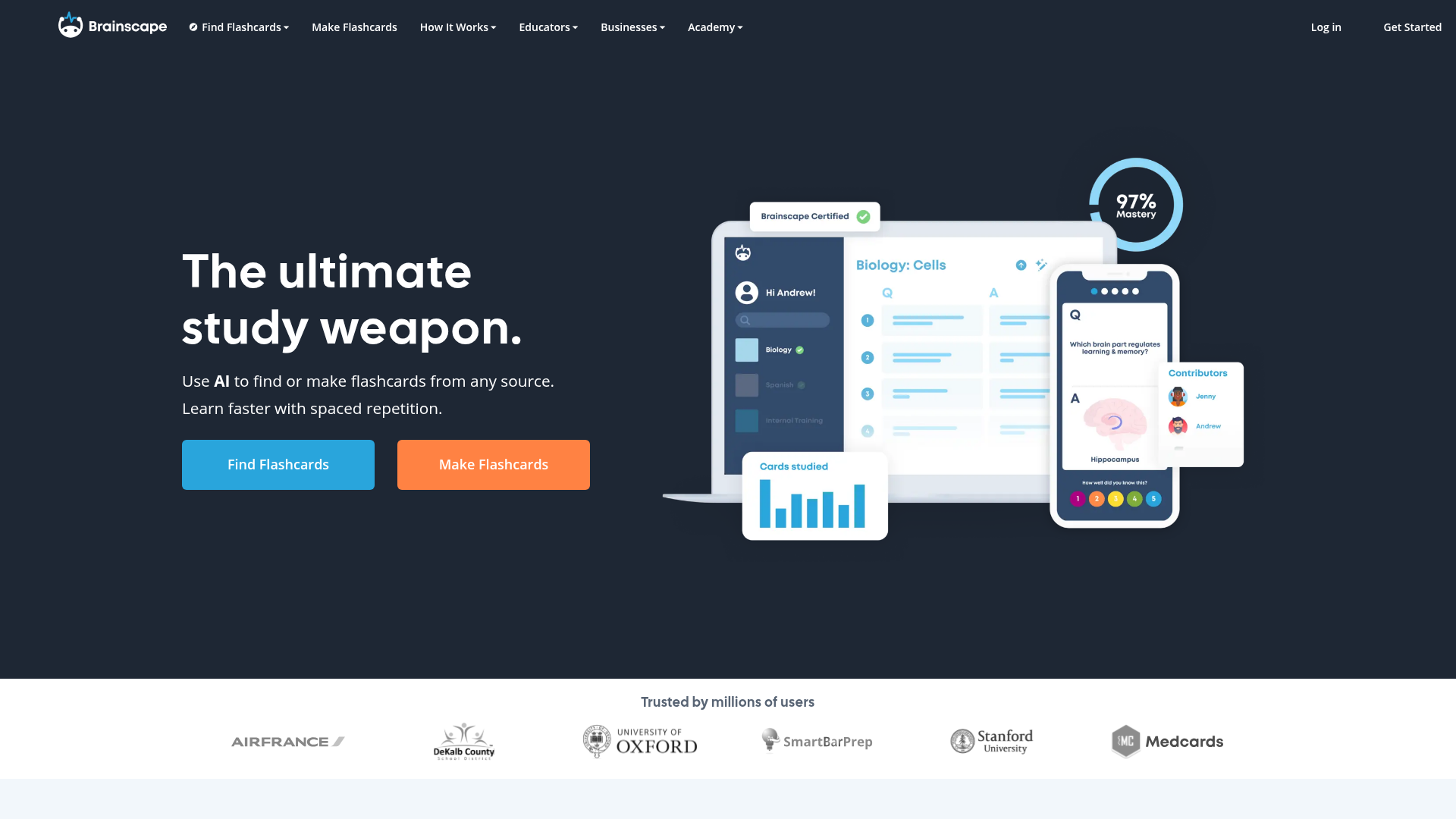
Brainscape does a strong job framing flashcards as a serious retention tool rather than a gimmick. Its emphasis on confidence-based review and spaced repetition reinforces an important point: the studying method matters as much as the content.
StudyFetch reflects the demand for easy AI generation from source materials
StudyFetch captures a clear market need: students want to upload real course materials and instantly produce usable study assets. That convenience is now expected, not optional.
The next step, and where CramAI becomes more compelling, is moving from generation alone to guided mastery: source-grounded answers, gap detection, concept networks, and adaptive planning.
Who benefits most from text to flashcards
University and graduate students
Dense readings, scattered notes, and cumulative exams make AI-supported flashcard workflows highly practical.
Standardized test takers
IELTS candidates, admissions test takers, and certification learners benefit from targeted recall practice and structured revision plans.
Busy professionals
For people studying around work, time efficiency matters as much as correctness. Adaptive review and automated planning reduce wasted effort.
Educators and knowledge creators
Text to flashcards is also a content engine. Materials can be turned into structured review sets, lessons, and reusable training assets. CramAI’s Creator Studio expands this into knowledge organization and content generation, which is especially useful for tutors, course builders, and learning brands.
Institutions and enterprise teams
Scalable study support matters beyond classrooms. Internal training, onboarding, compliance education, and certification readiness all benefit from structured, AI-assisted review systems.
Mistakes to avoid when using AI for flashcards
Accepting every generated card without review
AI output should be curated. Even strong systems need a human pass.
Making answers too long
If an answer reads like a textbook paragraph, the card is doing too much.
Ignoring weak-signal topics
Students often over-review what feels familiar. Adaptive assessments help redirect effort toward hidden gaps.
Treating flashcards as a complete learning system
Flashcards are powerful, but they work best when paired with summaries, concept maps, assessment loops, and a study plan. This is another reason all-in-one platforms outperform one-feature tools for serious exam prep.
Studying cards without source context
When something feels unclear, you need to return to the underlying material. Source traceability is not a luxury; it is part of reliable learning.
The future of text to flashcards
The next generation of study tools will not be defined by who can generate the most cards the fastest.
They will be defined by who can best answer these questions:
Which cards actually matter?
Which concepts are connected?
Which knowledge gaps are holding performance back?
Which source supports this answer?
What should the learner do next?
That is the direction the market is moving. From card creation to learning orchestration.
Text to flashcards is becoming less about conversion and more about intelligent transformation: from raw content to a personalized, adaptive, evidence-based study system.
Final verdict
Text to flashcards has earned its place as a core study method in 2026 because it aligns with how people actually retain information: through retrieval, repetition, prioritization, and feedback.
The best competitor tools prove that learners want speed, simplicity, and multiformat support. But the real opportunity is bigger than quick generation. Learners also need trust, strategy, and connected understanding.
That is where CramAI stands out.
It helps turn PDFs, notes, URLs, videos, audio, documents, and slides into more than flashcards. It builds personalized study plans, anchors answers to sources, reveals concept relationships, detects gaps, and adapts your study strategy in real time. For students, exam candidates, educators, creators, and organizations, that means a smarter path from information overload to confident performance.
If you are ready to move beyond passive review and use text to flashcards as part of a complete AI-powered study system, CramAI is the platform to try next.