
Upload Once, Learn Every Way: From Mind Maps and Flashcards to Quizzes and Podcasts
Most learners do not have a motivation problem. They have a conversion problem.
You already have the raw material: lecture slides, class notes, PDFs, textbook chapters, recorded explanations, YouTube links, and revision guides. What slows you down is having to manually turn that material into something usable for every stage of exam prep. One format helps you understand. Another helps you memorize. Another helps you test yourself under pressure. By the time you build them all, you have lost hours.
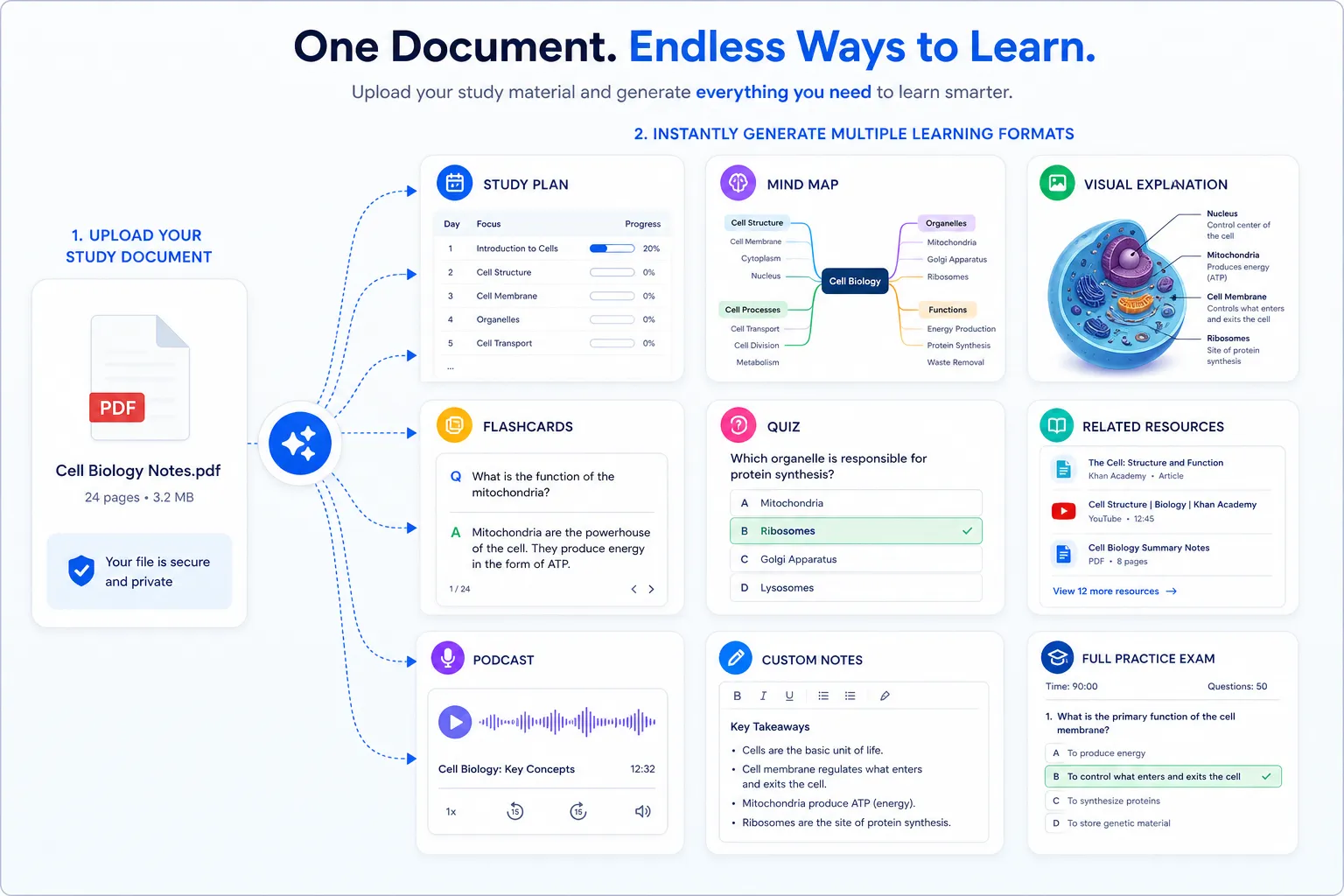
That is why the most effective AI study tools are not just note summarizers. They act like a study system. You upload your material once, and the platform helps you reuse it across multiple learning formats: study plans, mind maps, visual explanations, flashcards, quizzes, related resources, podcasts, custom notes, and full practice exams.
CramAI is built around exactly that idea. Instead of treating each task as separate, it supports the full learning cycle: learn, test, assess, guide, and support. Upload one source in multiple formats, get source-anchored outputs with traceability, uncover knowledge gaps through dynamic assessment, and let your study strategy adapt in real time as your understanding changes.
The Real Shift: Stop Rewriting the Same Material in Different Forms
A lot of students still study in a linear way:
Read notes
Highlight too much
Rewrite summaries
Make a few flashcards
Panic before the exam
The smarter workflow is nonlinear and format-aware. The same source should serve different purposes depending on where you are in preparation.
Imagine you are preparing for an exam in cellular respiration using a 22-page lecture PDF, one textbook chapter, and a short recorded explanation from your teacher. That one topic can become:
a study plan for what to tackle first
an AI mind map generator output showing pathways and dependencies
visual explanations for ATP yield and electron transport
flashcards for terminology and key steps
a quiz for retrieval practice
related resources for weak subtopics
a podcast for passive review
custom notes for reflection and synthesis
a full practice exam to simulate test conditions
The value is not in producing more content. It is in producing the right format at the right moment.
Why Multiple Learning Formats Work Better Than One
Different formats activate different cognitive processes. If you only reread notes, you are relying too heavily on familiarity. If you only do quizzes, you may miss the conceptual structure. If you only listen to audio, you may not retain key terminology.
"A systematic review of 50 experiments involving over 5,000 students found that 57% of the studies reported medium to large benefits from retrieval practice." - Educational Psychology Review
"Information encoded in both systems - dual coded - is better remembered than information encoded in only one system, because it has twice as many retrieval routes." - Cognitive Psychology Reference
That is the strategic reason to move from notes to flashcards, from notes to podcast, from concept structure to diagrams, and from explanation to testing. Each format fills a different role in durable learning.
One Source, Many Outcomes: A Realistic Example
Let’s stay with the cellular respiration topic.
Source Material Uploaded Once
You upload:
a lecture PDF on glycolysis, Krebs cycle, and oxidative phosphorylation
a set of handwritten notes photographed from class
a textbook excerpt
a short YouTube explainer
an audio recording of your own spoken summary
A platform like CramAI can process these as a unified study base rather than isolated files. That matters because learning rarely happens in one medium. It is cross-format by nature.
What the Same Material Can Become
Learning format | Main purpose | Best used when | What it helps you do |
|---|---|---|---|
Study plan | Prioritize time and effort | Start of revision | Decide what to study first |
Mind map | Understand structure and relationships | Early understanding stage | See how concepts connect |
Visual explanations | Clarify difficult or abstract ideas | When stuck on a concept | Reduce confusion quickly |
Flashcards | Memorization and spaced repetition | Mid to late prep | Lock in definitions, sequences, formulas |
Quizzes | Retrieval practice and confidence checks | Throughout revision | Prove what you can recall |
Related resources | Fill content gaps | After weak performance | Go deeper where needed |
Podcasts | Audio review and reinforcement | Commutes, walks, downtime | Increase review frequency |
Custom notes | Reflection and synthesis | After studying or testing | Turn information into personal understanding |
Practice exams | Exam simulation | Final stage | Build readiness under realistic pressure |
Study Plans: The Format That Decides What Matters
A study plan is often undervalued because it feels less academic than flashcards or tests. But without prioritization, learners waste time polishing what they already know.
With a good AI-generated study plan, your source materials are reorganized into:
topic order
urgency level
estimated study time
likely difficulty
review spacing
targeted weak areas
For example, your uploaded biology materials might produce a plan like this:
Day | Priority | Focus | Output |
|---|---|---|---|
1 | High | Glycolysis overview and terminology | Summary + mind map |
2 | High | Krebs cycle steps | Flashcards + diagram explanation |
3 | Medium | Electron transport chain | Visual explanation + quiz |
4 | High | ATP accounting | Custom notes + retrieval quiz |
5 | High | Full unit integration | Practice exam |
6 | Medium | Review weak quiz areas | Related resources + flashcards |
7 | High | Final timed rehearsal | Mock exam + recap podcast |
This is where CramAI’s adaptive logic is particularly useful. Instead of leaving the plan static, it can adjust in real time based on how you perform. If your quiz results show strong recall but weak conceptual linking, the next recommendation should not be “more flashcards.” It should shift toward maps, visuals, and connected explanations.
Mind Maps: Best for Structure, Relationships, and Big-Picture Thinking
Mind maps are strongest when you need to understand how parts fit together.
For cellular respiration, a mind map might show:
glucose as the starting node
glycolysis branching into pyruvate outcomes
links to NADH and FADH2 production
flow into the Krebs cycle
dependence of the electron transport chain on oxygen
ATP outputs at each stage
This is why an AI mind map generator is more than a convenience feature. It externalizes structure. That reduces cognitive load because you no longer have to hold the whole topic architecture in working memory.
Mind maps are especially useful:
early in a topic when everything feels disconnected
after lectures to consolidate the “big picture”
before essay-based exams
when comparing related processes or themes
When to move on from a mind map
Once the structure feels clear, switch to:
visual explanations if one node still feels abstract
flashcards if you need precise recall
quizzes if you want to verify understanding
Visual Explanations: Best for What Words Alone Do Not Fix
Some concepts stay confusing even after three summaries. Usually that is because the issue is not a lack of text. It is a lack of representation.
For example:
ATP yield can be hard to compare across stages
proton gradients are difficult to imagine
membrane transport mechanisms are abstract without a visual
causal sequences are easier to understand as flow-based images than paragraphs
Visual explanations help convert abstraction into something spatial, diagrammatic, or stepwise.
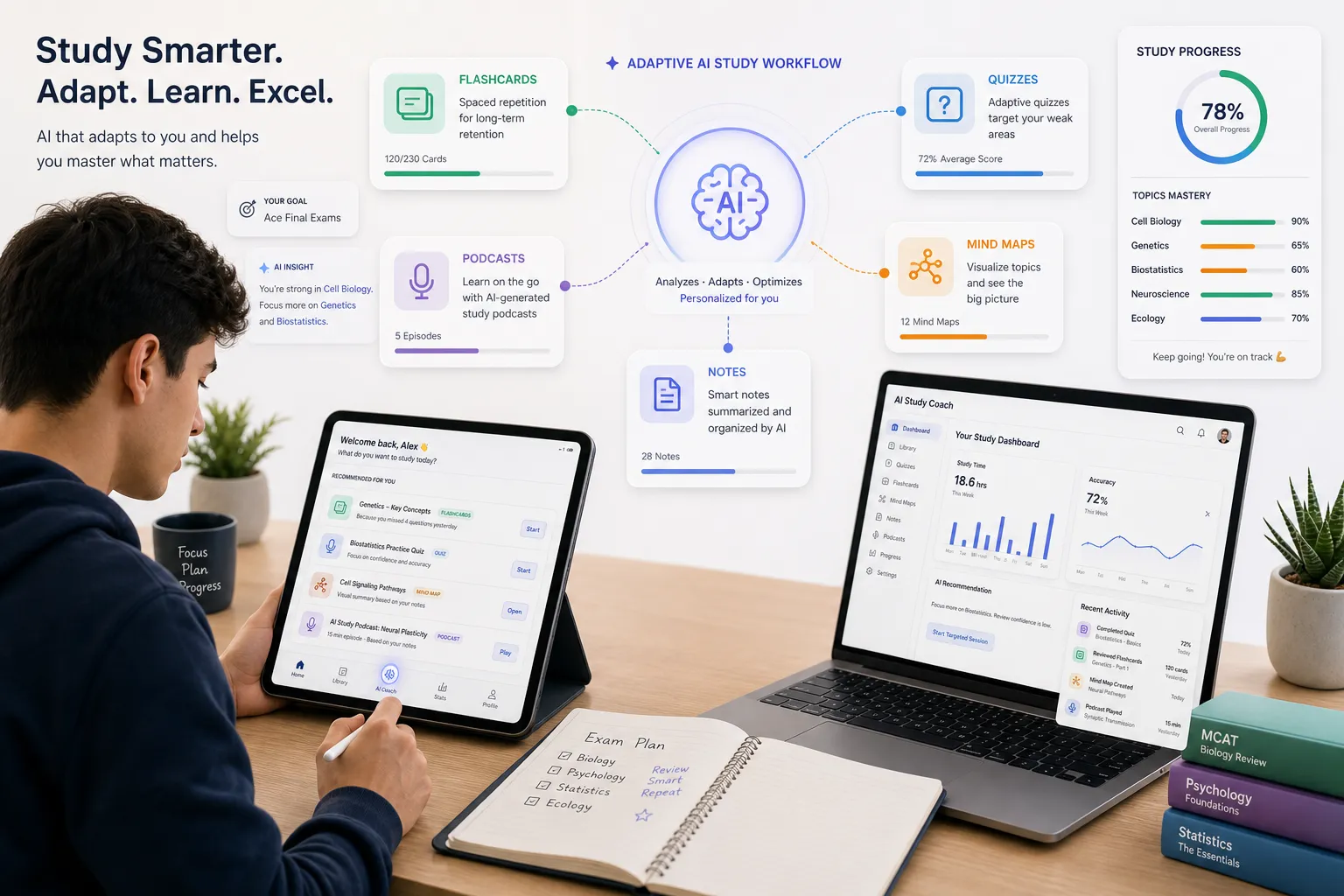
In CramAI, this becomes even more useful when visuals stay anchored to the original source. If an explanation references a specific section of your uploaded material, you can trace it back, verify context, and trust the output more confidently. That source traceability is a meaningful differentiator in an AI learning environment where hallucinated explanations are a real risk.
Flashcards: Best for Memory, Speed, and Spaced Repetition
Flashcards are not the starting point for every topic. They are the compression layer.
Once you understand the topic structure, flashcards help you retain:
terminology
definitions
stages in a process
formula components
cause-and-effect pairs
common exam traps
For cellular respiration, flashcards might include:
What is the net ATP gain from glycolysis?
Where does the Krebs cycle occur?
What role does oxygen play in the electron transport chain?
Which molecules carry high-energy electrons?
Why does oxidative phosphorylation produce most ATP?
This is where the classic notes to flashcards workflow becomes powerful. Instead of manually extracting points from pages of notes, AI can identify atomic facts and convert them into testable prompts. Better still, those prompts can be linked to your larger study system rather than existing as isolated cards.
The best moment to use flashcards
Flashcards work best when:
you already grasp the topic enough to avoid memorizing nonsense
you need repeated exposure over several days
you are tightening recall close to exam time
you want fast daily review sessions
When flashcards are not enough
If you can answer a card but cannot explain the concept in context, go back to:
mind maps for structure
visual explanations for mechanism
custom notes for synthesis
Quizzes: Best for Retrieval Practice and Diagnosing Weaknesses
Quizzes are where studying becomes evidence-based.
Reading feels productive. Answering reveals the truth.
An AI quiz generator from PDF or mixed-source materials gives you a practical way to test exactly what you studied, not a generic question bank detached from your course. That means your quiz can reflect your lecturer’s terminology, your textbook’s emphasis, and your specific exam scope.
For the same biology source, quizzes can include:
multiple choice for quick checks
short answer for active recall
sequence ordering for process understanding
application questions for transfer
mixed-difficulty sets to uncover false confidence
Why quizzes should influence your next step
The point of a quiz is not just scoring. It is routing.
If you miss terminology:
return to flashcards
If you miss relationships:
return to mind maps
If you miss explanations:
return to visual breakdowns or source-anchored guidance
If you miss application questions:
move toward full practice exams
CramAI’s dynamic assessment model fits this stage well because it can identify knowledge gaps and automatically shift what comes next instead of treating every learner the same.
Related Resources: Best for Filling the Gaps Your Original Notes Left Open
Your original notes are rarely complete. Lectures move fast. Handwritten summaries skip context. PDFs often explain what, but not why.
Related resources matter because they let your study system expand intelligently rather than randomly. Instead of opening ten tabs and hoping for clarity, the platform can surface relevant links and supplemental material around the exact concept you are struggling with.
This is particularly helpful when:
your original source is too brief
your explanation source is too advanced
you need an alternative framing
you want examples, case studies, or worked problems
A good AI learning platform should not just recommend “more content.” It should recommend the right adjacent content, ideally tied back to the concept graph of what you already uploaded.
Podcasts: Best for Reinforcement During Low-Focus Time
Audio should not replace active study. But it is incredibly useful for review.
That is where the notes to podcast workflow becomes practical. A topic you already uploaded can be converted into an audio recap for:
commutes
walks
gym sessions
pre-sleep review
low-energy revision blocks
For our biology example, the podcast version might include:
a short overview of the three main stages
key vocabulary recap
comparisons between ATP production methods
common misconceptions
a verbal mini-quiz at the end
Podcasts are most useful after first understanding, not before. If the topic is brand new, audio alone often moves too quickly. But after you have seen the structure and done some recall, audio becomes a highly efficient reinforcement layer.
Custom Notes: Best for Reflection, Consolidation, and Personal Meaning
AI-generated outputs are helpful, but learning deepens when you rewrite ideas in your own words.
Custom notes matter because they bridge external explanation and internal understanding. They help you answer:
What do I now understand clearly?
What still feels shaky?
How would I explain this to someone else?
Which examples make this concept stick?
What mistakes do I keep making?
The best use of notes is not copying. It is consolidating.
A strong workflow is:
Review a summary or mind map
Take a quiz
Check weak areas
Write a short custom note on only those weak areas
This creates a tighter loop than rewriting everything from scratch.
Full Practice Exams: Best for Pressure Testing Readiness
Practice exams are where the separate formats come together.
By the final phase of preparation, you should no longer just be asking, “Do I know this topic?” You should be asking:
Can I retrieve it quickly?
Can I explain it under time pressure?
Can I distinguish similar concepts?
Can I handle mixed-topic transitions?
Can I sustain performance across a full test?
Full practice exams are especially effective because they expose issues that smaller quizzes may hide:
stamina problems
timing problems
anxiety under pressure
errors in question interpretation
weak transfer across topics
An adaptive platform like CramAI can make this even more useful by feeding the results back into the plan. If your mock exam shows strong factual recall but weak application, the next cycle should emphasize scenario-based questions and deeper concept linking.
A Smarter Exam Workflow: How to Move Between Formats
The biggest content gap in many articles about AI learning is that they treat every output like a feature showcase. Real learners need a workflow.
Here is a simple recommended workflow built around one uploaded source set.
Stage 1: Orientation
Use:
study plan
summary
mind map
Goal:
understand the scope
identify high-priority topics
see how ideas connect
Stage 2: Clarification
Use:
visual explanations
source-anchored AI guidance
related resources
Goal:
resolve confusion
strengthen understanding of difficult concepts
replace vague familiarity with concrete comprehension
Stage 3: Retention
Use:
flashcards
custom notes
short recap podcast
Goal:
move information into long-term memory
reduce overload by focusing on the most testable material
review efficiently across the day
Stage 4: Verification
Use:
quizzes
dynamic assessments
targeted follow-up resources
Goal:
measure actual recall
find knowledge gaps
update the study plan based on performance
Stage 5: Simulation
Use:
full practice exams
mixed-topic review
final recap notes and podcast
Goal:
rehearse exam conditions
sharpen timing
stabilize performance before test day
What Makes This More Than a Productivity Shortcut
There is a major difference between generating study content and building a reliable study engine.
The strongest platforms do more than transform files. They help you:
maintain traceability back to the source
connect concepts across topics
adapt strategy in real time
reduce cognitive load by highlighting what matters most
support different content types in one workflow
scale from individual learners to institutions and enterprise teams
That is where CramAI stands out naturally. Its all-in-one AI study and exam prep model supports multimodal input, source-anchored answers, dynamic gap detection, adaptive planning, and creator tools for organizing knowledge and generating educational content. That makes it relevant not only for students and exam candidates, but also for educators, knowledge creators, and organizations building repeatable learning systems.
A Quick Look at the Broader AI Learning Ecosystem
The broader market clearly shows rising demand for integrated learning experiences rather than single-purpose tools.
Platforms in this space increasingly emphasize combinations of quizzes, flashcards, podcasts, grading, and study sets. The strategic opportunity for learners is not just having more options, but having those options orchestrated around the same source material.

The next step beyond fragmented tools is a platform that turns uploaded content into a connected learning graph, with assessment and guidance built in. That is the direction serious exam prep is moving.
Recommended Workflow Inside CramAI
If you want a simple practical system, use this:
1. Upload all relevant materials once
Include:
PDFs
slides
website URLs
YouTube videos
audio files
notes or documents
2. Start with organization, not memorization
Generate:
a study plan
a high-level summary
a mind map
3. Clarify difficult concepts before drilling them
Use:
visual explanations
source-anchored AI answers
related resources
4. Convert understanding into retention
Generate:
flashcards
recap notes
a short podcast version
5. Test early and let results guide you
Use:
quizzes
assessments
topic-level gap analysis
6. Finish with exam realism
Generate:
full practice exams
targeted revisions for weak sections
final condensed notes
This workflow is simple, but it solves a deep problem: it stops you from studying everything in the same way.
Final Verdict
Uploading study material once and learning from it in multiple ways is not just efficient. It is pedagogically smarter.
Study plans help you decide. Mind maps help you organize. Visual explanations help you understand. Flashcards help you retain. Quizzes help you verify. Related resources help you expand. Podcasts help you review on the go. Custom notes help you internalize. Practice exams help you perform.
When all of those outputs come from the same trusted source base, the result is not content overload. It is a connected, adaptive system that helps you focus on what matters most.
CramAI is well positioned for learners who want more than scattered tools. If you want an all-in-one AI study partner that can transform uploaded materials into personalized study plans, trustworthy source-anchored explanations, connected topic insights, dynamic assessments, and scalable learning workflows, it is worth trying.
If your current routine still involves rewriting the same material three different ways, this is the upgrade: upload once, then learn every way.